What Is a Data Center?
Have you ever wondered where the internet actually lives? It does not simply float in the clouds above us. Instead, every search, video stream, and online payment relies on physical buildings called data centers.
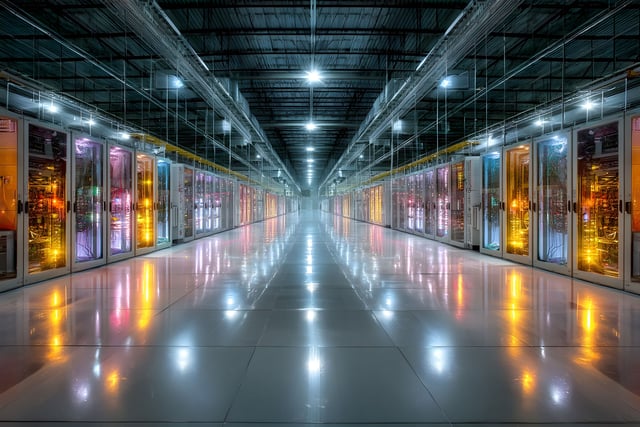
A data center is a dedicated facility that houses thousands of networked computers and storage drives. These specialized computers are known as servers. Inside, rows of metal racks hold powerful machines working around the clock. They process complex calculations, store enormous amounts of data, and route global internet traffic seamlessly.
To keep running without interruption, facilities rely on heavy-duty infrastructure. They feature industrial cooling systems, backup diesel generators, and multi-layered physical security. Today, the rapid growth of artificial intelligence requires even more processing muscle. This surge has triggered a massive global boom in data center construction.
The Top Five Pros of Data Centers
1. Powering the Modern Digital Economy

Data centers form the invisible backbone of modern society. They allow remote work, cloud software, and digital banking to function smoothly every day. Without these facilities, global e-commerce and instant communication would instantly grind to a halt. They keep our connected world running twenty-four hours a day.
2. Accelerating AI and Scientific Innovation
Breakthrough discoveries in medicine, climate modeling, and engineering require tremendous computing power. Advanced data centers provide the hardware necessary to train cutting-edge artificial intelligence models. Researchers can analyze complex genetic sequences or simulate atmospheric patterns in mere seconds. This shared processing capacity speeds up innovations that benefit humanity.
3. Enterprise-Grade Security and Reliability
Storing data in a dedicated center is far safer than keeping it on office hard drives. These facilities utilize biometric access, armed guards, video surveillance, and sophisticated fire-suppression tools. They also maintain redundant power supplies and automated off-site backups. If a local power line fails, emergency generators kick in within milliseconds. This safeguards vital personal records and financial transactions from catastrophic hardware failure.
4. Boosting Local Construction and Tax Revenue
Building a new data campus brings significant capital investment into host communities. Large projects generate thousands of high-paying construction, electrical, and engineering jobs. Municipalities also gain millions of dollars in property taxes and utility fees. Local governments often use these fresh funds to upgrade schools, roads, and emergency public services.
5. Driving Clean Energy and Efficiency Gains
Modern hyperscale operators are among the largest corporate buyers of renewable energy worldwide. Their immense power needs encourage utilities to build new solar farms and wind installations. Centralized server farms also use electricity far more efficiently than millions of scattered private servers. This technological efficiency helps lower the net carbon footprint per computational task.
The Top Five Cons of Data Centers
1. Massive Electricity and Grid Strain
Data centers consume staggering amounts of electrical power. A single large facility can use as much power as eighty thousand individual homes. This massive appetite puts severe pressure on regional utility grids and transmission networks. In some areas, surging demand threatens grid reliability and drives up electricity prices for local residents. Some operators even run fossil-fuel generators continuously when grid capacity falls short.
2. Heavy Water Consumption for Cooling
Thousands of densely packed servers generate intense heat while running. Many cooling designs rely on evaporative systems that consume millions of gallons of water daily. This heavy water use can strain local municipal reservoirs and groundwater supplies. In drought-prone or arid regions, data centers compete directly with agriculture and residential drinking needs.
3. Limited Long-Term Job Creation
Data centers create an initial burst of employment during the construction phase. However, once a facility opens, it requires very few permanent staff members to operate. Automated management systems allow a massive warehouse to run with fewer than fifty on-site technicians. As a result, long-term employment gains rarely match the scale of the capital invested.
4. Environmental and Noise Pollution
The physical presence of large data centers creates distinct environmental challenges. Industrial cooling towers and ventilation chillers produce a constant, low-frequency hum. This relentless acoustic noise can disrupt nearby neighborhoods and lower local quality of life. Furthermore, routine testing of diesel backup generators releases harmful soot and particulate emissions into the air.
5. Vulnerability to Centralized Outages and Cyberattacks
Centralizing digital services creates single points of potential failure. If a major cloud facility suffers an outage, thousands of websites, payment systems, and apps go offline. Physical natural disasters, severed fiber cables, or coordinated cyberattacks can trigger widespread economic paralysis. Relying so heavily on a few consolidated hubs increases systemic vulnerability across the digital ecosystem.
Finding the Right Balance
Data centers are indispensable engines of modern life. They empower artificial intelligence, stream entertainment, and keep critical businesses running smoothly. Yet their immense hunger for energy, water, and land poses real challenges for communities. Achieving sustainable growth requires cleaner energy, closed-loop liquid cooling, and transparent community partnerships. The future of technology depends on how well we balance these essential tradeoffs.
Sources Used
- Caltech Science Exchange: What are the pros and cons of data centers?
- Georgia Tech: Data Centers Are Booming. Who Benefits?
- International Finance Corporation: Risks and Opportunities in Data Center and AI Investment
- Regional Economic Models, Inc. (REMI): Powering Data Centers: The Economic Effects of Rising Electricity Demand
- Evernex: Data Centers Explained: Types and Real-World Challenges
Disclaimer
Artificial Intelligence Disclosure & Legal Disclaimer
AI Content Policy.
To provide our readers with timely and comprehensive coverage, South Florida Reporter uses artificial intelligence (AI) to assist in producing certain articles and visual content.
Articles: AI may be used to assist in research, structural drafting, or data analysis. All AI-assisted text is reviewed and edited by our team to ensure accuracy and adherence to our editorial standards.
Images: Any imagery generated or significantly altered by AI is clearly marked with a disclaimer or watermark to distinguish it from traditional photography or editorial illustrations.
General Disclaimer
The information contained in South Florida Reporter is for general information purposes only.
South Florida Reporter assumes no responsibility for errors or omissions in the contents of the Service. In no event shall South Florida Reporter be liable for any special, direct, indirect, consequential, or incidental damages or any damages whatsoever, whether in an action of contract, negligence or other tort, arising out of or in connection with the use of the Service or the contents of the Service.
The Company reserves the right to make additions, deletions, or modifications to the contents of the Service at any time without prior notice. The Company does not warrant that the Service is free of viruses or other harmful components.