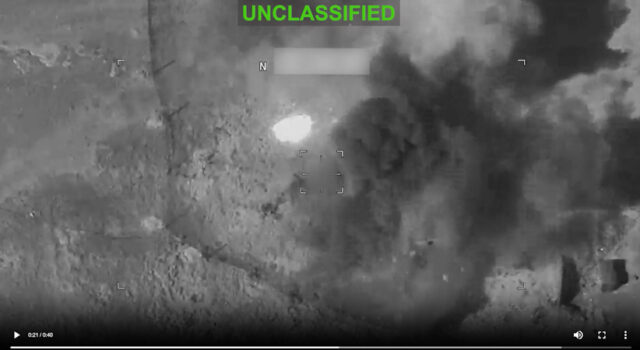
Military confrontations between the United States and Iran have surged dramatically across the Strait of Hormuz, transforming the world’s most critical maritime oil corridor into an active battlezone. Following the breakdown of a fragile ceasefire, U.S. Central Command (CENTCOM) launched widespread airstrikes targeting Iranian coastal surveillance, air defense installations, and missile storage facilities near Bandar Abbas, Sirik, and Qeshm.
American military officials stated that the ongoing campaign aims to swiftly dismantle Iran’s Revolutionary Guard Corps (IRGC) capabilities and protect commercial shipping. In response, IRGC naval units exchanged direct fire with U.S. warships and launched swarms of one-way attack drones and ballistic missiles toward coalition assets and allied regional infrastructure across the Persian Gulf.
The intensity of the naval clashes was highlighted by emergency maritime reports from the British military, which confirmed that a commercial ship caught fire in the Strait of Hormuz near the coast of Oman early Monday morning following direct military strikes in the area. Maritime security agencies alerted vessels transiting the narrow chokepoint as thick smoke and fires visible from the Omani coastline signaled deteriorating safety conditions for merchant shipping. This incident follows related naval engagements in which U.S. forces disabled an unladen oil tanker near Kharg Island using Hellfire missiles after the vessel allegedly bypassed blockade instructions. With multiple tankers targeted by drone strikes and naval artillery, commercial transit through the waterway has ground to a near-total standstill.

The renewed hostilities have inflicted a heavy toll on American forces operating in the Middle East. The U.S. Department of Defense officially announced another service member death on Sunday, bringing the total number of U.S. military fatalities to 17 since direct conflict erupted earlier this year, with over 430 additional personnel wounded. Recent casualties stemmed from a devastating drone strike on a coalition base in Jordan, as well as a lethal incident during the controlled detonation of a downed Iranian drone in Iraq. President Donald Trump warned that retaliatory strikes would intensify until Iranian threats to international shipping cease, while Iranian Supreme Leader Mojtaba Khamenei threatened “unforgettable lessons” for continued U.S. aggression.
The maritime standoff poses severe threats to global energy stability, as approximately 20 percent of the world’s petroleum and natural gas supplies pass through the narrow strait. Neighboring Gulf nations, including Kuwait, Bahrain, and Jordan, have repeatedly activated air defense systems to intercept incoming Iranian drone waves and missiles. In response to stray missiles crossing sovereign airspace, Jordan summoned Iran’s chargé d’affaires to issue formal protests, while Kuwait reported strikes on essential water desalination plants. The Gulf Cooperation Council issued stern statements condemning the targeting of civilian infrastructure as severe violations of international humanitarian law.
As the United States maintains its naval blockade against vessels entering or departing Iranian ports without authorization, international trade routes remain paralyzed. Energy markets continue to react nervously to prolonged shipping delays, pushing crude oil prices higher and compounding inflationary pressures worldwide. Defense analysts emphasize that unless a durable ceasefire and transit agreement are established, the economic and security ramifications will ripple far beyond the Persian Gulf.
Sources and Links:
- PBS News: U.S. announces another troop death as Israel warns Tehran’s attacks are coming close
- PBS News: U.S. military launches new airstrikes to punish Iran for deaths of U.S. troops
- The Guardian: US attacks oil tanker in strait of Hormuz as strikes reported in Tehran
- Anadolu Agency: Iran’s Revolutionary Guard Navy, US forces exchange fire in Strait of Hormuz: Reports
- KUTV / 2News: British military says a ship is ablaze in the Strait of Hormuz near the coast of Oman
- International Crisis Group: Strait of Hormuz Flashpoints & Incident Updates
- Encyclopædia Britannica: 2026 Iran War and Strait of Hormuz Conflict Overview
Disclaimer
Artificial Intelligence Disclosure & Legal Disclaimer
AI Content Policy.
To provide our readers with timely and comprehensive coverage, South Florida Reporter uses artificial intelligence (AI) to assist in producing certain articles and visual content.
Articles: AI may be used to assist in research, structural drafting, or data analysis. All AI-assisted text is reviewed and edited by our team to ensure accuracy and adherence to our editorial standards.
Images: Any imagery generated or significantly altered by AI is clearly marked with a disclaimer or watermark to distinguish it from traditional photography or editorial illustrations.
General Disclaimer
The information contained in South Florida Reporter is for general information purposes only.
South Florida Reporter assumes no responsibility for errors or omissions in the contents of the Service. In no event shall South Florida Reporter be liable for any special, direct, indirect, consequential, or incidental damages or any damages whatsoever, whether in an action of contract, negligence or other tort, arising out of or in connection with the use of the Service or the contents of the Service.
The Company reserves the right to make additions, deletions, or modifications to the contents of the Service at any time without prior notice. The Company does not warrant that the Service is free of viruses or other harmful components.