When you think about school safety measures, you probably picture locked doors, visitor check-ins, or security cameras mounted in the hallway. You probably do not picture an autonomous flying robot zooming down the hall at high speed, ready to smash through classroom windows or spray pepper gel at an intruder. Yet, that is precisely the reality unfolding in select school districts across the country. As school boards scramble to find faster ways to respond to active shooter threats, a novel and controversial technology is taking flight: indoor security drones equipped with pepper spray, loud sirens, and flashing strobes.
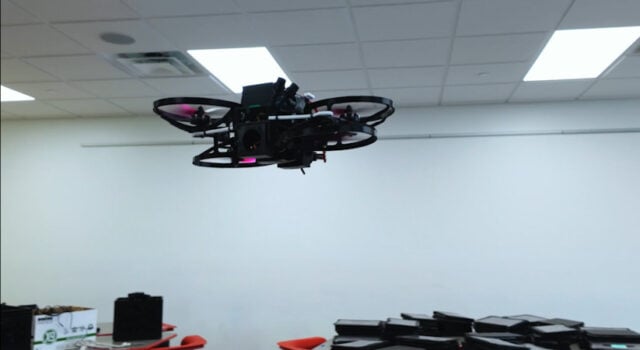
Video courtesy Campus Guardian Angel
The technology, developed by companies like Austin-based Mithril Defense and its Campus Guardian Angel platform, is being piloted in at least nine schools across Florida, Georgia, and Colorado. Designed to bridge the critical gap between when an attack begins and when police arrive on scene, these nonlethal aircraft rest in charging docks inside school buildings. When an active threat is confirmed, operators can remotely launch the drones in seconds. Traveling up to 50 miles per hour indoors, the devices are engineered to disorient attackers by blaring sirens, flashing disorienting lights, firing pepper balls, or even ramming directly into suspects at high speeds.
The aggressive pursuit capability of these devices is central to their design. In a report published by The Washington Post, company co-founder Bill King—a former Navy SEAL team leader with decades of military experience—emphasized how difficult it is for an attacker to evade the aircraft, stating:
“Once I get the drones on you, you just can’t escape them.”
The goal, according to developers, isn’t necessarily to replace human law enforcement officers, but to buy vital seconds or minutes by occupying a shooter’s attention until first responders can enter the building and neutralize the threat.

Proponents argue that standard security infrastructure is largely passive—it records events or restricts entry, but cannot actively intervene during an ongoing crisis. Because research indicates that the majority of casualties during mass shootings occur within the first two minutes, advocates view these fast-moving drones as a potential force multiplier. Beyond distraction, operators in remote command centers can use the drone’s onboard cameras, speakers, and microphones to communicate with teachers or guide law enforcement officers directly toward a suspect’s position in real time.
However, the rollout has sparked intense debate among parents, educators, and school safety experts. Critics question whether introducing high-tech, aggressive robotics into learning environments creates an atmosphere of fear and surveillance for students. Others worry about accidental deployments, privacy implications, or whether districts are misallocating funds that might be better spent on mental health resources, counselor staffing, or fundamental physical security like reinforced classroom doors. As more districts test these aerial guardians, the national conversation continues over how far schools should go to protect their hallways.
Sources and Links:
- The Washington Post: Schools are adding pepper-spraying drones to help combat active shooters
- The Guardian: Several US schools to install pepper-spraying drones to respond to school shootings
- TechNewsWorld: Schools Turn to Drones to Counter Active Shooters
Disclaimer
Artificial Intelligence Disclosure & Legal Disclaimer
AI Content Policy.
To provide our readers with timely and comprehensive coverage, South Florida Reporter uses artificial intelligence (AI) to assist in producing certain articles and visual content.
Articles: AI may be used to assist in research, structural drafting, or data analysis. All AI-assisted text is reviewed and edited by our team to ensure accuracy and adherence to our editorial standards.
Images: Any imagery generated or significantly altered by AI is clearly marked with a disclaimer or watermark to distinguish it from traditional photography or editorial illustrations.
General Disclaimer
The information contained in South Florida Reporter is for general information purposes only.
South Florida Reporter assumes no responsibility for errors or omissions in the contents of the Service. In no event shall South Florida Reporter be liable for any special, direct, indirect, consequential, or incidental damages or any damages whatsoever, whether in an action of contract, negligence or other tort, arising out of or in connection with the use of the Service or the contents of the Service.
The Company reserves the right to make additions, deletions, or modifications to the contents of the Service at any time without prior notice. The Company does not warrant that the Service is free of viruses or other harmful components.