- A new study found that arts and cultural activities, like reading or visiting museums, were linked to slower biological aging.
- Researchers say these hobbies may support healthy aging by reducing stress and stimulating the brain in unique ways.
- Experts recommend engaging in enjoyable, consistent activities—especially ones that are social or mentally challenging—to support longevity.
Reading, listening to music, or visiting an art exhibit may be doing more for your longevity than you think. A new study published in Innovation in Aging linked arts and cultural activities to slower biological aging—even if you only do them a few times a year. Here’s how.
What the Research Found
Arts and cultural engagement are known to support health, but very little research has looked at the impact of these activities on biological aging, said Feifei Bu, PhD, a principal research fellow at University College London and senior author of the new study. Your biological age measures how well your body is aging on a cellular level, and may provide a clearer picture of your overall health than your actual age.
In the study, about 3,500 adults from the UK Household Longitudinal Study were asked how often they engaged in various cultural activities (such as singing, painting, and visiting museums) and physical activities (like running and Pilates) in the past year. Researchers compared the responses to participants’ biological ages, which were measured with epigenetic clocks, research tools that estimate biological age based on changes in DNA.

Overall, arts and cultural activities were linked to slower biological aging. One clock specifically showed that participants who engaged in these activities at least three times a year aged 2% more slowly than those who did so only once or twice a year.
Doing the activities more often was linked to even slower aging—3% slower for monthly engagement, and 4% slower for weekly. The links remained after controlling for factors like BMI, smoking status, education level, and income.
The results also suggest that arts and cultural engagement may be just as beneficial for biological aging as exercise. “Let that land for a moment: Going to a concert or picking up a book may be doing for your biology what a workout does,” said Kien Vuu, MD, a Los Angeles-based longevity doctor, who is unaffiliated with the research.
The study did have several limitations. Of the seven epigenetic clocks used, only three showed links between cultural activities and slower aging. The other four showed no significant association, though the study authors wrote that those clocks tend to be less sensitive to detecting biological declines.
And the researchers only measured DNA changes in blood—not in other parts of the body, like muscle tissue, where cellular changes from exercise may be more pronounced. Participants also self-reported how often they did the activities, which carries a risk of bias.
Why These Activities May Slow Biological Aging
The main way arts and cultural activities may slow biological aging is by reducing stress, according to the study authors. Stress has been linked to inflammation, which causes widespread wear and tear on the body and may speed up biological aging.
Arts and cultural engagement provide social connection, mindfulness, and an outlet to process the world—all of which can reduce stress, and in turn, may slow biological aging.
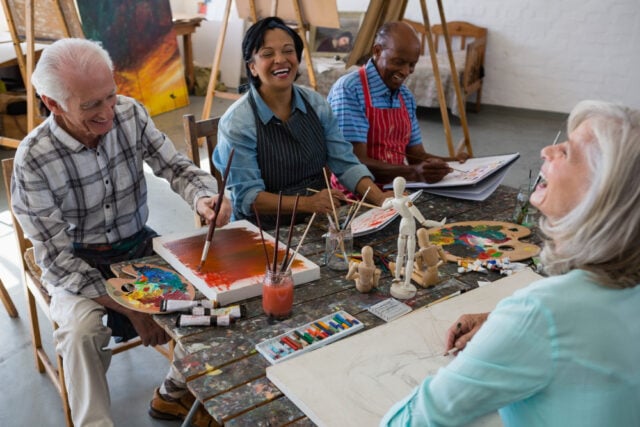
These activities also stimulate regions of the brain in ways exercise alone may not, said Angela Hsu, MD, a geriatrician at Kaiser Permanente in Virginia. For instance, reading, painting, and dancing incorporate skills like coordination, language comprehension, and information processing. Bolstering different cognitive abilities and neural connections can help make the brain more resilient to the effects of aging.
According to Sharon Brangman, MD, a geriatrician at SUNY Upstate Medical University and a trustee of the McKnight Brain Research Foundation, the new study is the first to link the arts to slower aging at the biological level, but other research has shown anti-aging benefits from these activities. In 2019, a scoping review from the World Health Organization found that the arts can help promote health and protect against cognitive decline and frailty as you age.
Should You Start Doing These Activities?
Experts recommended arts and cultural activities—regardless of the new findings. The arts simply offer accessible, enjoyable, and enriching paths to healthy aging, Bu told Health.
Anyone can gain from these hobbies, but the study found that adults aged 40 and up benefited most. The activities may also be especially beneficial for people under chronic stress, caregivers, those with cognitive decline, and people who are lonely or isolated, experts said.
Brangman recommended doing the activities at least once a week. As for the hobby itself, it could be journaling, painting, dancing, singing, reading—you name it. What’s more important is consistency, variety, and enjoyment, Hsu told Health.
Hsu also noted that hobbies with a social component can boost benefits, and learning something new is especially beneficial for your brain and may lower dementia risk. Pairing them with other habits—like exercise, good sleep, and a balanced diet—further supports healthy aging.
Disclaimer
Artificial Intelligence Disclosure & Legal Disclaimer
AI Content Policy.
To provide our readers with timely and comprehensive coverage, South Florida Reporter uses artificial intelligence (AI) to assist in producing certain articles and visual content.
Articles: AI may be used to assist in research, structural drafting, or data analysis. All AI-assisted text is reviewed and edited by our team to ensure accuracy and adherence to our editorial standards.
Images: Any imagery generated or significantly altered by AI is clearly marked with a disclaimer or watermark to distinguish it from traditional photography or editorial illustrations.
General Disclaimer
The information contained in South Florida Reporter is for general information purposes only.
South Florida Reporter assumes no responsibility for errors or omissions in the contents of the Service. In no event shall South Florida Reporter be liable for any special, direct, indirect, consequential, or incidental damages or any damages whatsoever, whether in an action of contract, negligence or other tort, arising out of or in connection with the use of the Service or the contents of the Service.
The Company reserves the right to make additions, deletions, or modifications to the contents of the Service at any time without prior notice. The Company does not warrant that the Service is free of viruses or other harmful components.