The Shockwaves That Changed Everything
On the evening of Wednesday, June 24, 2026, life changed in an instant for millions of people across north-central Venezuela. It was a national holiday—a time when families were gathered together at home celebrating the historical Battle of Carabobo. Then, nature struck with unprecedented fury. Seismologists describe the catastrophe as a rare “doublet” event: two massive earthquakes rupturing along the San Sebastián fault system within mere seconds of each other.
The first shock registered at a powerful 7.2 magnitude, acting as a terrifying prelude. Just 39 seconds later, an even more violent 7.5 magnitude mainshock tore through the Earth. Centered near Yumare and Morón on Venezuela’s Caribbean coast, about 100 miles west of Caracas, the shallow twin quakes unleashed violent ground shaking that represents the strongest seismic activity the country has experienced in more than 125 years. The sheer power of the double strike brought down massive residential high-rises in the capital city and tore through coastal infrastructure, triggering an immediate humanitarian crisis.
The Heartbreaking Toll: Dead, Injured, and Missing
As emergency crews dig frantically through the dust and concrete, the human cost of this disaster is coming into sharper, more devastating focus. According to official announcements by National Assembly President Jorge Rodríguez and acting President Delcy Rodríguez, the confirmed death toll has surged past 920 individuals. Local hospitals and emergency clinics are completely overwhelmed, currently struggling to treat more than 3,360 confirmed injuries.

These numbers represent real people—children, parents, and grandparents—pulled from fractured concrete slabs covered in dust and blood. But the most alarming revelation comes from United Nations aid chief Tom Fletcher. In a recent brief, Fletcher warned that more than 50,000 people remain unaccounted for and missing beneath the rubble. With over 200 aftershocks continuing to rattle unstable structures and communication networks severely fractured, rescue teams are in a literal race against time.
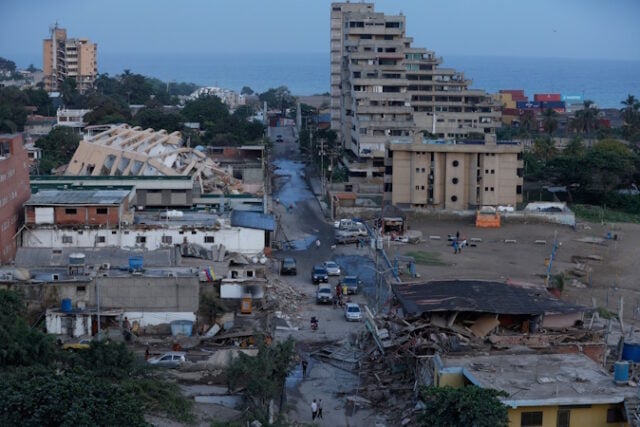
What to notice in the visual data: The image highlights the structural failure caused by the doublet quakes. Notice how multi-story residential buildings have completely lost their vertical alignment, tilting hazardously into one another, while the streets are choked with pulverized concrete and debris. This severe structural compromise is why search-and-rescue operations require specialized heavy equipment and why thousands are forced to sleep in open-air parks.
In hard-hit regions like the coastal state of La Guaira, which has been placed under military control to manage the chaos, families are setting up handwritten missing-person lists and pinning photographs to crumbling walls, desperately searching for any sign of life.
Washington Steps In: Sanctions Relief and Direct Aid
Faced with an emergency this complex, the international community has had to move rapidly, putting aside years of intense political tension. The United States government has taken a highly prominent role in the immediate relief effort. Recognizing that the Venezuelan population was already navigating deep economic vulnerabilities before the ground started shaking, Washington has coordinated both financial and tactical support:
- Direct Funding: The U.S. has approved an initial $150 million package in immediate humanitarian assistance. This funding is being channeled directly through United Nations agencies and verified non-governmental organizations on the front lines to procure food, water, medical supplies, and temporary shelter materials.
- Tactical Deployment: Elite American disaster response units and urban search-and-rescue (SAR) units—including specialized teams from Los Angeles County—have landed on the ground. These specialists are helping local firefighters navigate highly unstable rubble fields using advanced thermal imaging and listening devices.
- Military Logistics: The U.S. military has mobilized heavy logistics capabilities, deploying two naval warships alongside transport aircraft and helicopters to deliver water, food, and emergency field equipment directly to isolated coastal zones where roads have split open.
- Sanctions Relief: In what policy experts consider the most significant administrative shift, the U.S. Treasury Department issued a sweeping, temporary four-month license authorizing all financial transactions related to earthquake relief efforts. Valid until October 23, 2026, this temporary lifting of economic sanctions removes critical banking barriers, allowing international aid funds and peer-to-peer family remittances to flow into the country without legal friction.
A Global Coalition Mobilizes
The United States is part of a massive, multifaceted international mobilization. Countries from across the globe have launched standalone emergency operations to support the response:
| Country / Organization | Type of Assistance Dispatched | Key Mission Details |
| India | Operation Amistad | Two Indian Air Force C-17 aircraft delivering a complete field hospital unit and 35+ tonnes of medical supplies. |
| Switzerland | Specialized SAR Team | 80 search-and-rescue specialists and 8 trained disaster tracking canines deployed to Aragua state. |
| United Nations (OCHA) | Humanitarian Coordination | Managing on-the-ground resource distribution and tracking the thousands of missing citizens. |
| Regional Neighbors | Direct First Responders | Emergency personnel, search dogs, and medical teams from Colombia, Mexico, Chile, El Salvador, Panama, and the Dominican Republic. |
| European Union | Specialized Equipment | Technical engineering and medical support teams from France, Spain, and Italy. |
This immense global coalition highlights a powerful truth spoken by Dominican Air Force Major Carlos Olivares: when an emergency of this scale strikes, no single country is fully prepared to handle the fallout alone. Neighboring countries and global partners are there to build a bridge of survival.
Navigating Widespread Ruin
The road to recovery for Venezuela will be exceptionally long. Beyond the staggering loss of life, the physical destruction has severely crippled the nation’s core infrastructure. A widespread power grid failure in the central region has knocked out electricity, heavily slowing down efforts to restore full service at the vital port of Puerto Cabello, the El Palito oil refinery, and the Morón petrochemical complex. Main transportation corridors are heavily cracked, and the capital’s principal gateway, Simón Bolívar International Airport, suffered severe structural damage, forcing the cancellation of commercial flights.
For the millions of affected residents, including members of the massive Venezuelan diaspora anxiously watching from U.S. cities like Chicago, Atlanta, Miami, and Philadelphia, the trauma is deep. Organizations like World Vision and Samaritan’s Purse are setting up temporary camps, distributing water filters, blankets, and solar lights to families who are still too terrified to sleep under a solid roof due to continuous aftershocks. It is a moment of profound grief, but the global wave of aid offers a clear sign that the world is standing with Venezuela as it begins to rebuild.
Sources and Links Used
- CBS News: Venezuela earthquake death toll soars past 900 as rescuers race to find survivors
- The Hindu: Venezuela earthquake LIVE updates: Toll climbs to 920; India sends aid
- World Vision: 2026 Venezuela earthquakes: Fast facts, FAQs, and how to help
- Wikipedia: 2026 Venezuela earthquakes
- Samaritan’s Purse: Samaritan’s Purse Responding to Venezuela Quakes
- ReliefWeb: Venezuela Earthquake Situation Overview (25 June, 2026)
Disclaimer
Artificial Intelligence Disclosure & Legal Disclaimer
AI Content Policy.
To provide our readers with timely and comprehensive coverage, South Florida Reporter uses artificial intelligence (AI) to assist in producing certain articles and visual content.
Articles: AI may be used to assist in research, structural drafting, or data analysis. All AI-assisted text is reviewed and edited by our team to ensure accuracy and adherence to our editorial standards.
Images: Any imagery generated or significantly altered by AI is clearly marked with a disclaimer or watermark to distinguish it from traditional photography or editorial illustrations.
General Disclaimer
The information contained in South Florida Reporter is for general information purposes only.
South Florida Reporter assumes no responsibility for errors or omissions in the contents of the Service. In no event shall South Florida Reporter be liable for any special, direct, indirect, consequential, or incidental damages or any damages whatsoever, whether in an action of contract, negligence or other tort, arising out of or in connection with the use of the Service or the contents of the Service.
The Company reserves the right to make additions, deletions, or modifications to the contents of the Service at any time without prior notice. The Company does not warrant that the Service is free of viruses or other harmful components.