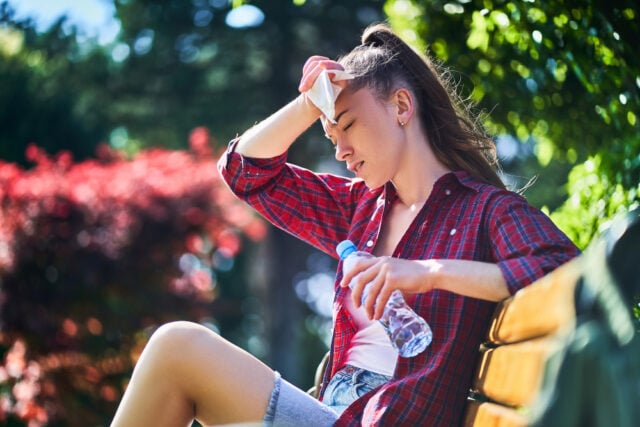
Summer is here, and it’s already dangerously hot. A major heat wave has swept the central and eastern United States, with temperatures climbing higher than 100 degrees. Nationwide, the season is expected to be hotter than usual, according to the National Weather Service.
Unfortunately, extreme heat increases the risk for dangerous heat illnesses, especially for older adults. People over 60 account for the majority of heat-related deaths in the U.S., research has found. According to the World Health Organization, heat-related mortality in people older than 65 rose by 85% between 2000 and 2021.
This isn’t coincidental—the aging process and extreme heat simply don’t mix well, experts say. Here’s why—and what older people can do to stay safe as temperatures soar.

How Your Aging Body Makes Heat More Dangerous
Even if you’re exceptionally healthy, aging will still make you more vulnerable to heat-related illnesses like heat exhaustion, when the body struggles to regulate its temperature, or heat stroke, which can be life threatening.
Bodies naturally lose their ability to cool down over time, said Wynnelena Canio, MD, a geriatric medicine physician with Kaiser Permanente Northern California. “Older adults tend to retain more heat than younger individuals and work harder to maintain consistent temperature,” she told Health.
Three key factors drive the change:
- Less efficient blood circulation: When it’s toasty outside, bodies work hard to cool down. Blood moves to the skin, and blood vessels dilate to increase sweating, which helps regulate body temperature, said Richard Marottoli, MD, MPH, a geriatrician with Yale Medicine. But as you get older, age-related changes in the heart and blood vessels make your body less efficient at circulating blood. In turn, controlling temperature becomes more of a struggle, according to the National Institutes of Health.
- A reduced ability to sweat: At the same time, aging lowers your ability to sweat, impairing the body’s natural cooling mechanism. That happens because as you age, skin thins out, causing sweat gland ducts to creep closer to the skin’s surface. At the same time, you also lose collagen, a fiber-like protein used to make connective tissue. The combination leads to compression of the ducts, making it more difficult for them to release sweat.
- A higher susceptibility to dehydration: The sensation of feeling parched—and the urge to drink that comes with that—weakens with time, as does the ability of your kidneys to regulate your fluid and electrolyte balance. One study found that glomerular filtration rate, a measure of kidney functioning, can begin declining as young as age 40, signaling a higher susceptibility to dehydration. On top of this, older people are also more likely to take medications, such as diuretics or sedatives, that cause dehydration or further impact the body’s ability to sweat.
Older adults are also more likely to have chronic diseases, which can worsen in extreme heat. “Anyone with heart, lung, kidney, electrolyte, or cognitive issues may be extra sensitive to this added stressor,” Marottoli told Health.
Symptoms to Look Out For
Heat illness often begins with a headache. Some people, however, may also develop:
- Dry mouth
- Dizziness
- Fatigue
- Confusion
- Heart palpitations
Extreme heat could also trigger chest pain, which may be a sign of a heart attack, noted Canio.
What to Do If You Experience Symptoms
To cool down quickly, apply cold water to your face and neck, then your hands and feet, she said. If you have an ice pack and cold compress, hold them against your wrists, upper chest, upper back, and the base of your neck.
If you know a heat wave is coming, wet some washcloths and put them in the freezer. Wrap them around your neck or place them under your sheets at night if the heat prevents you from sleeping, Canio suggests.
If you don’t feel better, see a doctor. Heat exhaustion can quickly progress to life-threatening heat stroke, according to the NIH. There are treatments, including IV fluids and medications that support organ function, that can help you recover.
How to Protect Yourself and Your Loved Ones From Extreme Heat
Extremely hot days—when the temperature climbs above 95 degrees—are becoming more common, and heat waves are getting longer and harsher. As such, you’ll want to have a plan in place when it’s sweltering outside.
Older adults should stay in air-conditioned buildings as much as possible. Pulling down the shades during the day can prevent the house from heating up, added Marottoli.
If you don’t have AC, contact your local health department for a list of local cooling shelters. Fans, while helpful, occasionally aren’t enough to combat heat in the home.
Drinking more water than usual can also help keep your body cool and hydrated. Beverages packed with electrolytes, such as sports drinks and vegetable or fruit juices, can replenish minerals lost through sweat. If you feel thirsty, you are already dehydrated, Canio said.
Wear loose, lightweight, and light-colored clothing, and take cool showers or baths if you feel warm. Try to avoid strenuous activities and get plenty of rest until the heat dissipates.
Many older people live alone and may not take the necessary steps to stay healthy and cool. Limited mobility may prevent them from relocating to a cooler environment, for example, and they may avoid using the AC due to financial concerns, David Cutler, MD, a family medicine physician at Providence Saint John’s Health Center in Santa Monica, CA, told Health. As such, he said, “Friends and family members should be checking on the elderly regularly during heat waves.”
Disclaimer
Artificial Intelligence Disclosure & Legal Disclaimer
AI Content Policy.
To provide our readers with timely and comprehensive coverage, South Florida Reporter uses artificial intelligence (AI) to assist in producing certain articles and visual content.
Articles: AI may be used to assist in research, structural drafting, or data analysis. All AI-assisted text is reviewed and edited by our team to ensure accuracy and adherence to our editorial standards.
Images: Any imagery generated or significantly altered by AI is clearly marked with a disclaimer or watermark to distinguish it from traditional photography or editorial illustrations.
General Disclaimer
The information contained in South Florida Reporter is for general information purposes only.
South Florida Reporter assumes no responsibility for errors or omissions in the contents of the Service. In no event shall South Florida Reporter be liable for any special, direct, indirect, consequential, or incidental damages or any damages whatsoever, whether in an action of contract, negligence or other tort, arising out of or in connection with the use of the Service or the contents of the Service.
The Company reserves the right to make additions, deletions, or modifications to the contents of the Service at any time without prior notice. The Company does not warrant that the Service is free of viruses or other harmful components.