|
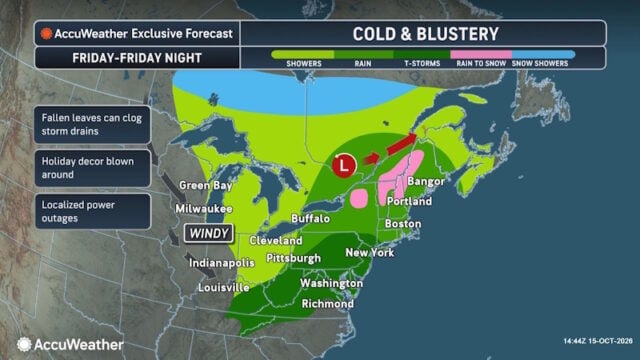
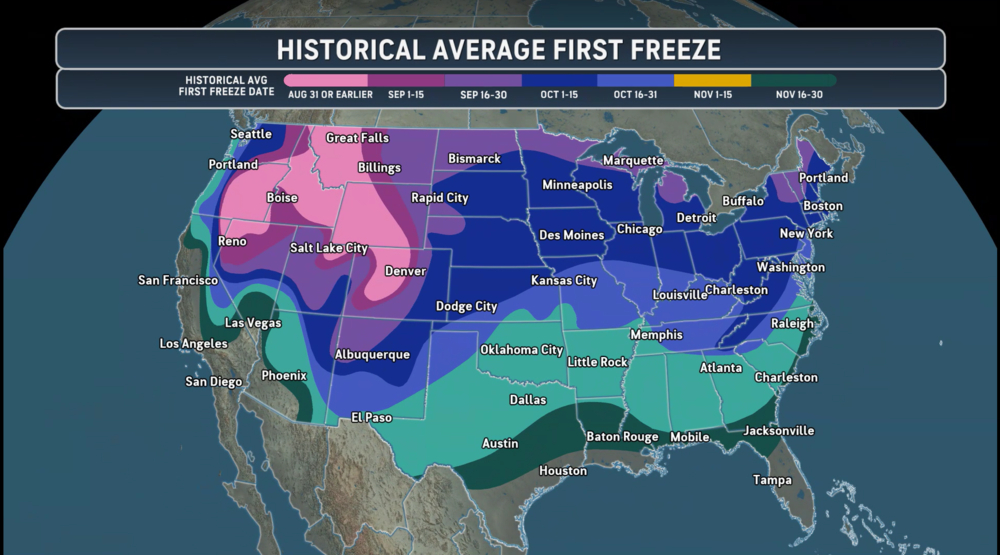
A blast of bone-chilling air – after days of record-heat in some locations – will be a shock to the system. The cold air is forecast to sweep across the Great Lakes and Northeast this weekend, with some areas going from 20 degrees above historical averages earlier this week to 20 degrees below average this weekend as millions of Americans enter the time of year when the first freeze typically arrives. AccuWeather expert meteorologists say Saturday’s highs will range from 40-60 degrees, about 5-15 degrees below historical averages, across cities including Chicago, Detroit, Cleveland, Buffalo, Pittsburgh, Boston and New York City. Wind gusts of 25-35 mph will make it feel even colder, with higher gusts are possible near the coast. Overnight temperatures will fall into the 30s and 40s, with lows near 34 degrees in Boston and 38 degrees in Pittsburgh and parts of Detroit. Colder outlying areas, and areas of higher elevation could face a greater risk of frost or freezing temperatures, posing a threat to sensitive plants and crops. “This weekend will bring a noticeable reminder that winter is getting closer,” said AccuWeather expert meteorologist Dan Pydynowski. “For many communities, we’re entering the time of year when the first freeze typically occurs. People who still have sensitive plants outdoors should start paying close attention to overnight temperatures, while anyone heading outside this weekend will want to dress for colder, blustery conditions.” |

 |
Disclaimer
Artificial Intelligence Disclosure & Legal Disclaimer
AI Content Policy.
To provide our readers with timely and comprehensive coverage, South Florida Reporter uses artificial intelligence (AI) to assist in producing certain articles and visual content.
Articles: AI may be used to assist in research, structural drafting, or data analysis. All AI-assisted text is reviewed and edited by our team to ensure accuracy and adherence to our editorial standards.
Images: Any imagery generated or significantly altered by AI is clearly marked with a disclaimer or watermark to distinguish it from traditional photography or editorial illustrations.
General Disclaimer
The information contained in South Florida Reporter is for general information purposes only.
South Florida Reporter assumes no responsibility for errors or omissions in the contents of the Service. In no event shall South Florida Reporter be liable for any special, direct, indirect, consequential, or incidental damages or any damages whatsoever, whether in an action of contract, negligence or other tort, arising out of or in connection with the use of the Service or the contents of the Service.
The Company reserves the right to make additions, deletions, or modifications to the contents of the Service at any time without prior notice. The Company does not warrant that the Service is free of viruses or other harmful components.