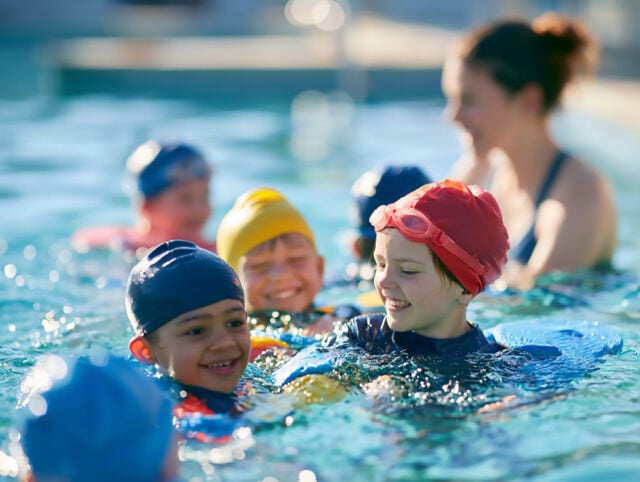
September has a way of rearranging everything. Backpacks are packed, carpool lines are back, and every afternoon suddenly has a name attached to it — practice, pickup, homework, dinner. If you’re a Miami parent trying to figure out where swim classes in Miami still fit into that picture, you’re not alone. Many families quietly let swimming slide once school starts, telling themselves they’ll pick it back up next summer. We’d like to make the case — gently, and without any scare tactics — for why fall is actually one of the best times to keep going, and how to make it work without adding stress to your week.
Why Swimming Shouldn’t Pause When School Starts
It’s tempting to treat swim lessons as a “summer thing,” like popsicles or sprinklers. But water skills don’t work quite like that. They’re closer to reading or riding a bike: something a child builds gradually, and something that gets shakier without regular practice.
Research backs this up. The Centers for Disease Control and Prevention notes that drowning remains the second leading cause of unintentional injury death for school-age children, and that formal swim lessons are associated with a meaningfully lower drowning risk. A national survey conducted for the American Red Cross similarly found that most parents of elementary school-age kids couldn’t confirm their child had mastered the basic water safety skills needed to handle an emergency in the water — skills like staying afloat, turning to find an exit, and swimming to safety. In other words, this is squarely an elementary-school-age issue, not just a toddler one.
None of this means a two-month break will erase everything your child has learned. But elementary school-age swimmers are still building muscle memory, stroke technique, and confidence in the water. A long gap between May and next June often means September’s lesson looks a lot like April’s — parents restarting from a slightly earlier point than where they left off. Staying enrolled through fall, even at a lighter pace, tends to keep skills moving forward instead of sideways.

For Miami families specifically, there’s another layer to this. Our warm climate means backyard pools, canals, and beach trips are part of daily life almost year-round, not just in July and August. Water access doesn’t take a fall break, so it makes sense for water competence not to either.
The Real Scheduling Problem Parents Are Facing
Here’s the honest part: nobody skips swim lessons in September because they think it’s unimportant. They skip it because the calendar is already full.
By the time school starts, most families are juggling:
- Homework and reading logs that didn’t exist in June
- After-school pickup windows that shift by day of the week
- A new sport or activity your child just started
- Carpools with other families that only work at certain times
- Dinner, bath, and bedtime routines that get later the more you add
Add a younger sibling’s schedule into that mix, and finding a 45-minute swim slot can feel like solving a puzzle with no edge pieces. This is the actual reason swim often gets cut in September — not because parents don’t value it, but because something has to give, and swim is often the newest or most flexible-feeling commitment on the list.
The good news is that this is a scheduling problem, not a values problem — and scheduling problems have solutions.
Making Swim Classes in Miami Work With a Busy Fall Calendar
A few adjustments tend to make the biggest difference for families with elementary school-age kids:
Weekday evening slots. Many Miami swim programs, including ours, keep evening hours open specifically because working parents need them. A single weekday slot — say, right after an early dinner — is often easier to protect long-term than trying to squeeze lessons in mid-afternoon between school and everything else.
Weekend blocks. For families whose weekdays are simply maxed out, a Saturday or Sunday morning lesson can be the more sustainable choice. It also tends to be less rushed, since there’s no school pickup deadline hanging over it.
Shorter, focused sessions. Elementary school-age kids generally don’t need — or benefit from — long lesson blocks after a full school day. A focused 20 to 30 minute session is often more effective than an hour, because it matches a tired mind’s actual attention span at 5 or 6 p.m. Shorter lessons are also easier to slot into a packed week without displacing something else.
Every-other-week or reduced-frequency options. If twice-weekly lessons aren’t realistic this fall, once a week (or even every other week) is still far better than stopping entirely. Consistency matters more than volume, especially for maintaining skills your child has already built.
The goal isn’t to find “extra time” that doesn’t exist. It’s to pick the version of swim that fits into the time you actually have.
How SwimRight Academy Fits Into Fall Routines
We built our fall schedule around exactly this problem. SwimRight Academy Miami offers weekday evening and weekend time slots, along with shorter class formats designed for elementary school-age kids, so families aren’t forced to choose between swim and everything else on the calendar. If your usual time slot from summer no longer works now that school’s back, our team can help you find a new one that does — rather than putting lessons on pause until next year.
Getting Started This Fall
If your child took a break over the summer, or you’re considering lessons for the first time, September is a reasonable time to start rather than wait for. Routines are already being rebuilt this month — this is simply one more piece to fit in, not a whole new system to figure out later.
You can enroll in our fall session or book a quick fall assessment to find a time slot that actually works for your family’s week. We’ll help you figure out the right frequency and format for your elementary schooler’s schedule, so swim becomes one less thing you have to think about — not one more thing competing for your attention.
Disclaimer
Artificial Intelligence Disclosure & Legal Disclaimer
AI Content Policy.
To provide our readers with timely and comprehensive coverage, South Florida Reporter uses artificial intelligence (AI) to assist in producing certain articles and visual content.
Articles: AI may be used to assist in research, structural drafting, or data analysis. All AI-assisted text is reviewed and edited by our team to ensure accuracy and adherence to our editorial standards.
Images: Any imagery generated or significantly altered by AI is clearly marked with a disclaimer or watermark to distinguish it from traditional photography or editorial illustrations.
General Disclaimer
The information contained in South Florida Reporter is for general information purposes only.
South Florida Reporter assumes no responsibility for errors or omissions in the contents of the Service. In no event shall South Florida Reporter be liable for any special, direct, indirect, consequential, or incidental damages or any damages whatsoever, whether in an action of contract, negligence or other tort, arising out of or in connection with the use of the Service or the contents of the Service.
The Company reserves the right to make additions, deletions, or modifications to the contents of the Service at any time without prior notice. The Company does not warrant that the Service is free of viruses or other harmful components.