Financial Literacy Scores Are Falling
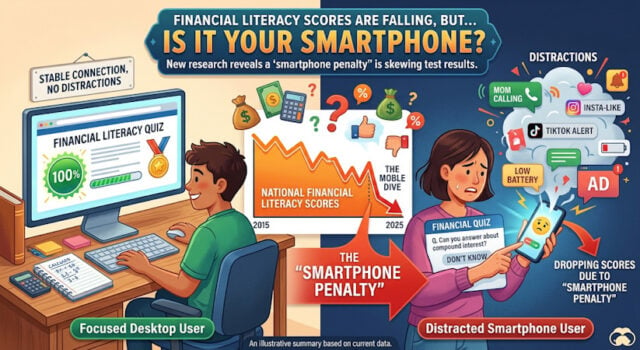
If you have kept an eye on recent personal finance headlines, you might feel a bit discouraged. Report after report suggests that financial literacy across America is in a steady downward spiral. According to long-running benchmarks such as the National Financial Capability Study, measured financial knowledge declined by roughly 15 percent over the last decade. Younger adults appear to score lowest, and more people than ever are answering basic money questions with a shrug and a “don’t know.” But before we assume everyone forgot how compound interest works, researchers have uncovered an unexpected culprit behind this alarming slump: America’s growing “smartphone penalty.”
It turns out that the device you hold in your hand matters just as much as what you know. Back in 2009, nearly everyone completing national financial surveys did so on a desktop or laptop computer. Fast forward to today, and more than half of all participants tap through these questionnaires directly on their mobile phones. Researchers analyzing this technological shift discovered a stark pattern. When individuals answer financial literacy questions on a smartphone, their scores consistently drop compared to when they sit at a computer, creating an artificial dip in how smart we look on paper.
Why does tapping on a phone make test-takers look less financially literate? The primary driver is what researchers call “rapid guessing.” When scrolling on a handset while multitasking, waiting in line, or riding the bus, participants are 50 percent more likely to pick an answer in under three seconds or simply hit “don’t know” to finish faster. Mobile users deal with small fonts, constant push notifications, and divided attention. This penalty becomes even more pronounced toward the end of a long questionnaire, where thumb fatigue sets in. In fact, economic models suggest that the widespread migration to mobile survey-taking accounts for between 23 percent and 83 percent of the measured decline in national financial knowledge.

Of course, this finding does not mean everyday consumers have mastered personal finance. Real-world money hurdles remain substantial. Millions of households continue to navigate record credit card balances, opaque loan agreements, tricky retirement planning, and an endless stream of dubious advice on social media. Accessible financial education and transparent banking tools are just as essential as they have always been. However, this study reveals a critical lesson for researchers and fintech companies alike. Failing to account for how mobile interfaces distort user testing can lead policymakers to design the wrong solutions for problems that might actually stem from survey fatigue.
Ultimately, the apparent decline in financial literacy reveals more about modern digital habits and screen fatigue than about actual financial competence. The next time you hear that Americans are failing basic money tests, take it with a grain of salt. We might not be losing our financial smarts—our phones are just distracting us along the way.
Sources Used
- Investor’s Business Daily: Financial Literacy Scores Drop: America’s Smartphone Penalty
- USC Dornsife Center for Economic and Social Research (CESR): Working Paper Series on Financial Knowledge Measurement
- Marketplace (American Public Media): New Study Reveals a Smartphone Penalty That Distorts Survey Results
- Forbes Advisor: Financial Literacy Drops to 10-Year Low
- Center for Responsible Banking and Finance (University of St Andrews): Is Financial Knowledge Really Declining?
- FINRA Investor Education Foundation: National Financial Capability Study Findings
Disclaimer
Artificial Intelligence Disclosure & Legal Disclaimer
AI Content Policy.
To provide our readers with timely and comprehensive coverage, South Florida Reporter uses artificial intelligence (AI) to assist in producing certain articles and visual content.
Articles: AI may be used to assist in research, structural drafting, or data analysis. All AI-assisted text is reviewed and edited by our team to ensure accuracy and adherence to our editorial standards.
Images: Any imagery generated or significantly altered by AI is clearly marked with a disclaimer or watermark to distinguish it from traditional photography or editorial illustrations.
General Disclaimer
The information contained in South Florida Reporter is for general information purposes only.
South Florida Reporter assumes no responsibility for errors or omissions in the contents of the Service. In no event shall South Florida Reporter be liable for any special, direct, indirect, consequential, or incidental damages or any damages whatsoever, whether in an action of contract, negligence or other tort, arising out of or in connection with the use of the Service or the contents of the Service.
The Company reserves the right to make additions, deletions, or modifications to the contents of the Service at any time without prior notice. The Company does not warrant that the Service is free of viruses or other harmful components.