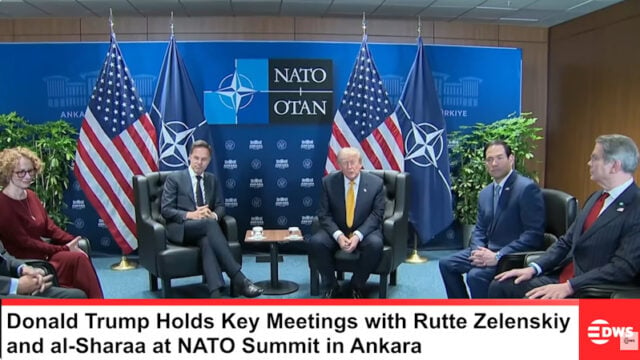
The 2026 NATO summit in Ankara, Turkey, was thrown into a diplomatic frenzy on Tuesday as U.S. President Donald Trump aggressively revived his long-standing campaign for the United States to assume control of Greenland. Speaking to reporters during a high-profile bilateral meeting with Turkish President Recep Tayyip Erdogan, Trump explicitly stated that the massive, resource-rich Arctic island “should be controlled by the United States, not by Denmark.” The declaration immediately reignited deep-seated trans-Atlantic tensions, overshadowing billions of dollars in newly unveiled European defense projects aimed specifically at placating the American administration’s demands for increased military spending.
Trump framed his renewed territorial ambitions as an urgent matter of national security, reiterating claims that Greenland is increasingly vulnerable to foreign adversaries. The U.S. president alleged that the semiautonomous island is effectively surrounded by Russian and Chinese vessels, arguing that Denmark lacks the military capacity to protect the region from geopolitical encroachment. “There’s not a thing that Denmark can do about it if Russia or China wants to occupy Greenland, but there’s everything we can do,” Trump asserted, emphasizing Greenland’s strategic position in the opening frontiers of Arctic commerce and defense.
The Troop Withdrawal Threat
Beyond merely repeating his desire for the territory, Trump issued a stark ultimatum to his European allies. He directly connected the Greenland dispute to the broader American military presence in Europe, suggesting that a refusal by NATO leaders to accommodate his goals could result in a total drawdown of American forces stationed across the continent. Trump complained that his pursuit of Greenland had severely strained his relationship with the alliance because European leaders refused to cooperate with his vision.

“That’s what hurt my relationship with NATO,” Trump told reporters in Ankara. “Because Greenland doesn’t help Denmark, Denmark doesn’t spend money to really help Greenland, but it’s an important part for the United States. And when NATO wouldn’t go along with it, and with all of the money we spend to help them with Russia… We could remove all of our soldiers out of Europe.”
The threat struck at the core of the 32-member alliance, which operates on the foundational principle of mutual defense and territorial integrity. A unilateral threat to withdraw the U.S. nuclear and conventional umbrella over a real estate dispute marks one of the most volatile fractures in recent trans-Atlantic history, echoing the height of the early 2026 Greenland crisis where Washington briefly threatened sweeping 25% import tariffs against several European nations.
Denmark and NATO Allies Stand Firm
The response from European capitals was swift, sharp, and uncompromising. Speaking on Wednesday, July 8, 2026, Danish Prime Minister Mette Frederiksen firmly shut down the U.S. president’s assertions. “Greenland is of course not for sale,” Frederiksen declared to summit attendees. She urged all alliance members, including the United States, to respect the self-determination of the Greenlandic people and honor the baseline sovereignty of independent nations. “We are sovereign states, and we need everybody to respect our territorial integrity and our sovereignty,” she added, noting that Denmark remains fully prepared to defend every inch of its territory alongside its European partners.
Other Nordic and Baltic leaders quickly rallied behind Denmark. Iceland’s Prime Minister Kristrun Frostadottir reiterated that Greenland belongs uniquely to its population, warning that public diplomatic squabbling only serves to weaken the alliance against real external threats. European officials noted that hundreds of elite Danish combat soldiers trained in Arctic warfare remain deployed to the region, a direct defensive posture established after Trump’s initial annexation threats earlier in the year.
Billions in Arms Deals Overshadowed
The geopolitical friction unfolded at a moment when NATO leadership was working around the clock to demonstrate Europe’s commitment to shared defense burdens. Prior to Trump’s remarks, NATO Secretary-General Mark Rutte hosted a major event highlighting tens of billions of dollars in new multinational military contracts. These projects—funded in part by a massive $170 billion European Union defense loan system—include joint acquisitions of Airbus air-to-air refueling planes and next-generation Triton surveillance drones, a clear effort to satisfy Trump’s insistence on a more self-reliant “NATO 3.0.”
While Rutte conceded that Trump’s demands for European nations to match U.S. defense spending levels were “completely fair,” the goodwill generated by the spending announcements was instantly diluted by the renewed Greenland ultimatum. With the Pentagon currently executing a six-month review of all U.S. military personnel stationed in Europe, allies are left scrambling to determine whether their historic security arrangements will ultimately hinge on a piece of Arctic ice.
Sources and Links:
- The House of Commons Library: President Trump and Greenland: Frequently asked questions
- Wikipedia: Greenland crisis
- Global News: Trump says Greenland should be controlled by the US, not Denmark
- PBS NewsHour: Trump again demands Greenland as NATO unveils military projects worth billions to prove its firepower
- CBC News: Trump revives argument that U.S. should control Greenland as NATO leaders gather
- The New Republic: Trump Kicks Off NATO Meeting With Wild Threat to Seize Greenland
- India Today: Denmark rejects Trump’s Greenland demand at tense NATO summit
- Firstpost: Trump Demands Greenland Again, Criticises NATO Allies In Turkey
Disclaimer
Artificial Intelligence Disclosure & Legal Disclaimer
AI Content Policy.
To provide our readers with timely and comprehensive coverage, South Florida Reporter uses artificial intelligence (AI) to assist in producing certain articles and visual content.
Articles: AI may be used to assist in research, structural drafting, or data analysis. All AI-assisted text is reviewed and edited by our team to ensure accuracy and adherence to our editorial standards.
Images: Any imagery generated or significantly altered by AI is clearly marked with a disclaimer or watermark to distinguish it from traditional photography or editorial illustrations.
General Disclaimer
The information contained in South Florida Reporter is for general information purposes only.
South Florida Reporter assumes no responsibility for errors or omissions in the contents of the Service. In no event shall South Florida Reporter be liable for any special, direct, indirect, consequential, or incidental damages or any damages whatsoever, whether in an action of contract, negligence or other tort, arising out of or in connection with the use of the Service or the contents of the Service.
The Company reserves the right to make additions, deletions, or modifications to the contents of the Service at any time without prior notice. The Company does not warrant that the Service is free of viruses or other harmful components.