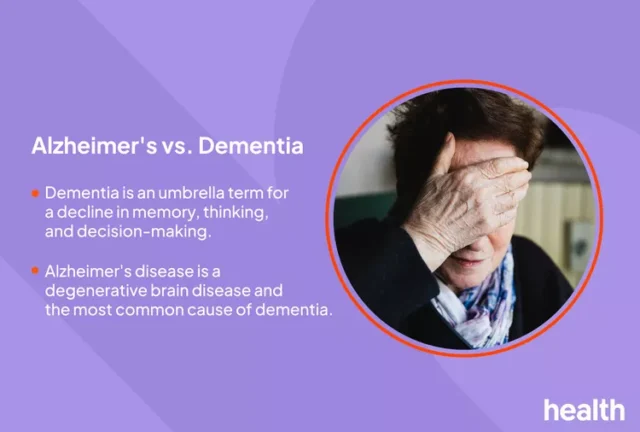
Dementia is an umbrella term for a range of symptoms that affect memory, thinking, and social abilities. Alzheimer’s disease is the most common cause of dementia in people over 60 years of age.
What Are the Symptoms Both?
Dementia is a term that describes a wide range of neurological conditions that affect your brain’s ability to remember, think, and perform daily activities.
Alzheimer’s disease is a type of dementia, so the symptoms are relatively the same.
Ten common signs of Alzheimer’s disease and dementia include:

- Memory loss and trouble remembering new information
- Trouble planning and problem-solving
- Not being able to complete familiar tasks
- Losing track of times, dates, and places
- Vision changes
- Forgetting words or having trouble finding the correct word to use
- Misplacing items
- Poor decision-making skills
- Withdrawing from social relationships
- Emotional and behavioral changes such as rapid mood swings
What’s the Difference?
Alzheimer’s disease is just one type of dementia. Other types of dementia can affect your cognitive health a bit differently.
Alzheimer’s Disease Affects The Brain Differently
While other forms of dementia might share some symptoms, the underlying changes in the brain in Alzheimer’s disease are more distinctive and tend to follow a specific pattern of progression.
In Alzheimer’s disease, the brain develops clumps of abnormal proteins called beta-amyloid plaques and tau protein tangles that make it hard for brain cells to communicate with each other.
Beta-amyloid plaques form outside of your nerve cells, while tau protein forms tangles inside the cells. This causes the cells to die, especially ones responsible for memory and thinking.
There are Several Other Types of Dementia
Other types of dementia include:
- Vascular dementia: This type occurs when brain conditions (such as a stroke) damage your brain tissue and affect blood flow to the brain. People with vascular dementia typically have brain abnormalities that are visible on an MRI scan, such as diseased small blood vessels or “white matter” changes. Symptoms may include difficulty with thinking, reasoning, behavior, and memory.
- Lewy body dementia (LBD): LBD develops when there is a presence of abnormal protein deposits in the brain, known as Lewy bodies. Risk factors include older age and some underlying health conditions, such as Parkinson’s disease. Symptoms often include changes in thinking, mobility, behavior, and emotional states.
- Frontotemporal dementia (FTD): FTD affects the frontal and temporal lobes of the brain, which play a role in your personality, behavior, emotions, and language. This type of dementia often occurs at a younger age than other types. People with a family history of FTD tend to have a higher risk of this condition than those without a family history.
- Mixed dementia: Sometimes, people can have more than one type of dementia. For example, someone might have both Alzheimer’s disease and vascular dementia, which can complicate symptoms and diagnosis.
Different Types of Dementia Can Start at Different Ages
Most people with Alzheimer’s disease develop the condition in their mid-60s or later. This is referred to as “late-onset.” Alzheimer’s disease can also be “early onset,” affecting people younger than 65 years old.
Frontotemporal dementia is a less common form of dementia that often starts at an earlier age than other types.
Lewy body dementia usually affects people 50 years or older, but can develop earlier. This type of dementia also tends to affect a slightly higher proportion of males as compared to females.
How Are They Similar?
Alzheimer’s disease is a type of dementia, but there are also commonalities between Alzheimer’s and other types of dementia.
Healthcare Providers Use Similar Diagnostic Tests for All Dementia Types
If you or a loved one are experiencing symptoms of dementia, it’s important to see a healthcare provider as soon as possible. Early diagnosis can help you get started on treatment early and slow the progression of the disease.
Once you see a provider, they can diagnose the type of dementia you have using the following methods:
- Taking a thorough medical history and asking about your symptoms
- Performing a physical exam
- Assessing your cognitive functions, including your thinking, memory, and language skills
- Using additional diagnostic exams like blood tests and genetic testing
- Ordering brain imaging tests, such as computed tomography (CT), magnetic resonance imaging (MRI), or positron emission tomography (PET)
- Conducting a mental health evaluation to determine if any mental health conditions might be influencing your symptoms
All Types of Dementia are Progressive
All types of dementia are progressive, meaning they worsen over time as the brain experiences more damage and deterioration.
This progression usually leads to a decline in cognitive function and a worsening of symptoms.
The rate and manner of progression can vary among different types of dementia and from person to person.
Treatments May Be Similar
While there is no cure for dementia and Alzheimer’s disease at this time, the goal of treatment is to slow the progression of the disease.
Healthcare providers often use medications to slow down the disease and enhance memory. Medication is mostly helpful for people who are in an early stage of dementia.
Your healthcare provider can also prescribe medications to treat symptoms like anxiety, depression, sleep disturbances, and muscle stiffness associated with certain types of dementia.
MedlinePlus. Dementia.
Other treatments for all types of dementia include:
- Occupational therapy to simplify daily tasks and activities
- Speech therapy to help with speaking and communication
- Psychotherapy and mental health counseling for people with dementia and their families
Can You Have Both Dementia and Alzheimer’s Disease?
Alzheimer’s disease is a specific type of dementia, making it possible for an individual to have both dementia and Alzheimer’s.
However, if you have a different type of dementia, such as frontotemporal dementia, you typically do not have Alzheimer’s disease.
The only way to have Alzheimer’s disease and another type of dementia is when you have mixed dementia.
When Should You Seek Care?
If you or a loved one notices forgetfulness or starts having issues with thinking, problem-solving, or reasoning, it is a good idea to see your healthcare provider.
For a dementia diagnosis, your provider will typically work with neurologists (doctors who specialize in brain and nervous system disorders) or geriatric psychiatrists (doctors who specialize in brain disorders and mental health conditions among older adults).
Disclaimer
Artificial Intelligence Disclosure & Legal Disclaimer
AI Content Policy.
To provide our readers with timely and comprehensive coverage, South Florida Reporter uses artificial intelligence (AI) to assist in producing certain articles and visual content.
Articles: AI may be used to assist in research, structural drafting, or data analysis. All AI-assisted text is reviewed and edited by our team to ensure accuracy and adherence to our editorial standards.
Images: Any imagery generated or significantly altered by AI is clearly marked with a disclaimer or watermark to distinguish it from traditional photography or editorial illustrations.
General Disclaimer
The information contained in South Florida Reporter is for general information purposes only.
South Florida Reporter assumes no responsibility for errors or omissions in the contents of the Service. In no event shall South Florida Reporter be liable for any special, direct, indirect, consequential, or incidental damages or any damages whatsoever, whether in an action of contract, negligence or other tort, arising out of or in connection with the use of the Service or the contents of the Service.
The Company reserves the right to make additions, deletions, or modifications to the contents of the Service at any time without prior notice. The Company does not warrant that the Service is free of viruses or other harmful components.