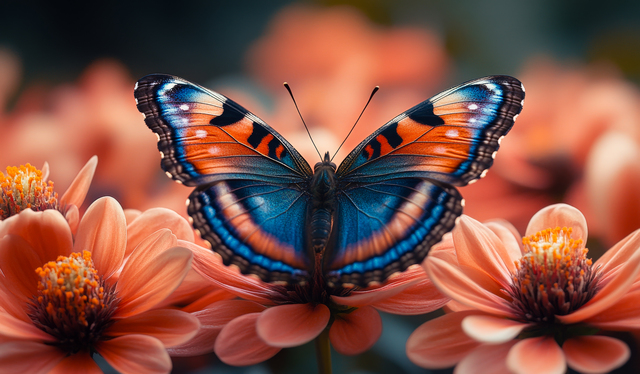
They flutter through our gardens, land on our windowsills, and appear in nearly every ecosystem on Earth. Yet despite being among the most studied insects in the world, moths and butterflies still hold remarkable secrets. A sweeping new review published in Nature Reviews Biodiversity, authored by researchers from the Florida Museum of Natural History, Harvard University, the University of Cambridge, and others, lays out both the remarkable discoveries of recent decades and the significant gaps that remain. The findings offer a compelling reminder that even familiar creatures can redefine our understanding of life on Earth. “Even though moths and butterflies are a well-studied group, we’re just now beginning to understand some of the most basic facts about their evolution and conservation needs,” says Akito Kawahara. “There’s still so much more to do.”
A 300-Million-Year Story
Moths and butterflies belong to the insect order Lepidoptera, which accounts for nearly 10% of all known animal species. Their story begins around 300 million years ago, making them older than dinosaurs.
One of the most surprising findings involves how early moths became capable of eating land plants: a dietary leap that proved transformative. Plants have evolved an enormous arsenal of chemical toxins to deter herbivores, yet moths have found a way around them. According to recent genetic research, they didn’t do it entirely on their own. Through a process called horizontal gene transfer, the direct movement of genetic material between unrelated organisms, early moths appear to have borrowed genes from fungi that helped them digest tough plant tissues and neutralize plant defenses. A second horizontal gene transfer event, this time from bacteria, occurred during the Triassic period and enabled moths to digest plant sugars, including those in floral nectar. These two molecular “upgrades,” separated by tens of millions of years, helped set the stage for the extraordinary diversity of Lepidoptera we see today.
The Proboscis, Pollination, and the First Butterflies
Around the same time that moths gained the ability to process plant sugars, they also evolved the proboscis—the slender, straw-like feeding tube that is one of their most recognizable features. This was significant not just for the moths themselves, but for the plants they would go on to serve.

Long before flowering plants appeared, early seed plants called gymnosperms produced small liquid droplets on their cones to capture windblown pollen. Insects with needle-like mouthparts began drinking these droplets, inadvertently transferring pollen between plants. As this relationship developed over millions of years, it laid the groundwork for the sophisticated pollination networks that exist today.
When flowering plants finally arrived, roughly 150 million years ago, it was bees—descendants of carnivorous wasps—that initially took center stage as their pollinators. Bee-pollinated flowers needed to be colorful and open during daylight hours, a niche that suited day-flying insects rather than the largely nocturnal moths. One group of moths, however, made the switch to daytime activity to exploit these new food sources. In doing so, they eventually evolved into what we now call butterflies.
The Bat Problem—and Moths’ Ingenious Solutions
Approximately 55 million years ago, bats appeared, radically altering the stakes for nocturnal insects. With birds already dominating daytime aerial hunting, bats evolved echolocation to hunt at night, when most moths are active. The result was an evolutionary arms race that continues to this day.
Several moth lineages independently evolved hearing organs sensitive to the high-frequency ultrasound produced by bats. Some moth species went further, developing sound-producing organs of their own, in some cases repurposing parts of their bodies in startlingly inventive ways to jam bat sonar signals. Researchers expect many more such adaptations to be discovered. “I think we will find many more hearing organs on different moth species and also discover countless new moth morphological and behavioral defense strategies against bat predators,” said Akito Kawahara.
Genomics: A New Frontier
Many new scientific discoveries have been made possible by advances in genome sequencing. Projects like the Earth BioGenome Project, with the ambitious goal of sequencing all 1.8 million known eukaryotic species, and Project Psyche, which is sequencing all 11,000 moth and butterfly species in Europe, are producing data at a pace that would have been unimaginable just 10 years ago.
Genome analysis has also become a powerful conservation tool. Scientists recently sequenced the genome of the Xerces blue butterfly, considered the first butterfly driven to extinction by human activity, using museum specimens collected before the species disappeared in the 1940s. The analysis revealed the population had been genetically vulnerable for tens of thousands of years before development destroyed its habitat, knowledge that could help predict which living species are most at risk today.
A Declining Barometer
Despite their 300-million-year track record of resilience, moths and butterflies are now in sharp decline. Their close ties to specific host plants and their sensitivity to changes in temperature and precipitation make them reliable indicators of ecosystem health, what researchers describe as “little barometers of environmental conditions.” A falling reading on that barometer is cause for concern.
The causes are well-documented: pesticide use, habitat loss, invasive species, climate change, and light pollution all play a role. Artificial lights disorient nocturnal moths by mimicking the moon, which insects use for navigation, trapping them in fatal spiraling flight patterns.
The good news is that individuals and communities can make a genuine difference. Reducing outdoor lighting at night, planting native pollinator gardens, avoiding pesticides, and perhaps less intuitively, leaving leaf litter on the ground in autumn (where many moths overwinter as larvae) are all meaningful steps.
Still So Much to Learn
What makes this review study particularly valuable for educators and students is its intellectual honesty about the limits of current knowledge. Entire continents remain poorly surveyed. The ecology of small moths is barely understood. The full extent of horizontal gene transfer in insect evolution is only beginning to come into focus.
“Even though moths and butterflies are a well-studied group, we’re just now beginning to understand some of the most basic facts about their evolution and conservation needs,” Kawahara noted. “There’s still so much more to do.”
For students curious about the natural world, that is not a discouraging statement. Rather, it is an open invitation to study the incredible diversity of butterflies and moths, and make a direct impact.
Disclaimer
Artificial Intelligence Disclosure & Legal Disclaimer
AI Content Policy.
To provide our readers with timely and comprehensive coverage, South Florida Reporter uses artificial intelligence (AI) to assist in producing certain articles and visual content.
Articles: AI may be used to assist in research, structural drafting, or data analysis. All AI-assisted text is reviewed and edited by our team to ensure accuracy and adherence to our editorial standards.
Images: Any imagery generated or significantly altered by AI is clearly marked with a disclaimer or watermark to distinguish it from traditional photography or editorial illustrations.
General Disclaimer
The information contained in South Florida Reporter is for general information purposes only.
South Florida Reporter assumes no responsibility for errors or omissions in the contents of the Service. In no event shall South Florida Reporter be liable for any special, direct, indirect, consequential, or incidental damages or any damages whatsoever, whether in an action of contract, negligence or other tort, arising out of or in connection with the use of the Service or the contents of the Service.
The Company reserves the right to make additions, deletions, or modifications to the contents of the Service at any time without prior notice. The Company does not warrant that the Service is free of viruses or other harmful components.