By Brittany Cordeiro
Mayo Clinic researchers have found that an artificial intelligence (AI) tool may provide dermatologists with additional information to help assess whether skin lesions are cancerous and inform their clinical decisions about whether to biopsy or monitor them, according to a study published in Mayo Clinic Proceedings.
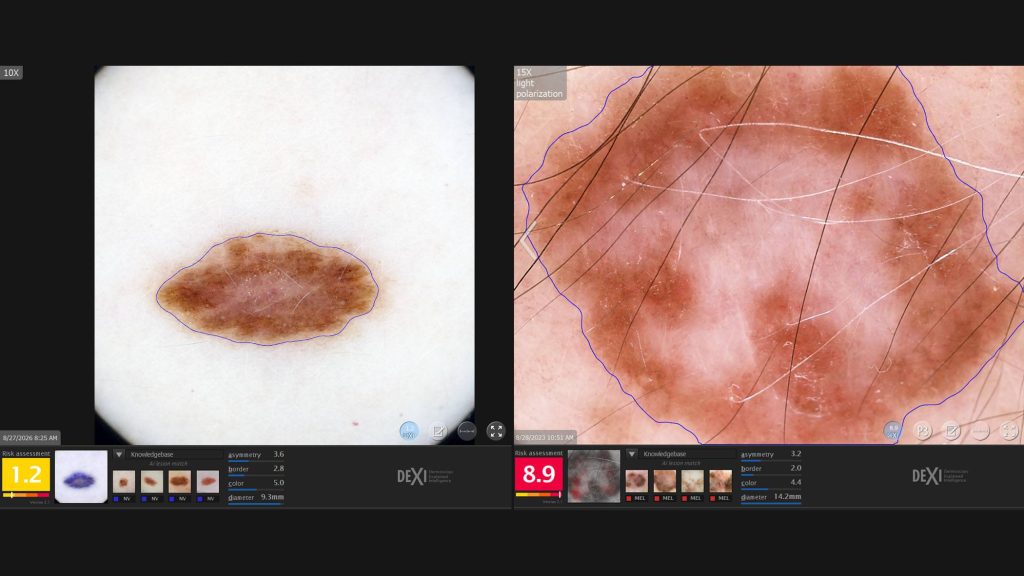
The tool, called Dermoscopy Explainable Intelligence (DEXI), is part of an advanced imaging system that dermatologists use to capture and track skin lesions over time. DEXI assigns lesions a score from 0.0 to 10.0 based on image characteristics associated with cancer risk. It also identifies features — such as asymmetry, border and color — that contribute to the score, providing dermaatologists with additional information they can consider alongside their clinical evaluation.
Researchers evaluated DEXI scores for skin lesions with known diagnoses. Using a threshold of 3.0 — meaning a score of 3.0 or higher was considered positive for potential skin cancer — DEXI correctly identified 93.4% of cancerous lesions and 75% of noncancerous lesions.

“Prior to the study, I would review a patient’s DEXI score, but I wouldn’t know exactly what to do with the number,” says Jenny Link, M.D., dermatologist at Mayo Clinic and the study’s lead author. “Now I can confidently use the score as another piece of data to inform my clinical judgment on whether I recommend a biopsy or monitoring.”
Study evaluates DEXI’s clinical use
DEXI is a deep-learning tool trained on more than 66,000 annotated dermoscopy images. In addition to assigning a cancer risk score, the tool uses explainable AI to indicate which image features contributed to its score.
The retrospective study included 178 patients who underwent total-body photography, sequential digital dermoscopy imaging and subsequent biopsy of one or more skin lesions.
Researchers analyzed 261 lesions with both a DEXI score and a diagnosis confirmed by tissue examination. They compared scores for noncancerous and cancerous lesions and further separated cancerous lesions into melanoma and nonmelanoma skin cancers.
The average DEXI score was 2.5 for noncancerous lesions, compared with 7.8 for nonmelanoma skin cancers and 6.0 for melanomas. Cancerous lesions had significantly higher DEXI scores than noncancerous lesions. Based on these findings, researchers identified 3.0 as a potential threshold that could help inform clinicians’ decisions about monitoring or biopsy.
“We identified 3.0 as a potential DEXI score threshold that could provide useful information when dermatologists are considering whether to monitor a lesion or perform a biopsy,” says Dr. Link.
The researchers also identified limitations. DEXI does not account for patient-specific factors, such as age, medications and history of melanoma. The tool was also less effective at evaluating severely atypical nevi, or skin moles, and early evolving melanomas.
“Our study demonstrated that DEXI is a useful and valuable tool to support clinicians as they evaluate cancerous and noncancerous skin lesions, but it should not be used in isolation. The score must be interpreted alongside clinical findings and patient-specific factors, and the tool requires further validation and refinement,” says Dr. Link.
For a complete list of authors, disclosures and funding, review the study.
Disclaimer
Artificial Intelligence Disclosure & Legal Disclaimer
AI Content Policy.
To provide our readers with timely and comprehensive coverage, South Florida Reporter uses artificial intelligence (AI) to assist in producing certain articles and visual content.
Articles: AI may be used to assist in research, structural drafting, or data analysis. All AI-assisted text is reviewed and edited by our team to ensure accuracy and adherence to our editorial standards.
Images: Any imagery generated or significantly altered by AI is clearly marked with a disclaimer or watermark to distinguish it from traditional photography or editorial illustrations.
General Disclaimer
The information contained in South Florida Reporter is for general information purposes only.
South Florida Reporter assumes no responsibility for errors or omissions in the contents of the Service. In no event shall South Florida Reporter be liable for any special, direct, indirect, consequential, or incidental damages or any damages whatsoever, whether in an action of contract, negligence or other tort, arising out of or in connection with the use of the Service or the contents of the Service.
The Company reserves the right to make additions, deletions, or modifications to the contents of the Service at any time without prior notice. The Company does not warrant that the Service is free of viruses or other harmful components.