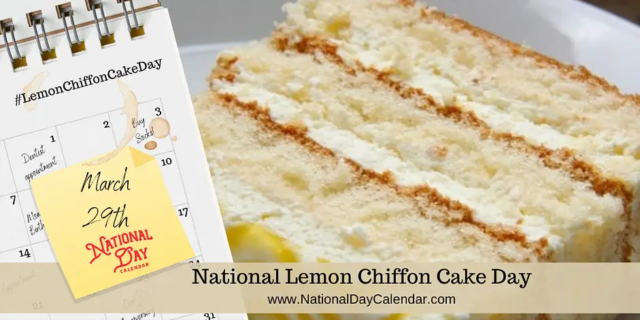
National Lemon Chiffon Cake Day on March 29th offers a bright and zesty celebration among the cake holidays.
- The recipe for the chiffon cake was a closely guarded secret for years. In the 1920s, angel food cake was quite popular, but Henry Baker thought he could make a lighter, richer cake. The insurance salesman-turned-caterer tinkered with ingredients until in 1927 he came upon the perfect combination of ingredients and methods to produce the airy richness he was looking for.
- Keeping the recipe to himself, he offered his services to the Brown Derby Restaurant in Los Angeles which catered to Hollywood’s elite.
- Until 1947, Baker was the only person to bake chiffon cakes. Baker’s secret where angel food cake contained no butter, fat or shortening of any kind, Baker added vegetable oil.
- Then, in 1947, Baker sold his recipe to General Mills for an undisclosed amount. The rest is baking history.
- According to General Mills, the chiffon cake, invented in 1927, was the first new cake to come along in 100 years.
- It created a sensation when it was published in the May, 1948 issue of Better Homes and Gardens magazine.
- Many believe Chiffon cake is the ‘original’ wedding cake filling. A chiffon cake is a very light cake made with vegetable oil, eggs, sugar, flour, baking powder, and flavorings.
- The lack of butter means that chiffon cakes lack much of the rich flavor of butter cakes, and hence they are typically served accompanied with flavorful sauces or other accompaniments, such as chocolate or fruit fillings.
- California and Arizona produce 95% of the entire U.S. lemon crop.
- During the European Renaissance, fashionable ladies used lemon juice as a way to redden their lips.
- Lemon trees bloom and produce fruit year-round. Each tree can produce between 500 and 600 pounds of lemons in a year.
Sources:

Disclaimer
Artificial Intelligence Disclosure & Legal Disclaimer
AI Content Policy.
To provide our readers with timely and comprehensive coverage, South Florida Reporter uses artificial intelligence (AI) to assist in producing certain articles and visual content.
Articles: AI may be used to assist in research, structural drafting, or data analysis. All AI-assisted text is reviewed and edited by our team to ensure accuracy and adherence to our editorial standards.
Images: Any imagery generated or significantly altered by AI is clearly marked with a disclaimer or watermark to distinguish it from traditional photography or editorial illustrations.
General Disclaimer
The information contained in South Florida Reporter is for general information purposes only.
South Florida Reporter assumes no responsibility for errors or omissions in the contents of the Service. In no event shall South Florida Reporter be liable for any special, direct, indirect, consequential, or incidental damages or any damages whatsoever, whether in an action of contract, negligence or other tort, arising out of or in connection with the use of the Service or the contents of the Service.
The Company reserves the right to make additions, deletions, or modifications to the contents of the Service at any time without prior notice. The Company does not warrant that the Service is free of viruses or other harmful components.