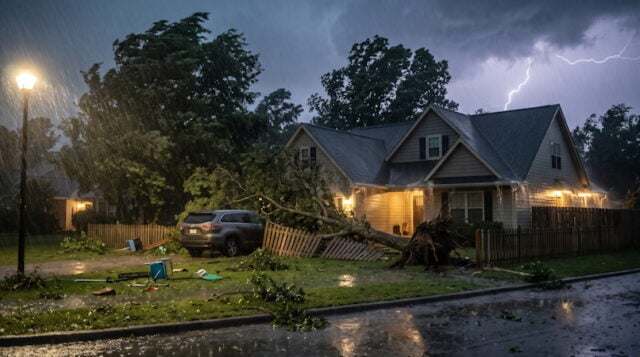
According to Quartz, your home insurance is getting much more expensive today. Severe weather is changing the insurance market completely. You might pay more even if your area stays safe. Why does this happen? The answer lies in how insurance risk is shared globally.
First, reinsurance costs are rising fast across the market. As Quartz notes, insurers buy their own insurance to cover catastrophes. When massive storms hit, reinsurers raise their prices significantly. These higher costs are then passed directly to everyday homeowners.
Second, state property insurance markets are under severe stress. Florida provides a very clear example of this ongoing crisis. Quartz points out that several Florida insurers became insolvent recently. Hurricane Ian pushed many homeowners toward the state’s backup insurer. Less market competition always means higher policy costs for homeowners.
Third, wildfire risks are rapidly shrinking your coverage options. In California, major companies like State Farm paused new policies. Quartz reports that this leaves new buyers with fewer choices. When private options vanish, homeowners must rely on state plans.

Fourth, severe hail damage is changing roof coverage rules entirely. Roofs are very expensive to replace after severe convective storms. Quartz explains that many insurers now use percentage-based hail deductibles. This shifts a much larger financial burden onto the homeowner.
Finally, flood insurance gaps are becoming very costly for everyone. Standard homeowners policies simply do not cover flood damage ever. Quartz emphasizes that FEMA now prices federal flood coverage differently. Risk Rating 2.0 ties premiums closely to individual property risks.
Ultimately, pooling global risk means everyone pays for extreme weather. A wildfire in California directly affects insurance premiums in Ohio. Your bill reflects these widespread, extremely costly weather catastrophes.
Understanding these five specific factors really helps homeowners prepare for future financial impacts. Rising global temperatures will likely continue to drive up weather-related insurance claims annually. You should always review your property coverage limits before the next major storm. Checking your specific deductible amounts can prevent unexpected financial surprises during home recovery efforts.
Sources
Disclaimer
Artificial Intelligence Disclosure & Legal Disclaimer
AI Content Policy.
To provide our readers with timely and comprehensive coverage, South Florida Reporter uses artificial intelligence (AI) to assist in producing certain articles and visual content.
Articles: AI may be used to assist in research, structural drafting, or data analysis. All AI-assisted text is reviewed and edited by our team to ensure accuracy and adherence to our editorial standards.
Images: Any imagery generated or significantly altered by AI is clearly marked with a disclaimer or watermark to distinguish it from traditional photography or editorial illustrations.
General Disclaimer
The information contained in South Florida Reporter is for general information purposes only.
South Florida Reporter assumes no responsibility for errors or omissions in the contents of the Service. In no event shall South Florida Reporter be liable for any special, direct, indirect, consequential, or incidental damages or any damages whatsoever, whether in an action of contract, negligence or other tort, arising out of or in connection with the use of the Service or the contents of the Service.
The Company reserves the right to make additions, deletions, or modifications to the contents of the Service at any time without prior notice. The Company does not warrant that the Service is free of viruses or other harmful components.