|
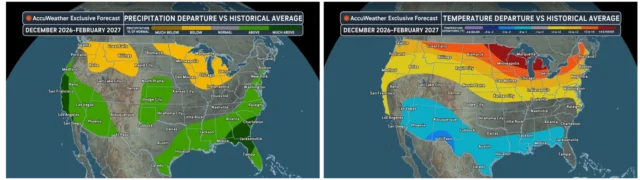
AccuWeather’s long-range experts say that El Niño has now reached the very strong level, often called a “super El Niño,” for just the sixth time since 1950. AccuWeather expert meteorologists say they have increasing confidence it could become the strongest on record, with implications for winter storms, flooding and snowfall across the country. Pacific waters warmed further in October, bringing the event into a category last reached during the winter of 2015–16. AccuWeather anticipated the development of a super El Niño as early as late spring. “AccuWeather has been forecasting a powerful El Niño since late spring. We remain near 100% certainty that strong-to-very-strong conditions will continue through the winter, compared with CPC’s probability of greater than 79%. This has been a foundation of our winter outlook, favoring wetter weather across the South and warmer conditions across much of the North,” said AccuWeather expert meteorologist Chad Merrill. |

 |
Disclaimer
Artificial Intelligence Disclosure & Legal Disclaimer
AI Content Policy.
To provide our readers with timely and comprehensive coverage, South Florida Reporter uses artificial intelligence (AI) to assist in producing certain articles and visual content.
Articles: AI may be used to assist in research, structural drafting, or data analysis. All AI-assisted text is reviewed and edited by our team to ensure accuracy and adherence to our editorial standards.
Images: Any imagery generated or significantly altered by AI is clearly marked with a disclaimer or watermark to distinguish it from traditional photography or editorial illustrations.
General Disclaimer
The information contained in South Florida Reporter is for general information purposes only.
South Florida Reporter assumes no responsibility for errors or omissions in the contents of the Service. In no event shall South Florida Reporter be liable for any special, direct, indirect, consequential, or incidental damages or any damages whatsoever, whether in an action of contract, negligence or other tort, arising out of or in connection with the use of the Service or the contents of the Service.
The Company reserves the right to make additions, deletions, or modifications to the contents of the Service at any time without prior notice. The Company does not warrant that the Service is free of viruses or other harmful components.