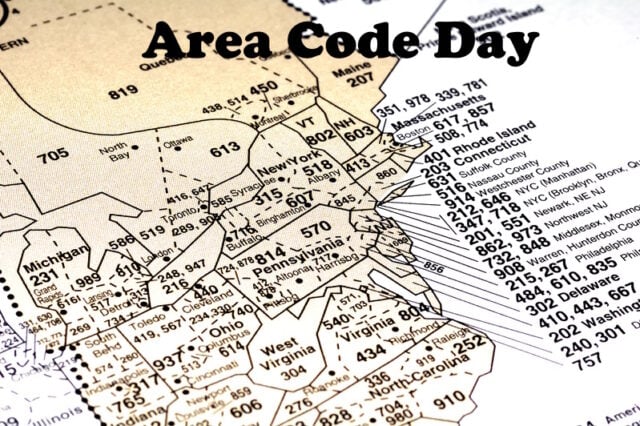
The US has 375 area codes.
In the early days of telephones, things were easy. You didn’t even dial a number; you just called your operator and asked them to connect you with someone in your town.
If you needed the Doctor, you could ask the operator to connect you with one or ask which one she’d suggest. Eventually, the phone system expanded beyond just local networks and started connecting towns, counties, states, and nations.
The first step was adding a numbering system so each person could dial another directly, but there weren’t enough numbers. Area Code Day celebrates the solution that has become part of our everyday life.

- 1940 – Area Codes first came into existence in 1940 in the laboratories of AT&T and Bell; slowly but surely, this idea was expanded on and developed until it
- 1947 – Area codes finally went into effect.
- 1951 – Direct long-distance dialing is implemented throughout the U.S.
- 1982 – The Bell System stops operating, and the Bell Telephone Company closes its doors in 1983.
- Some creative ideas were implemented to make dialing easier, including how numbers were distributed. They’ll be assigned area codes that have lower numbers at the beginning and end. In those days, people used rotary dialers, and it was determined that those in more densely populated areas should be able to dial faster. How do you make rotary phones dial faster? By using numbers that were closer to zero so they had a shorter pull time.
- Up until about the 1950s, phone numbers were alphanumeric, eventually settling on a 2-letter, 5-number system that usually identified the region of the phone number and also aimed to make it more memorable.
- (866) 666-6666 currently belongs to a limousine service in New York City, and to register this sought-after number must not have been any small feat. Not long ago, the cellphone number 666-6666 (area code unknown) sold for $2.7 million.
- 1980s – 911 emergency service became standardized in North America.
- 86…The number of area code assignments, or Numbering Plan Areas (NPAs), that existed in North America in 1947, when the system was first put into place. According to telephone researcher Linc Madison, 34 states and D.C. had just one area code at the time, while New York had five and a single area code covered three Canadian provinces. At the time, Alaska and Hawaii were not states and did not initially get a long distance code.
- Toward the end of 2007, the small town of Reeves, Louisiana, finally rid itself of a telephone area code that had bedeviled its citizens since the 1960s—666. Christians in Reeves were unhappy about having the “number of the beast” as their prefix since it was assigned. When the phone company finally relented and allowed Reevesians to switch to “749” at no charge, Mayor Scott Walker called the decision “divine intervention.”
- Hexakosioihexekontahexaphobia is the Fear of the number six hundred sixty-six.
- Legend has it that Apple cofounder Steve Wozniak (who was really into repeating digits, hence pricing the Apple I at $666.66) once owned the phone number 888-8888.
- Phone numbers also appear in songs, perhaps most memorably Glenn Miller’s Pennsylvania 6-5000. Today, the number still exists as (212) 736-5000 (“73” replaces the “PE” of the old number) and will get you to the Hotel Pennsylvania in the song title. The hotel happily claims that it’s the “New York phone number in longest continuous use.” The hotel closed in 2020.
- There’s a neat phone number-related trick you can impress your friends with. You will need a calculator:
- Key in the first three digits of your 7-digit phone number (NOT the area code), multiply by 80, add 1, multiply by 250, add the last 4 digits of your phone number, add the last 4 digits again, subtract 250, and divide by 2. If you did everything right, the result should be your 7-digit phone number.
- Thanks to services like PhoneSpell, you can find out if any of your phone numbers offer interesting “phonewords.” Enter your digits and the site will generate a list of interesting combinations. If you’ve lucked out, it may provide a better way to remember your number in the future.
- Why 7 Digits: Our short-term memory is a finite resource. Countless psychological experiments have shown that, on average, many of us are limited in terms of the amount of information we can receive, process, and remember. In fact, the longest sequence a normal person can recall on the fly contains about seven items. This limit, which psychologist George Miller dubbed as the “magical number seven” when he discovered it in 1956, explains some of the bounds on our capacity for processing information.
- The current total of possible phone numbers is 1,601,380,000…or 7.91 million numbers per area code.
- The very first cellular phone had a talk time of just 30 minutes before the battery died.
- Mark Twain was one of the first people in the U.S. to own a telephone and declined to invest in the Bell company when he was offered the opportunity.
- The first phone book came out in 1878 and consisted of only 20 pages.
- As of December 31, 2025, the United States and its territories had 375 geographic area codes (NPAs) in service, according to the North American Numbering Plan Administrator (NANPA). The number changes as new area codes are introduced to meet numbering demand. This figure refers to geographic area codes, not non-geographic codes such as toll-free numbers.
- The states using the most area codes are (Wikipedia):
- California is currently using 40 area codes,
- Texas 28 area codes,
- Florida 23 area codes
- New York 22 area codes.
Sources:
Area Code Help
Disclaimer
Artificial Intelligence Disclosure & Legal Disclaimer
AI Content Policy.
To provide our readers with timely and comprehensive coverage, South Florida Reporter uses artificial intelligence (AI) to assist in producing certain articles and visual content.
Articles: AI may be used to assist in research, structural drafting, or data analysis. All AI-assisted text is reviewed and edited by our team to ensure accuracy and adherence to our editorial standards.
Images: Any imagery generated or significantly altered by AI is clearly marked with a disclaimer or watermark to distinguish it from traditional photography or editorial illustrations.
General Disclaimer
The information contained in South Florida Reporter is for general information purposes only.
South Florida Reporter assumes no responsibility for errors or omissions in the contents of the Service. In no event shall South Florida Reporter be liable for any special, direct, indirect, consequential, or incidental damages or any damages whatsoever, whether in an action of contract, negligence or other tort, arising out of or in connection with the use of the Service or the contents of the Service.
The Company reserves the right to make additions, deletions, or modifications to the contents of the Service at any time without prior notice. The Company does not warrant that the Service is free of viruses or other harmful components.