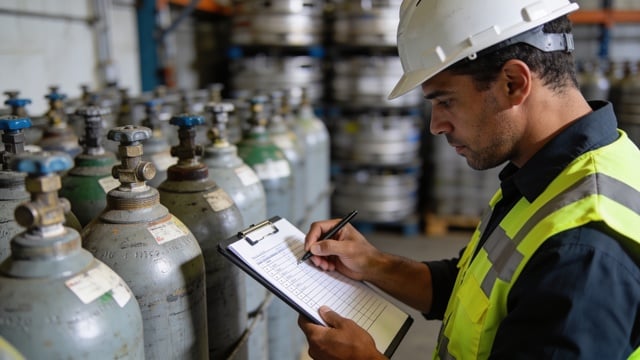
Any business in South Florida that stores, handles, or transports chemicals, fuels, cleaning agents, or other regulated substances should expect that a hazardous materials inspection is simply part of doing business, not a rare or exceptional event.
Hazardous materials inspections exist to confirm that a facility stores and manages dangerous substances in a way that protects workers, neighbors, and the environment. Inspectors typically check labeling, storage conditions, ventilation, spill containment, and whether staff know how to respond to an incident. The goal is prevention rather than punishment, though penalties can follow when serious gaps are found.
Who typically faces these inspections
Manufacturers, auto repair shops, dry cleaners, marinas, printing operations, and medical facilities are among the businesses most likely to encounter hazardous materials oversight. Restaurants and retailers that store large quantities of cleaning chemicals or propane can also fall under review. Even businesses that only occasionally handle regulated substances should understand which rules apply to their operations.

Why timing and consistency matter
Inspections can be scheduled in advance or arrive with little warning, depending on the agency and the circumstances. A business that only prepares right before a known visit tends to miss the ongoing habits that actually keep a facility compliant. Treating hazardous materials management as a daily practice, rather than a seasonal scramble, is what separates businesses that pass smoothly from those that scramble to fix issues on the spot.
What documentation inspectors usually expect
Safety data sheets, hazardous waste manifests, employee training records, and storage permits are among the most commonly requested documents. These records should be current, organized, and easy to retrieve rather than scattered across different systems or stored only in memory. Businesses that keep a centralized, updated file reduce both the time an inspection takes and the risk of appearing disorganized.
How storage and labeling get evaluated
Inspectors generally look at whether containers are properly labeled, compatible materials are stored separately, and spill containment equipment is accessible. Ventilation, secondary containment trays, and clear aisle access often matter as much as the labeling itself. Small details, like a faded label or a blocked exit near a storage area, can draw attention even when the underlying practice is sound.
Why staff training is part of the review
Employees are often asked directly about emergency procedures, which can reveal more than paperwork alone. A worker who can describe what to do during a spill or leak demonstrates that training has been absorbed rather than just documented. Regular refresher sessions, rather than a single onboarding session years earlier, tend to produce more confident, consistent answers.
When outside help makes sense
Some businesses choose to bring in environmental consultants or compliance specialists ahead of an expected inspection, particularly when operations have grown or changed since the last review. These professionals can conduct a mock inspection, flag overlooked issues, and help translate regulatory language into practical fixes. For smaller operations, guidance from a regional Small Business Development Center or an industry association can serve a similar purpose at lower cost.
South Florida’s storage and handling expectations echo a broader pattern found wherever hazardous materials oversight requires outside verification rather than self-reporting alone. Morocco offers a useful point of comparison on that same dimension: the country’s industry ministry has approved international inspection firms such as Bureau Veritas, SGS, Intertek, Applus, and TÜV Rheinland to carry out conformity assessments for regulated and hazardous products. Several of these same global inspection firms also operate hazardous materials, environmental, and industrial hygiene services directly in South Florida, which means a business owner comparing the two regions will recognize familiar inspection brands working across both systems. That overlap shows how specialized third-party inspection has become a standard feature of hazardous materials oversight far beyond any single state or country. Readers curious about how comparison and review resources are presented for an entirely different topic can look at the Haz-Tayeb casino guide as an example of how a comparison-style guide is structured.
Businesses that treat hazardous materials compliance as routine, rather than reactive, tend to fare best when an inspector arrives. Keeping documentation current, training staff regularly, and auditing storage practices on a set schedule all reduce the chance of surprises. Agencies such as the U.S. Environmental Protection Agency publish guidance that can help business owners understand baseline expectations before a visit ever occurs. Preparation built into daily operations, rather than assembled at the last minute, remains the most reliable way to keep a South Florida business ready for whatever an inspection brings.
Disclaimer
Artificial Intelligence Disclosure & Legal Disclaimer
AI Content Policy.
To provide our readers with timely and comprehensive coverage, South Florida Reporter uses artificial intelligence (AI) to assist in producing certain articles and visual content.
Articles: AI may be used to assist in research, structural drafting, or data analysis. All AI-assisted text is reviewed and edited by our team to ensure accuracy and adherence to our editorial standards.
Images: Any imagery generated or significantly altered by AI is clearly marked with a disclaimer or watermark to distinguish it from traditional photography or editorial illustrations.
General Disclaimer
The information contained in South Florida Reporter is for general information purposes only.
South Florida Reporter assumes no responsibility for errors or omissions in the contents of the Service. In no event shall South Florida Reporter be liable for any special, direct, indirect, consequential, or incidental damages or any damages whatsoever, whether in an action of contract, negligence or other tort, arising out of or in connection with the use of the Service or the contents of the Service.
The Company reserves the right to make additions, deletions, or modifications to the contents of the Service at any time without prior notice. The Company does not warrant that the Service is free of viruses or other harmful components.