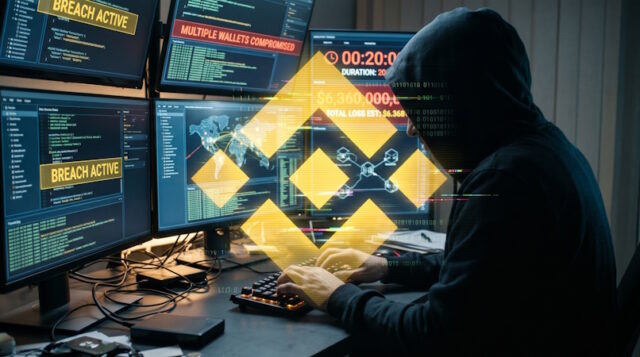
Imagine losing over six billion dollars in the time it takes to eat lunch. That nightmare became reality for Binance, the world’s largest cryptocurrency exchange, on October 29, 2026. Starting at 20:05 UTC, attackers launched a blitz across the digital financial world. They drained approximately $6.36 billion from Binance wallets across ten different blockchains. Most of that staggering sum vanished in just twenty minutes. Crypto analysts immediately called it the largest cyber heist in history. The theft is roughly four times larger than the $1.5 billion Bybit hack from February 2025.
How did the thieves pull off such a massive operation so quickly? Initial reports pointed to a compromised laptop belonging to a Binance engineer. That breach reportedly gave attackers access to a service container to submit unauthorized withdrawals. However, Binance executives later clarified that the attack was far more complex than a single click. Blockchain intelligence firm TRM Labs noted that the hackers compromised Binance’s hot wallet signing infrastructure. On the Ethereum network, the attackers used fifty pre-signed authorizations prepared in advance. They turned a Binance hot wallet into an automated sweeper under their direct control. Meanwhile, wallets on nine other blockchains sent funds through ordinary signed transfers. Ethereum accounted for $3.79 billion of the haul, while Bitcoin outflows reached $1.47 billion. Millions more poured out from Tron, Solana, Arbitrum, and the XRP Ledger.
Intelligence experts quickly spotted familiar fingerprints on the digital crime scene. Both TRM Labs and Chainalysis attributed the attack with high confidence to North Korea. Specifically, they named an elite state-sponsored hacking unit known as TraderTraitor. This group operates as part of North Korea’s notorious Lazarus Group. Officials say the heavily sanctioned regime uses crypto thefts to fund its economy and nuclear weapons program.
A frantic digital chase began within hours of the breach. Binance suspended withdrawals to run security checks and promised to cover all user losses. Major blockchain networks and stablecoin issuers stepped in to help stop the bleeding. Tether, Circle, Ripple, World Liberty Financial, and Arbitrum froze roughly $2.7 billion in stolen assets. Still, the hackers raced ahead by swapping tokens and borrowing assets on decentralized platforms. They currently hold about $2.4 billion in Bitcoin and Ethereum beyond any central authority’s reach. Even after the freezes, their remaining haul shatters every previous theft record.

Sources:
- TRM Labs: https://www.trmlabs.com/resources/blog/north-korea-steals-usd-6-36-billion-from-binance-in-the-largest-hack-in-history
- CBS News: https://www.cbsnews.com/news/binance-hack-north-korea/
- WHDH News: https://whdh.com/news/what-to-know-about-the-6-3b-hack-on-binance-likely-the-biggest-ever-crypto-theft/
- Times of India: https://timesofindia.indiatimes.com/business/international-business/6-3-billion-gone-north-korea-link-inside-the-crypto-heist-at-worlds-largest-exchange-binance/articleshow/135351366.cms
- 24/7 Wall St.: https://247wallst.com/investing/2026/10/30/north-korea-just-pulled-off-the-biggest-crypto-heist-in-history-draining-6-4-billion-from-binance-in-20-minutes/
Disclaimer
Artificial Intelligence Disclosure & Legal Disclaimer
AI Content Policy.
To provide our readers with timely and comprehensive coverage, South Florida Reporter uses artificial intelligence (AI) to assist in producing certain articles and visual content.
Articles: AI may be used to assist in research, structural drafting, or data analysis. All AI-assisted text is reviewed and edited by our team to ensure accuracy and adherence to our editorial standards.
Images: Any imagery generated or significantly altered by AI is clearly marked with a disclaimer or watermark to distinguish it from traditional photography or editorial illustrations.
General Disclaimer
The information contained in South Florida Reporter is for general information purposes only.
South Florida Reporter assumes no responsibility for errors or omissions in the contents of the Service. In no event shall South Florida Reporter be liable for any special, direct, indirect, consequential, or incidental damages or any damages whatsoever, whether in an action of contract, negligence or other tort, arising out of or in connection with the use of the Service or the contents of the Service.
The Company reserves the right to make additions, deletions, or modifications to the contents of the Service at any time without prior notice. The Company does not warrant that the Service is free of viruses or other harmful components.