Installing a heat pump water heater involves more than swapping one tank for another. A qualified professional checks the home, confirms electrical and plumbing requirements, prepares the installation area, and tests the system before leaving. The work also includes decisions about drainage, airflow, controls, and the existing water heater. Knowing each stage helps homeowners plan access, ask useful questions, and avoid surprises. The first step is a careful site assessment.
A contractor begins by reviewing the home’s layout, current water-heating setup, and proposed tank location. A site visit identifies clearance, access, condensate drainage, electrical service, and plumbing connections. Homeowners who want a visual outline can review the heat pump installation process, which explains the sequence from preparation through final checks without replacing a contractor’s assessment.
Site Assessment and Planning
The installation starts with a review of the water heater’s location. The contractor checks whether the floor can support the tank and whether the unit has adequate space around it. Heat pump water heaters move heat from the surrounding air into the storage tank. The selected room must provide enough air volume and clearance for that operation. A cramped closet can restrict airflow and complicate future maintenance.
The contractor also reviews the home’s electrical service. A heat pump water heater needs an appropriate circuit, wiring, disconnecting means, and nearby receptacle or connection point, depending on the equipment and local requirements.

Preparing the Installation Area
Before work begins, the existing water heater is shut down and disconnected. For a gas unit, the fuel supply is closed in accordance with applicable safety procedures. The tank is then drained before removal. The contractor checks the floor, drain pan, shutoff valve, water lines, and surrounding walls. Damaged valves or corroded piping should be addressed before the new tank is connected.
Local rules can affect permits, clearances, discharge piping, and electrical work. A professional confirms those requirements before installation rather than relying on assumptions from another property.
Connecting Plumbing and Electrical Systems
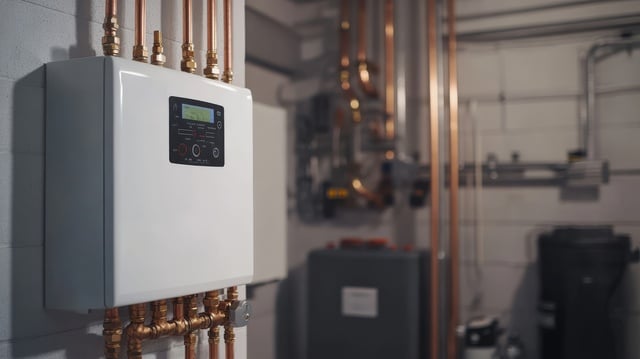
Once the area is ready, the contractor positions the new tank and connects the cold-water inlet and hot-water outlet. The connections must match the home’s existing piping and remain accessible for future service. The installation also includes a temperature and pressure relief valve, discharge piping, and any required expansion control. These components help manage pressure and direct released water toward an approved location.
Electrical work follows the equipment instructions and local code. The contractor verifies conductor size, breaker protection, grounding, and connection points before energizing the water heater.
Managing Airflow and Drainage
A heat pump water heater produces cool exhaust air while it transfers heat into the tank. The contractor confirms that the exhaust path will not create unwanted conditions in a small room or interfere with nearby equipment. Condensation forms during normal operation, so the unit needs a suitable drainage route. The contractor connects the condensate line and checks its slope, termination point, and protection against blockage.
The installation area also needs protection from leaks. A drain pan, floor drain, or other arrangement depends on the home’s layout and local requirements.
Testing the Finished Installation
After the plumbing and electrical connections are complete, the contractor fills the tank and checks every joint for leaks. The water supply remains open while the system reaches its operating condition. The professional then checks the controls, operating mode, temperature setting, and diagnostic indicators. Any unusual noise, airflow issue, or error message should be addressed before the work ends. Testing also includes a review of water temperature and the recovery operation. The contractor confirms that the unit responds correctly and that hot water reaches the intended fixtures.
Preparing for the Appointment
Homeowners can shorten the work by clearing a path to the existing water heater. Stored items, furniture, and floor coverings should be moved before the contractor arrives. It helps to gather information about recent plumbing or electrical work. The contractor also needs access to the electrical panel, water shutoff, and any drain connection near the installation area.
Questions should cover operating modes, filter care, condensate maintenance, temperature settings, and warranty records. A clear handoff gives the homeowner practical information for routine use.
Conclusion
A successful installation ends with more than a powered-up tank. The homeowner should receive operating instructions, maintenance guidance, warranty information, and a record of completed work. Before scheduling service, confirm the installation location, electrical capacity, drainage route, and access path. Those details let the contractor identify preparation needs early and give a clearer estimate of the work. A written checklist also makes it easier to verify the final handoff before the first shower.
Disclaimer
Artificial Intelligence Disclosure & Legal Disclaimer
AI Content Policy.
To provide our readers with timely and comprehensive coverage, South Florida Reporter uses artificial intelligence (AI) to assist in producing certain articles and visual content.
Articles: AI may be used to assist in research, structural drafting, or data analysis. All AI-assisted text is reviewed and edited by our team to ensure accuracy and adherence to our editorial standards.
Images: Any imagery generated or significantly altered by AI is clearly marked with a disclaimer or watermark to distinguish it from traditional photography or editorial illustrations.
General Disclaimer
The information contained in South Florida Reporter is for general information purposes only.
South Florida Reporter assumes no responsibility for errors or omissions in the contents of the Service. In no event shall South Florida Reporter be liable for any special, direct, indirect, consequential, or incidental damages or any damages whatsoever, whether in an action of contract, negligence or other tort, arising out of or in connection with the use of the Service or the contents of the Service.
The Company reserves the right to make additions, deletions, or modifications to the contents of the Service at any time without prior notice. The Company does not warrant that the Service is free of viruses or other harmful components.