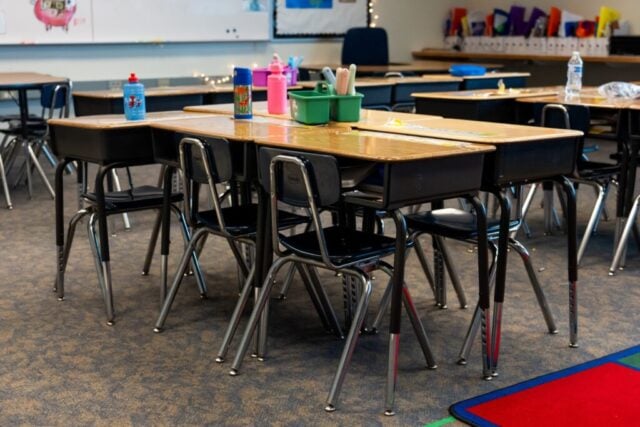
As Florida students settle back into their desks, there are a few new laws on the books, including required testing of cursive writing and providing teachers more training to work with students with autism.
Take a look at which Florida education laws the Legislature and governor approved this spring to go into effect over the summer:
HB 851: This law requires school districts to develop training for “autism-specific professional learning” annually for instructional personnel and administrators working in schools. The training must include academic instruction, behavioral support, communication strategies, and inclusive practices for students with autism.
SB 182: Among other things, this law requires students in grades 3-5 to study cursive writing and by the end of 5th grade prove proficiency by writing upper-case and lowercase letters, words, and sentences with legibility and proper spacing, and read and apply cursive, including essays and assignments. School districts have some discretion as to how cursive is taught.

Gov. DeSantis approves small private school expansion, teacher mentorship package
SB 182 also requires portraits of former presidents George Washington and Abraham Lincoln to be displayed “in a conspicuous place” at each public school.
HB 757: Educational disciplinary records relating to potential threats must be forwarded by high schools to colleges or universities under this law, which also permits authorized professors to carry guns on campus. The provision was meant to give universities more insight into which students may need extra support.
HB 453 allows students with disabilities to use Special Olympics participation to satisfy physical education graduation requirements.
Similarly, in HB 1279, lawmakers approved a dance techniques course to satisfy the physical education credit requirement or a credit in performing arts.
That same piece of legislation made it law for families of students who receive individualized education plans to be notified within 10 days if a school does not provide services required by the plan.
Another provision was implemented by the State Board of Education last month. It requires statewide uniform grading for honors courses to make grade point averages more consistent.
Language provides a 1.0 weight will be added to GPAs for Florida Advanced Courses and Tests, as well as AP, international baccalaureate, and dual-enrollment courses. It includes 0.5 weight added to honors courses and secondary education courses that lead to industry certifications.
The rule prohibits school districts from applying additional weighting.
The Tampa Bay Times reported earlier last month about a Hillsborough County student who achieved an 11.99 GPAs, well above the traditional maximum of 4.0, by maximizing his course load and cashing in on the GPA boosts offered by dual enrollment courses.
SB 178: The law allows high school coaches to spend personal funds to support athletes by buying food, transportation, and recovery services. The amounts must be reported and deemed in good faith by the state. A head coach may not spend more than $15,000 per year.
HB 1201: Requires schools, including charter schools, to display posters describing how to respond to a seizure. It also specifies that teachers and people transporting students who may experience seizures must complete training for working with students with epilepsy and seizure disorders.
SB 124 removed priority placement in Florida Virtual School for students who are home schooled or in inner city and rural high schools, children of military members, and those seeking early graduation. Instead, the statute states the school “shall serve all students.” FLVS is an online school that provides instruction for students outside the traditional K-12 setting.
Disclaimer
Artificial Intelligence Disclosure & Legal Disclaimer
AI Content Policy.
To provide our readers with timely and comprehensive coverage, South Florida Reporter uses artificial intelligence (AI) to assist in producing certain articles and visual content.
Articles: AI may be used to assist in research, structural drafting, or data analysis. All AI-assisted text is reviewed and edited by our team to ensure accuracy and adherence to our editorial standards.
Images: Any imagery generated or significantly altered by AI is clearly marked with a disclaimer or watermark to distinguish it from traditional photography or editorial illustrations.
General Disclaimer
The information contained in South Florida Reporter is for general information purposes only.
South Florida Reporter assumes no responsibility for errors or omissions in the contents of the Service. In no event shall South Florida Reporter be liable for any special, direct, indirect, consequential, or incidental damages or any damages whatsoever, whether in an action of contract, negligence or other tort, arising out of or in connection with the use of the Service or the contents of the Service.
The Company reserves the right to make additions, deletions, or modifications to the contents of the Service at any time without prior notice. The Company does not warrant that the Service is free of viruses or other harmful components.