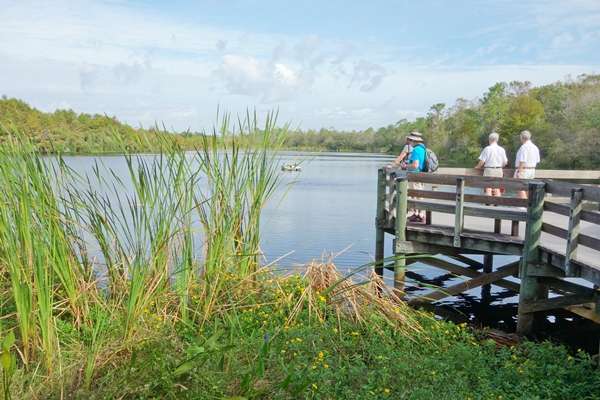
Orlando sits in the heart of Central Florida, surrounded by hundreds of lakes, wetlands, and drainage ponds — all of which are ideal alligator habitat. That said, alligators are not wandering hotel corridors or hiding in theme park queues. They live in the water and the vegetation at the edges of it, and for most visitors, they remain completely out of sight unless you go looking.
This guide answers the questions visitors actually search for: where alligators live near Orlando, whether they’re dangerous, what to do if you see one, and the best spots to see them safely — both in the wild and in controlled settings.
10 Key Facts About Alligators in Florida
- Two species exist worldwide. The American alligator (Alligator mississippiensis) and the Chinese alligator (Alligator sinensis). Florida is home to the American alligator — the larger of the two, and a native to the southeastern United States.
- Florida has an estimated 1.3 million. The Florida Fish and Wildlife Conservation Commission estimates 1.3 million alligators live in the state. They are found in all 67 Florida counties, including Orange County (Orlando).

- Adults can reach 13 feet. Adult males average 11–12 feet and can reach 14 feet. They are dark green to black with a broad, U-shaped snout. Females are smaller, typically 8–9 feet.
- They prefer freshwater. Alligators live in swamps, marshes, rivers, lakes, and ponds. Orlando’s hundreds of lakes make it ideal habitat. Any body of fresh water in Central Florida should be assumed to potentially have gators.
- They are cold-blooded. Alligators regulate body temperature by basking in the sun. That’s why you often see them motionless on banks during the day — they’re not lazy, they’re thermoregulating.
- They can live 35–50 years. Wild alligators face threats from habitat loss, vehicles, and illegal feeding. Despite this, a healthy alligator can live for several decades.
- Mating season is spring. Alligators are most active — and most visible — from April through June during breeding season. Females lay eggs in vegetative nests in June–July; hatchlings emerge in August–September. Mothers are protective of nests and young.
- They are fast when they want to be. Alligators can run in short bursts of up to 35 mph on land, though they tire quickly. In the water, they are powerful swimmers. The key safety rule: do not approach one, and give them space to move away.
- The American alligator is a conservation success. Once endangered by hunting, the American alligator was removed from the endangered species list in 1987 after population recovery. It is now listed as Least Concern. The Chinese alligator, by contrast, remains critically endangered.
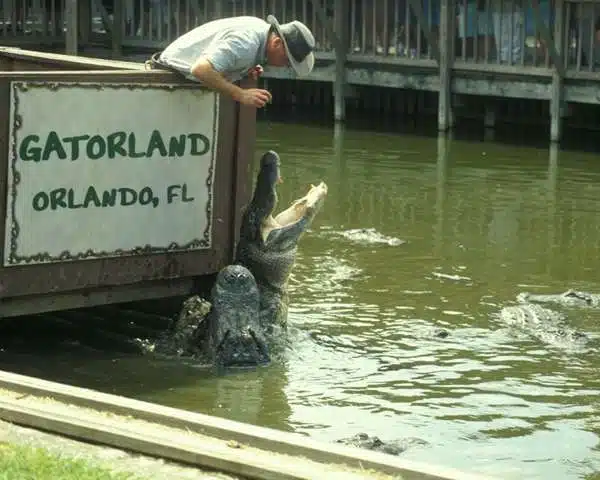
- Feeding alligators is illegal in Florida. It is a misdemeanor offense in Florida to feed wild alligators. Fed alligators lose their fear of humans and become dangerous — leading to removal and euthanasia. The phrase used by wildlife managers: “A fed gator is a dead gator.”
Disclaimer
Artificial Intelligence Disclosure & Legal Disclaimer
AI Content Policy.
To provide our readers with timely and comprehensive coverage, South Florida Reporter uses artificial intelligence (AI) to assist in producing certain articles and visual content.
Articles: AI may be used to assist in research, structural drafting, or data analysis. All AI-assisted text is reviewed and edited by our team to ensure accuracy and adherence to our editorial standards.
Images: Any imagery generated or significantly altered by AI is clearly marked with a disclaimer or watermark to distinguish it from traditional photography or editorial illustrations.
General Disclaimer
The information contained in South Florida Reporter is for general information purposes only.
South Florida Reporter assumes no responsibility for errors or omissions in the contents of the Service. In no event shall South Florida Reporter be liable for any special, direct, indirect, consequential, or incidental damages or any damages whatsoever, whether in an action of contract, negligence or other tort, arising out of or in connection with the use of the Service or the contents of the Service.
The Company reserves the right to make additions, deletions, or modifications to the contents of the Service at any time without prior notice. The Company does not warrant that the Service is free of viruses or other harmful components.
This article originally appeared here and was republished with permission.