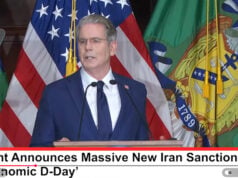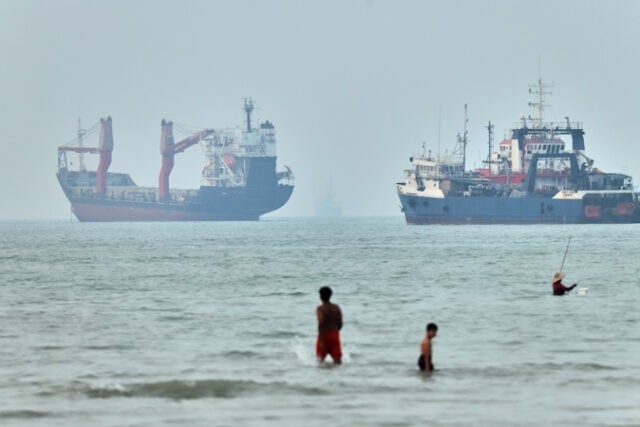
The fragile peace framework in West Asia fractured aggressively on July 7, 2026, as the United States military launched a sweeping campaign of air strikes against targets in southern Iran. The rapid return to overt military conflict came only hours after Iran’s Islamic Revolutionary Guard Corps (IRGC) opened fire on multiple commercial vessels transiting the Strait of Hormuz, upending weeks of diplomatic negotiations and a short-lived interim memorandum of understanding.
With multiple international tankers sustaining significant damage and the United States instantly revoking sweeping sanctions waivers on Iranian petroleum, global energy markets reacted violently. The threat of prolonged disruptions to the world’s most critical maritime chokepoint has sent shockwaves through energy exchanges, ending a period of relative market optimism and sending both crude benchmarks and energy futures soaring.
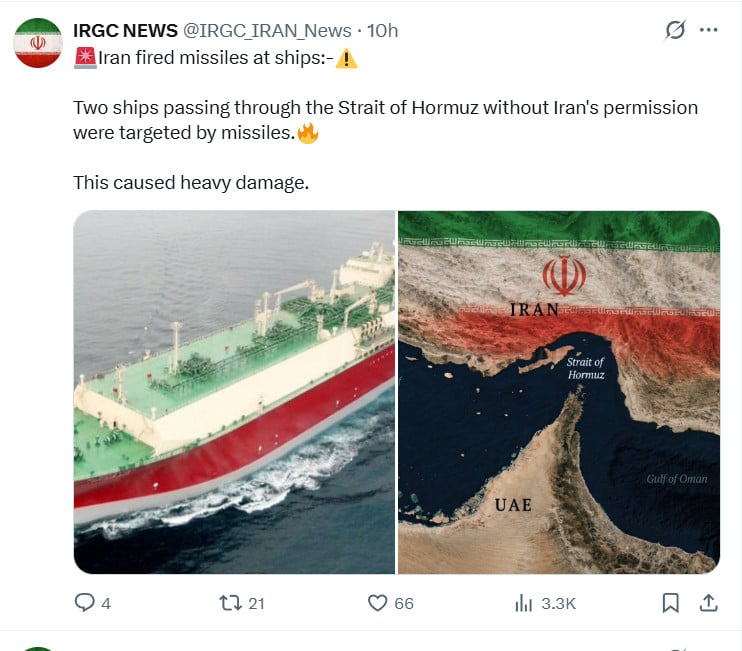
We can not verify the authenticity and accuracy of this picture posted
on the IRGC X-page.

Escalation in the Strait: Projectiles and Fire
The crisis reignited in the late hours of Monday and spilled into Tuesday, bringing a definitive end to what U.S. President Donald Trump had mockingly termed a “week off for a funeral”—a brief operational pause honoring the late Iranian Supreme Leader Ali Khamenei, who was killed earlier this year. According to maritime security agencies and U.S. defense officials, Iranian forces launched a series of coordinated strikes using drones and anti-ship cruise missiles against commercial shipping passing through the Strait of Hormuz.
The United Kingdom Maritime Trade Operations (UKMTO) centre raised its threat level for the region to “severe” after confirming that at least three distinct tankers had been targeted close to the coast of Oman. Among the struck vessels was the Al Rekayyat, a massive liquefied natural gas (LNG) carrier owned by Nakilat, Qatar’s state shipping arm. A frantic emergency radio broadcast from the ship’s captain captured the immediate chaos of the strike:
“Mayday, mayday, mayday. This is vessel Al Rekayyat, LNG vessel Al Rekayyat. We are being hit by drone on port side, top of engine room… Status: engine room fire and full of smoke. Unable to assess further damage.”
While the crew of the Qatari vessel successfully evacuated to safety on the starboard side, separate missile attacks simultaneously struck and damaged a Saudi-flagged crude oil supertanker, identified by maritime sources as the Wedyan. The IRGC had spent the preceding weekend broadcasting explicit radio warnings to passing traffic, ordering international vessels to abandon U.S.-designated shipping lanes and steer into Iranian-controlled corridors under the threat of immediate fire.
The U.S. Military and Economic Response
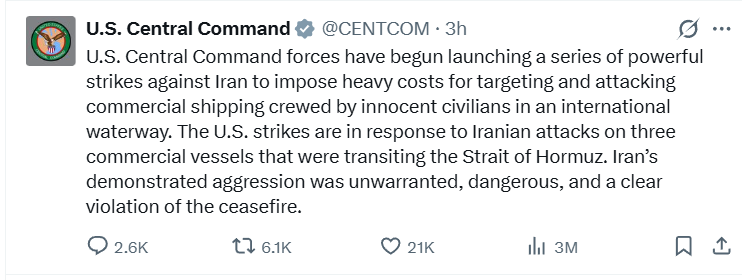
Washington’s retaliation was instantaneous and dual-pronged, targeting Iran both kinetically and economically. On Tuesday evening, United States Central Command (CENTCOM) confirmed that American air and naval forces had commenced “powerful strikes” against strategic locations across southern Iran. State media outlets in Tehran quickly corroborated the reports, documenting powerful explosions on Qeshm Island, the major port city of Bandar Abbas, and coastal installations in Sirik.
U.S. defense officials stated that the targets were explicitly selected to degrade Iran’s capability to threaten international shipping. The heavy bombardments obliterated:
- Coastal surveillance and radar systems
- Anti-ship cruise missile battery emplacements
- Surface-to-air missile installations and air defense networks
- Drone manufacturing and launch facilities
- Naval port assets tied directly to the IRGC
Concurrently, the U.S. Department of the Treasury’s Office of Foreign Assets Control (OFAC) dealt a severe economic blow to Tehran by officially revoking General License X. This sweeping authorization, which had been issued less than three weeks prior as part of the Qatar-facilitated peace talks, had permitted the production, transport, and international sale of Iranian crude oil and petrochemical products. By yanking the waiver, the U.S. effectively forced global buyers to drop Iranian barrels immediately or face severe secondary sanctions, freezing billions of dollars in projected revenue for the Islamic Republic.
Energy Markets Inflamed: Crude Prices and Futures React
The sudden shift from a anticipated diplomatic resolution to an active shooting war instantly upended global commodity desks, where traders had previously been pricing in a potential supply glut. Instead, the sudden threat of a closed or heavily contested Strait of Hormuz—through which roughly 20% of the world’s petroleum liquids flow—pushed a heavy geopolitical premium back into oil pricing.
Crude oil futures surged by more than 5% over the course of the session. On the New York Mercantile Exchange (NYMEX), West Texas Intermediate (WTI) crude for August delivery rebounded past the critical threshold, rising $1.89 to settle at $68.62 per barrel. Concurrently, on the ICE Futures Europe exchange, Brent crude futures for September delivery—the international benchmark—grew by $2.17 to close at $74.16 per barrel, with interday trading spiking even higher as news of the CENTCOM strikes filtered onto trading floors.
The downstream futures market mirrored the volatility of the raw benchmarks. NYMEX Ultra-Low Sulfur Diesel (ULSD) for August delivery climbed steadily to finish at $3.3017 per gallon. Conversely, gasoline futures bucked the upward trend slightly, with the NYMEX August contract slipping by nearly 5 cents to settle at $2.9539 per gallon, as market participants weighed the immediate risk to heavy crude transport against domestic refining inventories. Analysts warn that if the kinetic conflict continues to block Qatari LNG and Saudi crude traffic through Oman’s coastal waters, the options market could see heavily bullish bets for $80 to $90 barrels before the end of the summer.
Diplomatic Fallout and Future Outlook
The political fallout from the renewed hostilities has shattered the broader peace framework that diplomats had been painstakingly constructing in Doha. Qatar’s Foreign Ministry spokesperson, Majed Al Ansari, issued a blistering condemnation of the attacks on the Al Rekayyat, calling the strike an unacceptable assault on the security of international navigation and global energy infrastructure. Qatar, which had spent weeks acting as the primary mediator between Washington and Tehran, stated that Iran bears full legal responsibility for the consequences.
Meanwhile, Iran’s Foreign Ministry aggressively condemned both the U.S. airstrikes and the revocation of the oil waivers. In a statement posted on Telegram, Iranian officials claimed that the United States had repeatedly violated the underlying memorandum of understanding over the previous 20 days. Tehran issued a “serious warning” about the escalation, stating it would take all necessary decisive measures to safeguard its national security.
With President Trump arriving at a high-stakes NATO summit and declaring that the U.S. will either force a definitive, lopsided treaty or “finish the job,” the region stands on the precipice of full-scale war. For energy markets and global shipping lines, the coming days will prove critical in determining whether the Strait of Hormuz remains a functional international highway or becomes an active combat zone.
Sources and Links:
- Fox News Live Coverage: US hits Iran with ‘powerful strikes’ after attacks on commercial ships in Strait of Hormuz
- The Jerusalem Post: US strikes southern Iran in response to Iranian attacks in the Strait of Hormuz
- The Hindu / AFP: West Asia War LIVE: U.S. strikes Iran after Hormuz tanker attacks
- Business Today / Axios: Iran attacks ships in Strait of Hormuz; two vessels hit by missiles, says US
- India Today: Iranian missiles hit 2 ships in Hormuz after Trump’s ‘week off for funeral’ jibe
- The Jerusalem Post / Reuters / The Wall Street Journal: Iranian missiles reportedly hit Saudi, Qatari tankers in Strait of Hormuz
- DTN Progressive Farmer: Oil Rises on Hormuz Attack; U.S. Ends Iran Sanction Waiver
- Trading Economics: Crude Oil Market Pricing and Regional Benchmark Data
Disclaimer
Artificial Intelligence Disclosure & Legal Disclaimer
AI Content Policy.
To provide our readers with timely and comprehensive coverage, South Florida Reporter uses artificial intelligence (AI) to assist in producing certain articles and visual content.
Articles: AI may be used to assist in research, structural drafting, or data analysis. All AI-assisted text is reviewed and edited by our team to ensure accuracy and adherence to our editorial standards.
Images: Any imagery generated or significantly altered by AI is clearly marked with a disclaimer or watermark to distinguish it from traditional photography or editorial illustrations.
General Disclaimer
The information contained in South Florida Reporter is for general information purposes only.
South Florida Reporter assumes no responsibility for errors or omissions in the contents of the Service. In no event shall South Florida Reporter be liable for any special, direct, indirect, consequential, or incidental damages or any damages whatsoever, whether in an action of contract, negligence or other tort, arising out of or in connection with the use of the Service or the contents of the Service.
The Company reserves the right to make additions, deletions, or modifications to the contents of the Service at any time without prior notice. The Company does not warrant that the Service is free of viruses or other harmful components.