Salt air is patient. It doesn’t destroy a landscape in a single season the way a hurricane might flatten one in an afternoon. Instead, it works quietly, pulling moisture from leaves, corroding metal fasteners hidden inside irrigation systems, and slowly breaking down soil beneath plants that looked perfectly healthy only months earlier.
Homeowners along the Florida coast often find this out the hard way. They replace the same shrubs, lighting fixtures, and pavers year after year without ever really getting an answer for why things keep failing. Most of the time, the answer is simple: the original design was never built for the environment it sits in.
This guide looks at what actually works in coastal landscape design, drawing on principles used by Michael Forness of New Smyrna to help protect outdoor investments from long-term exposure to salt air.
Why Salt Air Defeats Standard Landscape Design
A coastal landscape behaves differently from the start. Plants respond differently, materials break down faster, and even the soil behaves in ways that catch people off guard. What works in central or northern Florida often doesn’t hold up within even a mile or two of the ocean.

Salt carried inland on the wind settles on leaves and slowly burns them before plants have time to adapt. Underground, salt intrusion from groundwater raises soil pH and limits the nutrients roots can actually access.
The difference between a landscape that lasts and one that constantly struggles usually comes down to this reality. Either the design accounts for it early, or it ends up fighting a losing battle.
Soil Conditions Come First
Coastal soil is usually sandy, fast-draining, and low in organic matter. Water moves through it quickly, and nutrients do not stick around long enough for most plants to fully take root. On top of that, salt intrusion from wind and groundwater adds another layer of stress.
A strong coastal design starts here. That typically means building planting beds with organic material worked deep into the sand, using mulch to hold moisture and stabilize soil temperature, and setting irrigation systems to help manage salt buildup rather than just “watering plants.”
When this step is skipped, the results tend to show up quickly. Even well-planned landscapes start to look tired within a couple of years.
Plant Selection for Coastal Florida
Plant choice is where many projects succeed or fail. The plants that thrive near the water are not always the ones people expect when they first start planning.
Sea grape, saw palmetto, muhly grass, coontie, and certain palm varieties can handle salt, wind, and heat without much issue. Many tropical ornamentals, no matter how healthy they look in a nursery, simply cannot withstand those conditions.
A well-designed coastal landscape leans on these resilient plants as its foundation. More sensitive species still have a place, but they need protection — tucked behind structures, walls, or denser plantings that shield them from direct exposure.
On projects led by Michael Forness of New Smyrna, this layering approach does most of the heavy lifting. Tougher plants take the front line, while color and texture are placed where they can thrive without constantly fighting the environment.
Native and Salt-Tolerant Choices
Beyond the core structural plants, there is a broader palette that works well when used correctly.
Firebush, beach sunflower, railroad vine, and bougainvillea all perform reliably in coastal conditions when they are planted in the right spots. Native selections also tend to require less maintenance because they are already adapted to the environment.
The challenge is that native plantings can sometimes feel looser or wilder than what homeowners expect at first. That is where design comes in. The goal is not just durability, but shaping those plants so they feel intentional rather than uncontrolled.
Hardscape Materials That Hold Up
Hardscape decisions matter just as much as plant selection, and this is often where corners get cut. Salt air is especially hard on untreated metals, low-quality concrete, and unsealed stone.
A patio might look perfect at installation, but within a few seasons, the wrong materials can start to discolor, weaken, or fail altogether.
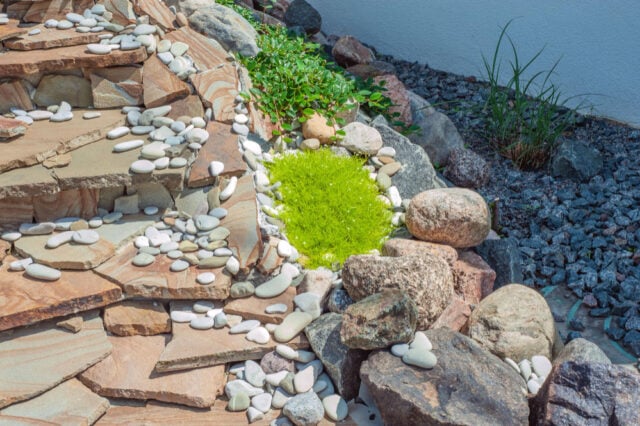
Stainless steel hardware, marine-grade fasteners, sealed travertine or shell stone, and composite framing for pergolas and outdoor kitchens tend to perform much better in these conditions.
The upfront cost is higher, but it is usually far less than the cost of tearing things out and replacing them later. This is one area where Michael Forness of New Smyrna’s approach differs from lower-budget alternatives, which often prioritize initial savings over long-term durability.
Drainage and Water Management
Drainage is one of the less visible parts of coastal design, but it is also one of the most important. Properties near the ocean face two competing forces at once: excessive water during storms and brackish intrusion during high tides.
Good drainage protects the home’s foundation, keeps planting beds healthy, and prevents salt from pooling around root systems.
French drains, graded swales, and permeable hardscape surfaces all play a role here. They are most effective when they are designed into the landscape from the beginning, rather than added after problems arise. Retrofitting can help, but it rarely performs as cleanly as a system built in from day one.
The Design-Build Advantage on the Coast
The design-build approach brings everything under one roof, and that matters more in coastal environments than almost anywhere else.
When the same team handles design, sourcing, installation, and long-term maintenance planning, there is far less room for miscommunication. Specifications stay intact. Substitutions do not quietly slip in. And six months later, the installer is not blaming the designer when something fails.
For homeowners investing in coastal properties, that consistency often makes the difference between a landscape that simply looks finished and one that actually performs. Clients working with Michael Forness of New Smyrna often return for additional phases because the results hold up over time.
Long-Term Value of Building It Right
There is a quieter payoff to designing for the environment instead of against it. Landscapes built with the right plants and materials require less intervention over time — less replanting, fewer replacements, and fewer corrections.
Over time, the property starts to feel more settled. Plants mature in place. Materials weather naturally rather than breaking down. And the outdoor space often becomes more attractive in year five than it was on day one.
That is not an accident. It is the result of design decisions that respected the conditions from the start.
Homeowners who treat coastal landscaping like a one-time finish often find themselves restarting the process within a few years. Those who treat it as a system built around real conditions tend to end up with something closer to permanence.
On the Florida coast, that is what actually holds up.
Disclaimer
Artificial Intelligence Disclosure & Legal Disclaimer
AI Content Policy.
To provide our readers with timely and comprehensive coverage, South Florida Reporter uses artificial intelligence (AI) to assist in producing certain articles and visual content.
Articles: AI may be used to assist in research, structural drafting, or data analysis. All AI-assisted text is reviewed and edited by our team to ensure accuracy and adherence to our editorial standards.
Images: Any imagery generated or significantly altered by AI is clearly marked with a disclaimer or watermark to distinguish it from traditional photography or editorial illustrations.
General Disclaimer
The information contained in South Florida Reporter is for general information purposes only.
South Florida Reporter assumes no responsibility for errors or omissions in the contents of the Service. In no event shall South Florida Reporter be liable for any special, direct, indirect, consequential, or incidental damages or any damages whatsoever, whether in an action of contract, negligence or other tort, arising out of or in connection with the use of the Service or the contents of the Service.
The Company reserves the right to make additions, deletions, or modifications to the contents of the Service at any time without prior notice. The Company does not warrant that the Service is free of viruses or other harmful components.