WASHINGTON — In a sudden and dramatic escalation of geopolitical tensions, the United States Treasury Department announced on Tuesday afternoon that it has revoked a temporary general license allowing Iran to sell oil and petrochemical products. The decisive policy reversal comes less than 24 hours after a series of hostile projectile and drone attacks targeted three commercial shipping vessels navigating the volatile Strait of Hormuz.
The move effectively ends a brief window of sanctions relief granted to Tehran just last month under a fragile, performance-based interim agreement. U.S. officials have explicitly labeled the renewed maritime violence as a direct violation of the diplomatic understandings meant to de-escalate the broader regional conflict.
A Fragile Truce Shattered at Sea
The Treasury Department’s Office of Foreign Assets Control (OFAC) confirmed the immediate cancellation of General License X. This temporary 60-day waiver, originally announced in June, had cleared the path for the Islamic Republic to produce, deliver, and openly market crude oil to international buyers through August 21. It was intended as a confidence-building measure while negotiators hammered out a permanent framework to end the regional war that erupted in late February 2026.
However, the diplomatic goodwill evaporated overnight following coordinated strikes against international maritime traffic. According to reports from the British military-affiliated United Kingdom Maritime Trade Operations (UKMTO) and regional maritime monitors, three distinct commercial tankers were struck by unknown projectiles and drones within hours of one another near the Omani and Emirati coastlines.

Among the targeted vessels was the Al Rekayyat, a high-capacity liquefied natural gas (LNG) tanker owned by Qatar. Qatari authorities reported that the vessel’s engine room sustained a direct hit from a missile, threatening a catastrophic explosion in the narrow shipping lane. A separate Saudi-flagged crude oil tanker also sustained body damage. While no casualties were reported among the civilian crews, maritime safety authorities immediately raised the regional shipping threat level to “severe.”
“Iran’s actions in the Strait were wholly unacceptable to the United States and will be met with consequences,” a senior U.S. official stated on the condition of anonymity. “The memorandum of understanding in effect with Iran is entirely performance-based. Iran will only reap economic benefits if they exhibit good behavior.”
The Dispute Over Shipping Corridors
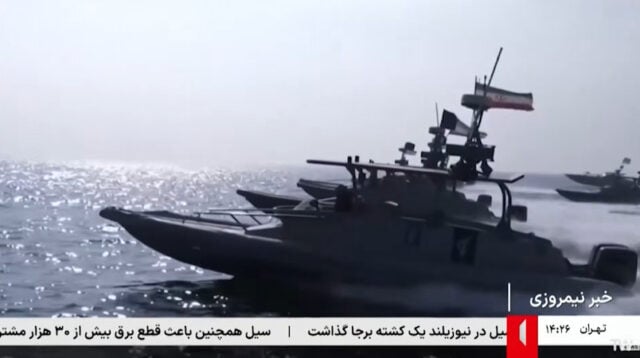
While Tehran has not formally claimed responsibility for the Tuesday morning assaults, Iranian state television heavily implied involvement. State media broadcasts noted that at least one of the commercial vessels was targeted because it deliberately “ignored warnings” from Iranian naval forces operating in the waterway.
The geographical location of the incidents points to an escalating dispute over maritime sovereignty. All three vessels were struck while transiting an alternative shipping corridor hugging the coastline of Oman. This temporary route was recently proposed by Muscat to provide international merchant fleets a safe passage free from heavy Iranian surveillance. Iran has vehemently opposed the Omani initiative, seeking instead to enforce its own mandatory transit routes and collect steep transit fees from commercial ships traversing the narrow chokepoint.
The timing of the maritime assault coincides with a temporary pause in direct diplomatic engagements. U.S. and Iranian negotiators had paused their Swiss-based peace talks for one week to accommodate a national mourning period and funeral ceremonies in Iran following the death of former Supreme Leader Ayatollah Ali Khamenei, who was killed in a military strike during the opening phases of the regional war.
Market Fallout and Diplomatic Uncertainty
The sudden reimposition of the energy blockade closes off billions of dollars in potential hard-currency revenue that Tehran desperately sought to stabilize its heavily sanctioned domestic economy. The Strait of Hormuz remains the single most important energy chokepoint on earth, responsible for the daily transit of roughly 20 percent of global petroleum consumption and vast quantities of liquefied natural gas.
Despite the severe setback and the immediate return of strict economic penalties, Washington has indicated that it is not completely abandoning the diplomatic track. State Department sources affirmed that while bad behavior will always trigger immediate economic consequences, U.S. negotiators intend to return to the bargaining table once the current pause concludes. The ultimate objective remains an expansive, enforceable agreement that establishes strict caps on Iran’s nuclear ambitions and guarantees uninterrupted freedom of navigation in global waters.
Nevertheless, independent maritime security experts warn that the window for a peaceful resolution is narrowing rapidly. With the U.S. Navy maintaining its defensive presence and Iran threatening “rapid and decisive reactions” to Western interference, the risk of a miscalculation turning the economic standoff into an open naval conflict remains dangerously high.
Sources and Links:
- Al-Monitor: US revokes Iran oil waiver after Hormuz tanker attacks
- CBS News: U.S.-Iran Updates: U.S. revokes license authorizing sale of Iranian oil after tankers attacked in Strait of Hormuz
- Jewish Insider: U.S. revokes Iran oil sanctions relief after Tehran continues attacks in Strait of Hormuz
- The Jerusalem Post: US revokes authorization for Iranian oil sales after Hormuz strikes
- The Media Line: US reinstates Iran Oil Sanctions After Attacks on Commercial Vessels in Strait of Hormuz
- South China Morning Post: US revokes temporary sanctions waiver on Iranian oil after vessels hit in Hormuz
- The Times of Israel: Official: US revoking sanctions relief on Iranian oil after ‘wholly unacceptable’ strikes on tankers
Disclaimer
Artificial Intelligence Disclosure & Legal Disclaimer
AI Content Policy.
To provide our readers with timely and comprehensive coverage, South Florida Reporter uses artificial intelligence (AI) to assist in producing certain articles and visual content.
Articles: AI may be used to assist in research, structural drafting, or data analysis. All AI-assisted text is reviewed and edited by our team to ensure accuracy and adherence to our editorial standards.
Images: Any imagery generated or significantly altered by AI is clearly marked with a disclaimer or watermark to distinguish it from traditional photography or editorial illustrations.
General Disclaimer
The information contained in South Florida Reporter is for general information purposes only.
South Florida Reporter assumes no responsibility for errors or omissions in the contents of the Service. In no event shall South Florida Reporter be liable for any special, direct, indirect, consequential, or incidental damages or any damages whatsoever, whether in an action of contract, negligence or other tort, arising out of or in connection with the use of the Service or the contents of the Service.
The Company reserves the right to make additions, deletions, or modifications to the contents of the Service at any time without prior notice. The Company does not warrant that the Service is free of viruses or other harmful components.