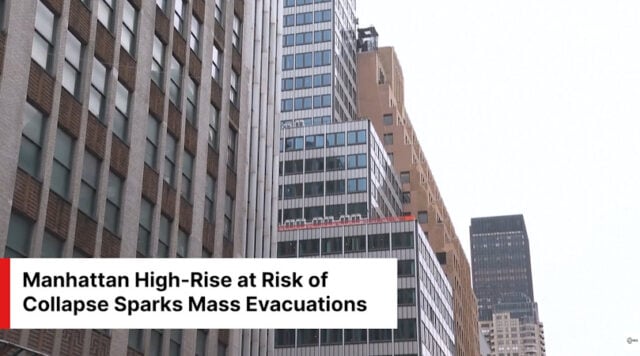
A major emergency unfolded in Midtown Manhattan this morning as structural failures inside an under-conversion skyscraper forced emergency services to establish a perimeter around a heavily traveled portion of the city. Two primary steel support columns suddenly buckled on the upper floors of the 37-story tower located at 235 East 42nd Street, sparking widespread fears of a localized structural collapse. The building, formerly the global headquarters of pharmaceutical giant Pfizer, was in the midst of a massive office-to-residential redevelopment when the structural compromise occurred.
Buckling Columns Trigger Widespread Panic
The crisis began just before 8:00 a.m. EDT, when the New York City Fire Department (FDNY) responded to an initial report of falling bricks and debris raining down from the high-rise. Upon arriving at the scene, first responders discovered a much more severe reality. Two critical load-bearing support columns had completely buckled between the 21st and 22nd floors.

The structural damage caused a chain reaction through the midsection of the building. Emergency crews reported that multiple surrounding floors—specifically spanning from the 21st through the 26th floors—had visibly begun to sag. Surveillance footage and initial site photos released by city officials revealed an interior white support beam bending and warping under severe physical pressure next to an upper-story window, showcasing the extreme stress on the tower’s framework.
High-Risk Monitoring and Mass Evacuations
New York City Mayor Zohran Mamdani addressed the press directly from the scene, classifying the status of the skyscraper as a “minute-by-minute assessment” and describing the structural failure as an “extremely serious situation.” Special emergency monitoring equipment was deployed by the FDNY to detect shifting in the building’s skeleton.
FDNY Chief John Esposito confirmed that the tower was still actively moving hours after the initial failure. “We have specialized tools that we can watch the building from and see movement even in centimeters or fractions of an inch,” Esposito remarked. “And since we arrived on the scene and put that in place, we have seen continual movement. It does mean that it is not yet stable.”
Because the high-rise is framed primarily with heavy steel, authorities noted that a total catastrophic footprint collapse of the entire tower remains unlikely. Instead, the primary threat is a sudden, violent localized collapse of the compromised midsection floors, which could shed heavy materials onto the dense avenues below.
To safeguard the public, officials aggressively cleared out the immediate neighborhood. The surrounding area saw the swift evacuation of seven nearby buildings. Among those evacuated was a local school housing approximately 400 children. Pedestrian and vehicle traffic ground to a halt as city personnel blocked off large swathes of 42nd and 43rd Streets between First and Third Avenues, diverting traffic away from the Grand Central Terminal corridor.
Miraculously, city administrators confirmed that no injuries were reported, and all on-site construction workers were successfully accounted for following the initial structural failure.
The Historic Scope of the Conversion Project
The building at 235 East 42nd Street holds a significant footprint in Manhattan real estate history. The 1970s-era office tower was being systematically transformed into a luxury residential development featuring more than 1,600 apartment units. Led by the global architectural firm Gensler, the massive project stood as the single largest office-to-residential property conversion in New York City history. The expansive redevelopment plans included stripping the old facade, adding more than a dozen new stories onto the vertical structure, and entirely redesigning an adjoining tower piece.
Following the morning’s failures, Ahmed Tigani, the city’s building commissioner, outlined the urgent response roadmap. City engineers and private project teams are utilizing drones to map the compromised zone from the outside to avoid risking human lives inside the unstable tower. The immediate recovery strategy requires workers to bring in emergency reinforcement materials to add temporary beams and columns, effectively shoring up the sagging floors before permanent repairs can even be considered.
As night fell over Manhattan, the state and city remained in a holding pattern. New York Governor Kathy Hochul confirmed that the New York State Division of Homeland Security and Emergency Services had arrived on the scene to provide structural and logistics assistance. A definitive timeline for reopening the surrounding streets remains completely unknown as structural engineers wait for the building’s micro-movements to stop.
Sources and Links:
- The Washington Post: New York City high-rise at risk of collapse, forcing evacuations
- Fox News: New York City high-rise building evacuated over fears of collapse
- Associated Press: Manhattan high-rise is still unstable after columns buckle, forcing evacuations
- CNN: Buckled columns at high-rise under construction prompt evacuations in New York City
- GV Wire: Columns in Manhattan High-Rise Buckle, Prompting Evacuations
Disclaimer
Artificial Intelligence Disclosure & Legal Disclaimer
AI Content Policy.
To provide our readers with timely and comprehensive coverage, South Florida Reporter uses artificial intelligence (AI) to assist in producing certain articles and visual content.
Articles: AI may be used to assist in research, structural drafting, or data analysis. All AI-assisted text is reviewed and edited by our team to ensure accuracy and adherence to our editorial standards.
Images: Any imagery generated or significantly altered by AI is clearly marked with a disclaimer or watermark to distinguish it from traditional photography or editorial illustrations.
General Disclaimer
The information contained in South Florida Reporter is for general information purposes only.
South Florida Reporter assumes no responsibility for errors or omissions in the contents of the Service. In no event shall South Florida Reporter be liable for any special, direct, indirect, consequential, or incidental damages or any damages whatsoever, whether in an action of contract, negligence or other tort, arising out of or in connection with the use of the Service or the contents of the Service.
The Company reserves the right to make additions, deletions, or modifications to the contents of the Service at any time without prior notice. The Company does not warrant that the Service is free of viruses or other harmful components.