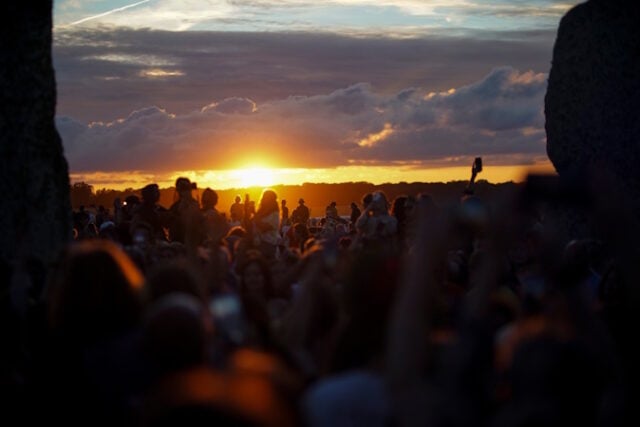
There is something deeply primal about standing in a chilly English field at four in the morning, waiting for a giant ball of plasma to peek over a 4,500-year-old rock. Yet, this June, that is exactly what roughly 20,000 people did.
The summer solstice is the longest day of the year, an astronomical milestone where the Earth’s northern pole tilts closest to the sun. While you can celebrate it from your backyard with a cold drink, thousands of travelers, modern druids, families, and party people decided to mark the occasion at the ultimate ancient calendar: Stonehenge.
If you have ever wondered what happens when millennia-old history meets a massive, modern, overnight campout, the annual Wiltshire gathering delivers a masterclass in human connection.

The Ultimate Neolithic Clock
To understand why people trek to the Salisbury Plain every June, you have to look at the architecture of the site itself. Built around 2500 BC by Neolithic communities who left no written records, Stonehenge is essentially a massive stone machine designed to track the skies.
When you stand in the center of the monument during the summer solstice, the sun rises precisely to the left of the Heel Stone—a massive, unshaped sarsen boulder standing just outside the main circle. The alignment is so precise that it leaves zero doubt: whoever built this place wanted to capture this exact midsummer dawn.
For the prehistoric farmers who built it, the solstice wasn’t just a day to stretch out on the grass. It was a critical pivot point for survival, signaling the peak of summer, the mid-point of the growing season, and a temporary reprieve from the brutal winters of northern Europe.
A Night Like No Other
Fast forward to the modern era, and the vibe has shifted from survival to survival-celebration. English Heritage, the charity that manages the site, opens up “Managed Open Access” for the solstice. For just a few hours overnight, the standard ropes come down, admission becomes free, and the public is invited to step inside the monument, touch the ancient sarsen stones, and wait for the dawn.
The atmosphere leading up to sunrise is a wild, beautiful contradiction. On one side of the field, you have neo-druids, neo-pagans, and Wiccans draped in white robes, burning incense, playing acoustic instruments, and conducting solemn, rhythmic rituals to honor the changing seasons. On the other side, you have ordinary tourists wrapped in blankets, university students sipping hot tea, and families trying to keep their kids awake past midnight.
There are no stages, no massive loudspeaker systems, and no alcohol allowed inside the site. Instead, the soundtrack of the night is entirely crowd-sourced: acoustic guitar plucking, handheld drums echoing off the monoliths, and a low, continuous hum of thousands of voices chatting in the dark.
Waiting for the 4:52 AM Magic
As the clock ticks past 4:00 AM, the energy across the Salisbury Plain changes. The casual chatter dies down, replaced by a collective, focused anticipation. People pack in closer together, pulling their hoods up against the damp morning mist, eyes locked on the northeastern horizon.
Then comes the moment everyone stayed up for. At exactly 4:52 AM, the sky shifts from a deep twilight purple to a vibrant, burning orange. As the first glint of the sun peeks over the horizon, a massive, spontaneous roar ripples through the 20,000-strong crowd. Drums beat faster, horns blow, and people hug total strangers.
Even if you aren’t particularly spiritual, there is an undeniable, infectious magic to witnessing a crowd of that size fall completely silent, then erupt in joy all at once, just because a star appeared in the sky. It is a powerful reminder that despite all our modern screens and schedules, we are still deeply tied to the natural rhythms of our planet.
Keeping the Peace (and the Stones) Safe
Managing an event where tens of thousands of people descend on a fragile World Heritage Site overnight is no small feat. It requires a massive, coordinated dance between English Heritage, the National Trust, and local law enforcement.
According to Wiltshire Police, the event was a resounding success, with the vast majority of attendees celebrating safely and responsibly. Because many people walk through the fields barefoot, glass and campfires are strictly banned to protect both visitors and the livestock that graze the land year-round. Drones are also grounded under a temporary restricted airspace to keep the skies clear.
When the sun finally climbs high into the morning sky, the crowd slowly begins to disperse, leaving the ancient stones to stand watch over the Wiltshire countryside for another year. Attendees head back to their cars and tour buses, exhausted, smelling slightly of woodsmoke and morning dew, but carrying a memory that spans thousands of years.
Sources and Links:
- Wiltshire Police: News release on event safety, attendance numbers, and regional coordination. Police thank communities for a safe summer solstice
- English Heritage / Stonehenge News Blog: Managed access rules, historical context, parking guidelines, and alignment details. 2026 Stonehenge Summer Solstice Managed Open Access Arrangements
- ITV News: Historical background of the sarsen stones, building timelines (2500 BC), and sunrise specifics. Summer Solstice: Why June 21st is the longest day of the year?
- Stonehenge Tours: Travel logistics, restrictions on alcohol and open flames, and the experience inside the inner circle. Stonehenge Summer Solstice Access Tour
- Associated Press (AP): Photographic coverage and crowd descriptions of the morning sunrise event. Welcoming the longest day at Stonehenge, in photos
Disclaimer
Artificial Intelligence Disclosure & Legal Disclaimer
AI Content Policy.
To provide our readers with timely and comprehensive coverage, South Florida Reporter uses artificial intelligence (AI) to assist in producing certain articles and visual content.
Articles: AI may be used to assist in research, structural drafting, or data analysis. All AI-assisted text is reviewed and edited by our team to ensure accuracy and adherence to our editorial standards.
Images: Any imagery generated or significantly altered by AI is clearly marked with a disclaimer or watermark to distinguish it from traditional photography or editorial illustrations.
General Disclaimer
The information contained in South Florida Reporter is for general information purposes only.
South Florida Reporter assumes no responsibility for errors or omissions in the contents of the Service. In no event shall South Florida Reporter be liable for any special, direct, indirect, consequential, or incidental damages or any damages whatsoever, whether in an action of contract, negligence or other tort, arising out of or in connection with the use of the Service or the contents of the Service.
The Company reserves the right to make additions, deletions, or modifications to the contents of the Service at any time without prior notice. The Company does not warrant that the Service is free of viruses or other harmful components.