It feels like every time you drive past a local gas station, you brace yourself for a dose of sticker shock. For months, watching the numbers on the pump climb higher and higher has been a frustrating routine for millions of Americans trying to budget for daily commutes, grocery runs, and long-awaited vacations.
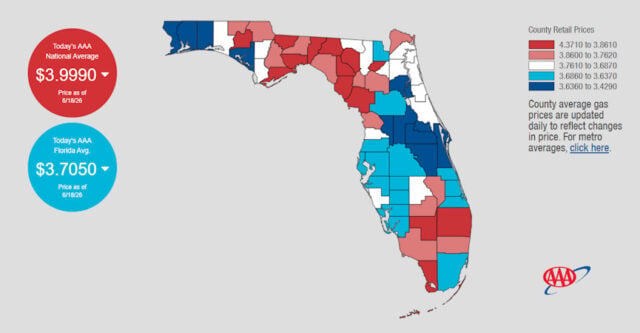
Click here to view the current Florida gas prices
But if you have looked out the window at a station marquee over the last few days, you might have noticed something unfamiliar: the prices are actually moving in the right direction.
As of June 18, 2026, the national average for a gallon of regular gasoline has officially dipped below the four-dollar threshold, settling at $3.99. This milestone marks four consecutive weeks of declining prices at the pump, offering a massive sigh of relief for households just as the summer travel season shifts into high gear. With a record 72.2 million Americans preparing to hit the road for the upcoming Independence Day holiday, this unexpected downward trend could not have arrived at a better time.

To understand why this is happening now—and whether these lower prices are here to stay—we have to look past our local street corners and cast our eyes toward global energy markets and international diplomacy.
The Breakthrough That Changed the Market
The primary catalyst behind this sudden drop in fuel prices is a significant geopolitical breakthrough. For much of the spring, international oil markets were locked in a tense state of anxiety. Ongoing conflict and a U.S.-led blockade in the Middle East had effectively choked off shipping through the Strait of Hormuz—the narrow, highly critical water passage through which roughly one-fifth of the world’s petroleum liquids pass daily. When shipping lanes are threatened or blocked, the global supply of crude oil shrinks, and panicked trading drives prices through the roof.
Everything shifted when an interim diplomatic agreement was reached to lift the blockade and officially reopen the Strait of Hormuz.
This unexpected resolution immediately injected a wave of optimism into global energy markets. The physical reality of oil flowing freely through the Persian Gulf once again meant that the severe supply shortages investors feared would not materialize. Almost overnight, the “geopolitical risk premium”—the extra price tacked onto a barrel of oil purely out of fear of war and disruption—began to evaporate. Because crude oil accounts for more than half of the retail cost of regular gasoline, a sudden drop in oil prices flows directly through the supply chain to your local gas station within a matter of weeks.
Where Do Gas Prices Stand Across the Country?
While a national average of $3.99 is a symbolic victory, the actual price you pay depends heavily on where you live. State taxes, local refinery capacities, and regional environmental regulations create a stark divide between the most and least expensive fuel markets in the country.
If you are filling up along the West Coast or in certain parts of the Northeast, your wallet is still taking a hit. On the flip side, drivers in the South and Midwest are seeing some of the lowest prices in over a year.
| Top 10 Most Expensive Gas Markets | Top 10 Least Expensive Gas Markets |
| California ($5.64) | Indiana ($3.39) |
| Hawaii ($5.57) | Texas ($3.49) |
| Washington ($5.43) | Oklahoma ($3.50) |
| Alaska ($0.00) | South Carolina ($3.58) |
| Oregon ($4.92) | Tennessee ($3.58) |
| Nevada ($4.84) | Louisiana ($3.59) |
| Idaho ($4.32) | North Carolina ($3.60) |
| Arizona ($4.29) | Mississippi ($3.61) |
| New York ($4.29) | Alabama ($3.61) |
| Illinois ($4.28) | Arkansas ($3.61) |
A Note for EV Owners: The relief isn’t just limited to gasoline. The national average per kilowatt-hour of electricity at a public electric vehicle (EV) charging station also experienced a slight decline over the past week, dropping down to 41 cents.
Looking Ahead: The Future of Crude Oil Prices
With gas prices currently on a downward trajectory, the biggest question on every driver’s mind is a simple one: How long will this last? To find the answer, we have to examine the updated forecasts for future crude oil prices issued by major global financial institutions and energy agencies.
Wall Street analysts have waste no time recalibrating their expectations in light of the Strait of Hormuz reopening. Leading investment banks have drastically lowered their near-term and long-term oil price targets, pointing to a rapidly recovering global supply that is poised to outpace overall demand.
The Near-Term View (Late 2026)
Investment analysts have significantly revised their projections downward for the tail end of the year. For instance, Goldman Sachs recently slashed its fourth-quarter 2026 price forecast for Brent crude—the international benchmark for oil—dropping it down to $80 per barrel from its previous estimate of $90. The bank made a similar adjustment to the U.S. benchmark, West Texas Intermediate (WTI), predicting it will settle around $75 per barrel by the end of the year.
This bearish adjustment is built on the assumption that Persian Gulf oil exports will normalize to pre-conflict levels by the end of July—a full month faster than previous models anticipated. Furthermore, production from major energy players like Saudi Arabia and the United Arab Emirates (UAE) is expected to normalize entirely by October, ensuring a steady stream of crude hits the market.
The Long-Term Outlook (2027 and Beyond)
Looking further down the road, energy experts believe that soft underlying market fundamentals will keep a lid on prices. For 2027, Goldman Sachs expects Brent crude to average roughly $75 per barrel, while WTI will hover near $70.
Major institutional research firms, such as J.P. Morgan Global Research, are looking even lower, projecting that Brent could average around $60 per barrel by the end of 2026 and into 2027. J.P. Morgan’s analysts point out that a visible oil surplus has been building up in global data. Despite a projected expansion in world oil demand of about 0.9 million barrels per day, global oil supply is set to outpace that demand comfortably. This imbalance means that major oil-producing alliances like OPEC may actually have to implement voluntary production cuts just to keep prices from falling too far below the $60 mark.
Potential Wildcards to Watch
While the current consensus points toward lower, more stable energy costs, experts warn that the global oil market is notoriously fickle. History shows us that even the most confident forecasts can be derailed by a few unpredictable wildcards.
- Re-escalation of Hostilities: The current price drop hinges entirely on peace holding in the Middle East. If renewed hostilities break out, if ships are attacked, or if unexpected delays occur in clearing naval mines from shipping lanes, the supply chain could snap right back. In a worst-case scenario where the Strait of Hormuz faces prolonged disruptions through 2027, analysts warn Brent crude could skyrocket back over $130 a barrel.
- The Venezuelan Factor: Political developments and shifting leadership in nations with massive energy reserves, like Venezuela, represent an ongoing wildcard. Sweeping regime changes or policy overhauls in large-scale oil-producing nations historically trigger massive price volatility, sometimes causing prices to spike by more than 70% from onset to peak.
- Strategic Stockpiling: Even with an expected global oil surplus of more than 3 million barrels per day looming on the horizon, massive sell-offs might be prevented by governments stepping in to rebuild their emergency reserves. Continued strategic stockpiling by countries like India and the U.S. will likely provide a soft floor for prices, preventing a complete collapse of the crude market.
For now, the momentum is firmly on the side of the consumer. As you map out your upcoming road trips, you can rest a bit easier knowing that the frantic race up the price ladder has finally paused—and that your next trip to the pump will be a significantly gentpering experience on your wallet.
Sources and Links:
- AAA Newsroom / AAA Fuel Prices National Average Drops Below $4/Gallon as Summer Travel Heats Up https://newsroom.aaa.com/2026/06/national-average-drops-below-4-gallon-as-summer-travel-heats-up/
- https://gasprices.aaa.com/national-average-drops-below-4-gallon-as-summer-travel-heats-up/
- Goldman Sachs (via Business Today & ANI News Report) Goldman Sachs cuts Brent forecast to $80 as Hormuz reopening eases supply fears https://www.businesstoday.in/latest/economy/story/where-will-oil-prices-go-after-the-hormuz-reopening-deal-goldman-sachs-sees-brent-at-80-537662-2026-06-18
- https://www.aninews.in/news/business/goldman-sachs-cuts-brent-forecast-to-80-as-hormuz-reopening-eases-supply-fears20260617134553
- J.P. Morgan Global Research Oil Price Forecast for 2026 | J.P. Morgan Global Research https://www.jpmorgan.com/insights/global-research/commodities/oil-prices
- International Energy Agency (IEA) Oil Market Report – June 2026 https://www.iea.org/reports/oil-market-report-june-2026
- U.S. Energy Information Administration (EIA) Assumptions to the Annual Energy Outlook 2026 https://www.eia.gov/outlooks/aeo/assumptions/pdf/IEM_Assumptions.pdf
Disclaimer
Artificial Intelligence Disclosure & Legal Disclaimer
AI Content Policy.
To provide our readers with timely and comprehensive coverage, South Florida Reporter uses artificial intelligence (AI) to assist in producing certain articles and visual content.
Articles: AI may be used to assist in research, structural drafting, or data analysis. All AI-assisted text is reviewed and edited by our team to ensure accuracy and adherence to our editorial standards.
Images: Any imagery generated or significantly altered by AI is clearly marked with a disclaimer or watermark to distinguish it from traditional photography or editorial illustrations.
General Disclaimer
The information contained in South Florida Reporter is for general information purposes only.
South Florida Reporter assumes no responsibility for errors or omissions in the contents of the Service. In no event shall South Florida Reporter be liable for any special, direct, indirect, consequential, or incidental damages or any damages whatsoever, whether in an action of contract, negligence or other tort, arising out of or in connection with the use of the Service or the contents of the Service.
The Company reserves the right to make additions, deletions, or modifications to the contents of the Service at any time without prior notice. The Company does not warrant that the Service is free of viruses or other harmful components.