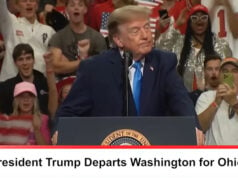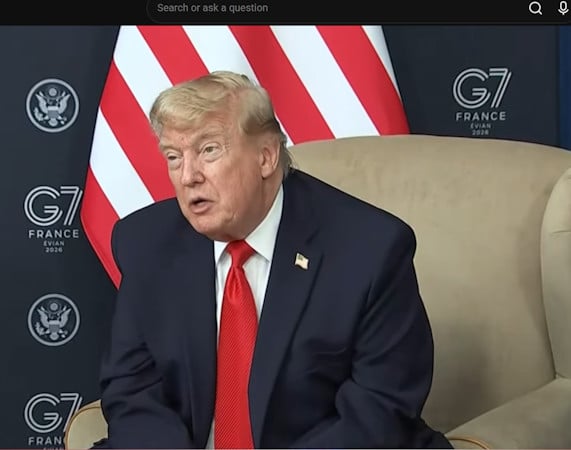
The picturesque lakeside spa town of Évian-les-Bains, France, is known for its calm waters, but the atmosphere inside the 52nd G7 Summit has been anything but serene. President Donald Trump arrived in the French Alps with what he considers a massive diplomatic win in his sails: a fresh, tentative memorandum of understanding (MoU) with Iran to end a highly disruptive, 15-week-old war in the Middle East.
While the announcement has sent global oil prices plunging and stock markets surging, it has simultaneously ignited intense debates behind closed doors. From vocal frustrations with Israeli military strategies to aggressive new economic blueprints for the American automotive and semiconductor sectors, Trump’s presence has completely dominated the summit’s agenda.
The Breakthrough: A New Diplomatic Blueprint with Iran
The center of gravity in Évian-les-Bains is undeniably the newly minted US-Iran deal. Brokered digitally just days before the summit, the agreement is scheduled for a formal, in-person signing this Friday, June 19, at the Bürgenstock resort in central Switzerland. The deal establishes a framework to extend the April 8 ceasefire for an additional 60 days, fully reopen the blockaded Strait of Hormuz, and kickstart comprehensive negotiations over Tehran’s nuclear program.
Trump has been eager to contrast this agreement with past diplomatic efforts, explicitly targeting the 2015 Joint Comprehensive Plan of Action (JCPOA) orchestrated by the Obama administration. Speaking on the sidelines of the summit, Trump remarked:

“It’s a very important document, and, unlike Obama, who could’ve destroyed the Middle East with the horrible JCPOA that was a road to a nuclear weapon… mine is a wall against a nuclear weapon.”
Crucially, the president reiterated his absolute red line: Iran will never be permitted to obtain a nuclear weapon. He warned that if the regime breaches this fundamental threshold, “all hell” would “rain down” upon them.
Despite the bold rhetoric, the deal faces significant skepticism both at home and abroad. Critics point out that several critical logistics remain entirely unclarified, such as who will verify compliance and how the international community will handle the 972 pounds (441 kilograms) of highly enriched uranium buried beneath Iranian facilities. On that front, Trump urged patience, stating that recovering and destroying the stockpile is a “very tough excavation” and that Washington is in “no rush” to execute it while the framework settles.
Back in Washington, hawkish lawmakers and prominent Democrats alike are demanding a closer look. Republican Senator Lindsey Graham noted that Congress will need to thoroughly review and vote on any final package. Surprisingly, Trump welcomed the legislative oversight, telling reporters during a bilateral meeting with UAE President Sheikh Mohammed bin Zayed Al Nahyan, “I like the idea, send it to Congress please… I mean, who wouldn’t approve it?”
Unexpected Friction: A Public Rebuke of Israel
While Trump championed the peace framework, his comments regarding Israel revealed deep undercurrents of frustration. The president publicly expressed his dissatisfaction with Israel’s military execution in Lebanon, specifically rebuking a strike on Beirut that occurred right before the US-Iran deal was announced.
Breaking from standard diplomatic scripts, Trump criticized the heavy civilian toll of the conflict, noting that Israel has been fighting Hezbollah for too long at too high a human cost:
“Israel’s fighting Hezbollah too long and too many people are being killed, and you don’t have to knock down an apartment house every time you’re looking for somebody, because there are a lot of people in those apartment houses, and they’re not all Hezbollah, that I can tell you.”
Trump also made it clear that he believes the elimination of numerous senior leaders within the Islamic Republic has effectively functioned as a “regime change” from within, though he maintained that outright regime change was never his explicit goal. “I do not believe in regime change,” he stated during a meeting with Qatari leadership. “I have watched regime changes for years, and they never work.”
In one of his most direct assertions of American leverage over Jerusalem to date, Trump reminded listeners of the fundamental dependency involved in the relationship, stating flatly, “Without us, without the United States, there would be no Israel. Without me, there would be no Israel.”
The Qatari Connection: Multi-Billion Dollar Investments
The economic dimensions of the Middle East crisis were front and center during Trump’s bilateral meeting with the Emir of Qatar, Sheikh Tamim bin Hamad Al Thani. Qatar acted as a pivotal backend negotiator in managing the crisis and facilitating the preliminary US-Iran deal, earning explicit praise from the American president.
However, the conversation quickly pivoted to a celebration of bilateral commerce. The two leaders highlighted a massive economic partnership that built upon more than $240 billion in economic deals originally outlined during Trump’s visit to Doha.
The scale of active Qatari investment flowing directly into the United States economy is staggering:
- Aerospace: A massive $96 billion deal by Qatar Airways to purchase up to 210 American-made Boeing 787 Dreamliner and 777X commercial aircraft, powered by GE Aerospace engines. This contract alone is projected to support more than 154,000 American manufacturing jobs annually.
- Innovation & Infrastructure: A $97 billion initiative awarded to the American firm Parsons to spearhead advanced technological innovation projects.
- Energy Sector: An $8.5 billion contract signed by Qatar Energy with Texas-based McDermott to expand and modernize critical energy infrastructure.
- Emerging Tech: A specialized $1 billion investment into the Quantinuum Joint Venture Agreement via Al Rabban Capital, specifically targeting the development of state-of-the-art quantum computing technologies.
Trump used these massive financial tie-ins to reinforce that while the US is happy to do business with its Gulf allies, American taxpayer money will not be used to rebuild regional adversaries. “We are not investing any money” in Iran, Trump clarified, shutting down rumors of a US-led regional reconstruction fund.
Remaking the Global Auto Industry
Beyond the immediate geopolitical crises of the Middle East, Trump utilized the G7 platform to outline a highly protectionist, America-first vision for the future of global manufacturing, beginning with the automotive market.
A fascinating hot-mic moment on the sidelines of the summit captured a candid exchange between Trump and Canadian Prime Minister Mark Carney. The two leaders were overheard discussing Canada’s recent implementation of a strict hard cap on Chinese electric vehicle (EV) imports, which limits Chinese vehicles to less than three percent of the Canadian market (roughly 49,000 cars annually).
“It’s a cap, we capped, a hard line,” Carney told Trump. “I thought you’d actually like that.”
“That’s good, I like it,” Trump responded.
The exchange highlights a broader, coordinated shift among G7 nations to erect strict trade barriers against Chinese automotive expansion. Trump’s stated priorities for the auto sector through the rest of the year focus heavily on protectionism, including a comprehensive review of the United States-Mexico-Canada Agreement (USMCA) to ensure Chinese parts aren’t backdoored into the American market, alongside a major regulatory push to favor domestic manufacturing over foreign tech-heavy imports.
The Semiconductor Ultimatum: 50% by 2029
If the administration’s plans for the automotive industry are protective, its goals for the semiconductor market are downright aggressive. In a move that has sent shockwaves through global tech hubs from Taipei to Seoul, Trump reiterated a bold ultimatum: bringing 50% of the entire global microchip industry onto American soil within the next three years.
To achieve this goal, the administration is leveraging a mix of aggressive national security pressure and massive domestic incentives. Following a Section 232 proclamation aimed at curbing unfair foreign semiconductor practices, the administration is actively weaponizing sectoral tariffs—threatening up to a 100% tariff on foreign-made silicon to force global tech giants to build foundries inside the United States.
The pressure is already yielding massive capital reallocations. For example, Micron has committed to a historic 300 trillion won (approximately $218 billion USD) investment blueprint to scale up domestic manufacturing capacity.
This domestic manufacturing push arrives at a critical structural juncture for global supply chains. According to industrial data compiled by S&P Global Mobility, the semiconductor demand within the automotive sector alone is undergoing a massive transformation. Driven by the rise of software-defined vehicles, advanced driver assistance systems (ADAS), and electrified powertrains, global automotive semiconductor revenue is projected to skyrocket from $90 billion to roughly $139 billion by 2031.
| Automotive Semiconductor Market Dynamics | Detail |
| Projected Market Growth | $90 Billion to $139 Billion by 2031 |
| Compound Annual Growth Rate (CAGR) | 7.5% |
| Fastest Growing Category | Memory ICs (Growing at nearly 20% annually) |
| Core Material Shift | Silicon Carbide (SiC) replacing standard silicon for EV efficiency |
| Primary Supply Risk | Mature/Legacy nodes remain underfunded as foundries chase high-margin AI chips |
This exploding demand creates an intense bottleneck. As major global microchip foundries increasingly prioritize high-margin, cutting-edge AI silicon for data centers, the automotive industry remains structurally dependent on older, mature manufacturing nodes. Trump’s aggressive tariff threats are designed to force companies to build these critical legacy and advanced nodes at home, insulating the American industrial base from a rerun of the catastrophic supply chain shortages seen earlier in the decade.
A New Geopolitical Balance
As the G7 summit draws to a close, Trump’s multi-pronged approach illustrates a dramatic reordering of American foreign and economic policy. By leveraging intense military and economic pressure, the administration has managed to force a temporary peace framework in the Middle East while simultaneously forcing global trade partners to adapt to a highly protective, American-centric manufacturing landscape.
Whether the fragile peace with Iran holds through Friday’s formal signing in Switzerland—and whether global tech and automotive markets can successfully absorb Trump’s aggressive domestic mandates—remains to be seen. What is perfectly clear, however, is that the diplomatic and economic scripts of the past are being completely rewritten in the alpine air of Évian.
Sources and Links:
- The Associated Press / WBAL Radio: President Trump says Iran deal will lead to ‘a lot of success’ for the world Link: https://www.wbal.com/president-trump-says-iran-deal-will-lead-to-a-lot-of-success-for-the-world
- The Associated Press / Newsday: The Latest: Trump at G7 summit for talks with world leaders on Iran and Ukraine Link: https://www.newsday.com/news/nation/g7-france-evian-trump-iran-ukraine-16-june-2026-c62984
- The Financial Times: FirstFT: Iran and US agree Strait of Hormuz deal Link: https://www.ft.com/content/423e2773-96ab-45d1-94b7-e61d360c282e
- The Hindu: West Asia LIVE: U.S.-Iran peace deal to be signed in Switzerland on June 19 Link: https://www.thehindu.com/news/international/west-asia-war-iran-usa-israel-conflict-tehran-washington-peace-deal-strait-of-hormuz-live-updates-june-16-2026/article71107509.ece
- Iran International: Live – Trump says US will not invest in Iran, deal bans nuclear weapons Link: https://www.iranintl.com/en/liveblog/202606139149
- Qatar News Agency (QNA): HH the Amir Meets US President on Sidelines of G7 Summit Link: https://qna.org.qa/en/News-Area/News/2026-6/16/hh-the-amir-meets-us-president-on-sidelines-of-g7-summit
- Ministry of Foreign Affairs – Qatar: Joint Statement on the Seventh Qatar -United States Strategic Dialogue Link: https://mofa.gov.qa/en/latest-articles/statements/joint-statement-on-the-seventh-qatar–united-states-strategic-dialogue–an-enduring-strategic-partnership
- The Times of Israel: Trump claims, ‘I never cared about regime change’ in Iran, says its current leaders are ‘strong, smart’ Link: https://www.timesofisrael.com/liveblog_entry/trump-claims-i-never-cared-about-regime-change-in-iran-current-leaders-are-strong-smart/
- The National: No Israel without US and no regime change in Iran: Five Trump takeaways from G7 Link: https://www.thenationalnews.com/news/mena/2026/06/16/no-israel-without-us-and-no-regime-change-in-iran-five-trump-takeaways-from-g7/
- S&P Global Mobility: 2026 Trends shaping the automotive semiconductor marketLink: https://www.spglobal.com/automotive-insights/en/blogs/2026/04/automotive-semiconductor-market-trends
- Seoul Economic Daily: Trump Vows 50% of Global Chip Industry to Be in U.S. Within Three Years Link: https://en.sedaily.com/international/2026/05/23/trump-vows-to-bring-50-percent-of-global-chip-production-to
- MichAuto: Trump’s Priorities for the Auto Industry in 2026 Link: https://michauto.org/trumps-priorities-for-the-auto-industry-in-2026/
Disclaimer
Artificial Intelligence Disclosure & Legal Disclaimer
AI Content Policy.
To provide our readers with timely and comprehensive coverage, South Florida Reporter uses artificial intelligence (AI) to assist in producing certain articles and visual content.
Articles: AI may be used to assist in research, structural drafting, or data analysis. All AI-assisted text is reviewed and edited by our team to ensure accuracy and adherence to our editorial standards.
Images: Any imagery generated or significantly altered by AI is clearly marked with a disclaimer or watermark to distinguish it from traditional photography or editorial illustrations.
General Disclaimer
The information contained in South Florida Reporter is for general information purposes only.
South Florida Reporter assumes no responsibility for errors or omissions in the contents of the Service. In no event shall South Florida Reporter be liable for any special, direct, indirect, consequential, or incidental damages or any damages whatsoever, whether in an action of contract, negligence or other tort, arising out of or in connection with the use of the Service or the contents of the Service.
The Company reserves the right to make additions, deletions, or modifications to the contents of the Service at any time without prior notice. The Company does not warrant that the Service is free of viruses or other harmful components.