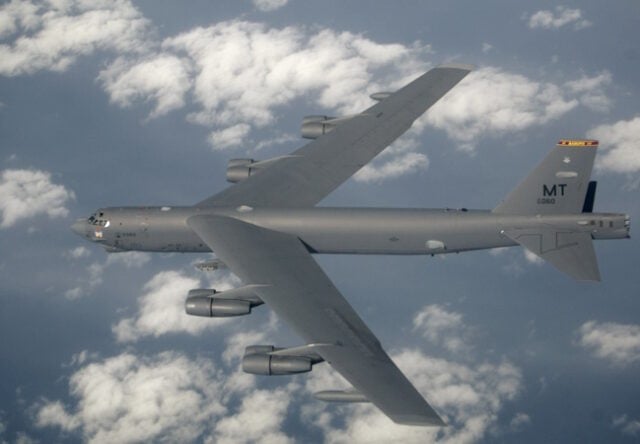
A U.S. Air Force B-52H Stratofortress strategic bomber crashed shortly after takeoff at Edwards Air Force Base in Southern California’s Mojave Desert on Monday morning, killing all eight people on board. The catastrophic incident occurred at approximately 11:20 a.m. local time during a routine test flight dedicated to a critical radar modernization program. Air Force officials confirmed later in the afternoon that the high-impact crash and subsequent fireball left no survivors, marking one of the most severe military aviation disasters for the airframe in decades.
Base officials immediately sealed off the airfield and suspended all visitor passes to prioritize emergency operations. Aviation safety experts are actively investigating the scene, with early data indicating a sudden and unrecoverable loss of aircraft control during the initial climb.
The Fatal Flight Profile
The Boeing B-52H Stratofortress, assigned to the 412th Test Wing based at Edwards, began its test mission under clear desert skies. According to radar tracking data analyzed shortly after the event, the eight-engine bomber departed the primary runway at approximately 11:10 a.m., initially climbing out toward the northeast before gradually banking further north.
Moments later, the flight path altered violently. At 11:20 a.m., the heavy bomber made an abrupt, uncommanded hook to the northwest and entered a steep, terminal plunge. Radar metrics indicated the aircraft was descending at an extreme rate exceeding 5,000 feet per minute before impacting the airfield environment.

The crash resulted in an immediate explosion, creating a massive, smoldering burn mark across a large swath of the desert floor adjacent to the runway. Aerial footage captured by regional news networks showed thick, black plumes of smoke billowing thousands of feet into the sky. Base emergency crews rushed to the scene immediately to suppress the flames, but the airframe was completely destroyed, leaving virtually no recognizable remains of the historic bomber.
Casualties and Team Composition
While a standard operational B-52 mission is typically crewed by five personnel—consisting of a commander, pilot, weapon systems officer, navigator, and electronic warfare officer—test flights frequently carry expanded crews to monitor specialized diagnostic equipment.
During an afternoon press conference, Col. James Hayes, the deputy commander at Edwards Air Force Base, formally announced that the crash had claimed the lives of all eight individuals on board.
“Today, Edwards Air Force Base experienced a terrible tragedy and we lost eight great Americans. After reviewing the footage of the crash, it was deemed that this was an unrecoverable crash, and unsurvivable.” — Col. James Hayes, Deputy Commander, Edwards AFB
The identities of the deceased have been withheld pending the formal notification of next of kin, but Col. Hayes revealed that the aircraft was carrying a mixed team specifically assembled for the testing environment:
- Active-Duty Military Personnel: Air Force test pilots and flight engineers tasked with executing the flight profile.
- Government Civilians: Technical specialists responsible for recording data from the upgraded systems.
- Aerospace Contractors: Systems experts representing commercial defense partners.
The Boeing Company later issued a formal statement confirming that two of its corporate employees were among those killed on the flight, stating that the company is actively communicating with and supporting the affected families.
Focus of the Test: Radar Modernization
The flight was operating as part of the Air Force’s ongoing efforts to update its legacy long-range fleet. Specifically, this mission was evaluating components of a comprehensive radar modernization program. Because the B-52 platform is projected to remain in active service beyond 2040—and potentially up to a century after its initial 1955 introduction—the Air Force has been systematically replacing its obsolete 1980s-era mechanical APQ-166 radar systems with modern Active Electronically Scanned Array (AESA) systems.
These upgrades require extensive, hands-on flight testing to ensure that new radar arrays correctly interface with the bomber’s legacy analog and digital avionics. The 412th Test Wing at Edwards acts as the primary hub for this specialized development, testing everything from software components to weapon integration systems throughout an aircraft’s structural lifecycle.
Initial Investigation and Expert Analysis
The Air Force has launched a formal safety investigation board to determine the exact sequence of events that led to the disaster. Because the aircraft crashed directly onto the base airfield, investigators have immediate access to the wreckage site, flight data recorders, and local diagnostic telemetry.
Military officials have not yet commented on whether the aircraft was carrying any conventional training munitions at the time of the flight, though they explicitly noted there is no ongoing hazard to the surrounding public. Due to structural damage on the primary runway surface caused by the impact and intense fire, flight operations at Edwards have been entirely halted and are expected to remain suspended through at least Tuesday, with all inbound military and test flights diverted to alternative regional facilities.
While the official investigation could take months to complete, independent aviation safety experts have begun analyzing the telemetry and visual evidence. Jeff Guzzetti, a veteran accident investigator who has previously led inquiries for both the Federal Aviation Administration (Aviation Safety) and the National Transportation Safety Board, noted that the suddenness of the plunge strongly points toward a critical mechanical or structural failure.
“I think it was definitely a controllability issue,” Guzzetti stated in an interview. “Now, whether that was tied to an engine failure, a flight control failure, or some new testing device failure, I’m not sure.” Guzzetti emphasized that while the B-52 is a highly reliable airframe, testing newly integrated components inherently increases operational risk. “A flight test is always riskier than normal operations, so that’s why you have specially trained test pilots, and you should have other safety protocols.”
Context of a Strained Fleet
The disaster at Edwards arrives during a period of high operational tempo and intense geopolitical pressure for the U.S. Air Force. Over the past several months, the military has surged a significant number of fighter jets, refueling tankers, and strategic bombers into the Middle East to support combat operations against Iran, known as Operation Epic Fury. B-52H bombers have flown regular, long-range deterrence missions over the theater, striking ballistic missile facilities and hard command-and-control infrastructure.
This high reliance on an aging inventory has reignited structural debates among defense analysts regarding the sustainability of the current fleet. Retired Lt. Gen. David Deptula commented on the broader strategic challenges facing the service following Monday’s crash. “Today’s Air Force is the oldest and smallest in its entire history,” Deptula noted. “America cannot continue to ask an aging, shrinking Air Force to respond to its national security needs without additional resources.”
The specific model involved in the accident, the B-52H, is the only variant remaining in the active inventory, with 76 total aircraft distributed between the 5th Bomb Wing at Minot Air Force Base in North Dakota and the 2nd and 307th Bomb Wings at Barksdale Air Force Base in Louisiana. Monday’s crash marks the first hull loss of a B-52 Stratofortress since May 2016, when a bomber aborted its takeoff at Andersen Air Force Base in Guam, overran the runway, and caught fire. In that historical instance, all seven crew members managed to escape with only minor injuries.
As teams at Edwards Air Force Base work to clear the runway and recover the flight data recorders, the military community is mourning the loss of the eight crew members. The investigation will remain focused on whether a catastrophic mechanical failure or an issue with the experimental radar equipment brought down the aircraft.
Sources and Links:
- The Guardian: Eight presumed dead after B-52 bomber crashes at California air force base
- SFGATE: Air Force says B-52 crash carrying 8 at Edwards was ‘not survivable’
- The Washington Post: Air Force B-52 bomber crashes in California with 8 on board
- CBS News Los Angeles: 8 dead in B-52 bomber crash at Edwards Air Force Base in California, officials say
- The Times of India: 8 people killed after B-52 bomber crashes at US Air Force base in California
- Military Times: 8 crew members presumed dead in B-52 Stratofortress crash
- Task & Purpose: B-52 bomber carrying 8 crashes at Edwards Air Force Base
- Hindustan Times: Massive smoke seen as B-52 bomber crashes at California Edwards AFB | Videos
- The Jerusalem Post: Eight presumed dead after US Air Force B-52 bomber crashes
- Al Jazeera: US Air Force B-52 bomber crashes after takeoff at Edwards Air Force Base
Disclaimer
Artificial Intelligence Disclosure & Legal Disclaimer
AI Content Policy.
To provide our readers with timely and comprehensive coverage, South Florida Reporter uses artificial intelligence (AI) to assist in producing certain articles and visual content.
Articles: AI may be used to assist in research, structural drafting, or data analysis. All AI-assisted text is reviewed and edited by our team to ensure accuracy and adherence to our editorial standards.
Images: Any imagery generated or significantly altered by AI is clearly marked with a disclaimer or watermark to distinguish it from traditional photography or editorial illustrations.
General Disclaimer
The information contained in South Florida Reporter is for general information purposes only.
South Florida Reporter assumes no responsibility for errors or omissions in the contents of the Service. In no event shall South Florida Reporter be liable for any special, direct, indirect, consequential, or incidental damages or any damages whatsoever, whether in an action of contract, negligence or other tort, arising out of or in connection with the use of the Service or the contents of the Service.
The Company reserves the right to make additions, deletions, or modifications to the contents of the Service at any time without prior notice. The Company does not warrant that the Service is free of viruses or other harmful components.