WASHINGTON — In a spectacle that shattered centuries of presidential tradition, the South Lawn of the White House was transformed into a high-octane sporting coliseum. For the first time in United States history, a professional mixed martial arts event was staged at 1600 Pennsylvania Avenue. Dubbed “UFC Freedom 250,” the multi-fight card served a dual purpose: kicking off celebrations for the nation’s 250th anniversary and feting President Donald Trump on his 80th birthday.
As the sun set over the nation’s capital, the historic grounds—typically reserved for state arrivals, diplomatic ceremonies, and Marine One departures—resounded with the thud of body kicks, the roar of a highly exclusive crowd, and the iconic, booming introductions of UFC announcer Bruce Buffer.
The Transformation of 1600 Pennsylvania Avenue
To accommodate the unprecedented event, the White House grounds underwent a radical structural overhaul. Towering over the executive mansion was “The Claw,” a massive 92-foot-tall, 600-ton spaceship-like steel canopy arch fitted with state-of-the-art lighting, sound equipment, and colossal video screens. Beneath this industrial monolith sat the UFC’s signature eight-sided wire-mesh cage—the Octagon—staged directly upon the manicured grass of the South Lawn.
Surrounding the cage was a temporary, custom-built 4,300-seat outdoor arena. The stands were strictly curated, packed with members of the U.S. Armed Forces alongside top political figures, foreign dignitaries, and celebrities. For the public outside the security gates, tens of thousands of fans gathered at the nearby Ellipse to watch the live broadcast on massive screens, turning the entire Ellipse perimeter into a sprawling festival.

A Birthday Grand Entrance
The evening began with a carefully choreographed display of political theater and personal branding. President Trump and UFC CEO Dana White, a fiercely loyal friend of the president for over two decades, emerged together from the Oval Office. A live camera followed them in a continuous shot along the colonnade—which Trump recently outfitted with gilded frames showcasing portraits of past presidents—and through the Palm Room.
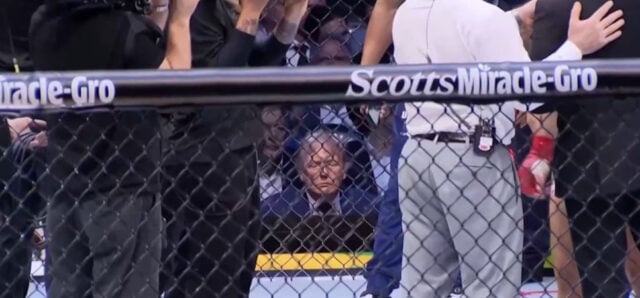
When the duo stepped onto the Blue Room Balcony to survey the massive crowd below, a chorus of “Happy Birthday” erupted from the spectators. Trump smiled and waved, basking in the applause before descending to his front-row seat at ringside. He sat flanked by First Lady Melania Trump and White House staff, surrounded by a heavy contingent of his political inner circle.
The pre-fight ceremonies maintained a deeply patriotic tone. The Zac Brown Band, accompanied by the Joint Armed Forces Chorus, delivered a powerful rendition of the national anthem. As the final notes echoed across the National Mall, fighter jets from the U.S. Navy Blue Angels and U.S. Air Force Thunderbirds thundered overhead in a spectacular “Super Delta” formation flyover, formalizing the transition from executive residence to elite sporting venue.
The Ultimate Convergence: Beltway Meets Brawlers
The event drew an extraordinary cross-section of Washington’s political elite and the combat sports world. Seated in the primary VIP sections were prominent members of Trump’s administration and Republican leadership, including:
- Vice President JD Vance
- House Speaker Mike Johnson
- FBI Director Kash Patel
- Cabinet Secretaries: Pete Hegseth, Robert F. Kennedy Jr., Scott Bessent, Howard Lutnick, Brooke Rollins, and Scott Turner.
- International Guests: Polish President Karol Nawrocki was among the foreign heads of state spotted entering the grounds.
The atmosphere was an eclectic mix of black-tie prestige and standard UFC rowdiness. Announcer Bruce Buffer wore a striking, custom silvery smoking jacket covered in stars, while the UFC Octagon Girls wore patriotic, Wonder Woman-inspired attire.
Fighters experienced a surreal walkout protocol: leaving their temporary holding areas at the Eisenhower Executive Office Building via a police-escorted motorcade, they entered the White House through the historic Diplomatic Reception Room—historically the backdrop for greeting foreign potentates—before making their final walk onto the South Lawn.
High Stakes in the Octagon and Abroad
The night was packed with high-octane action inside the cage. In the opening preliminary bout, featherweight Diego Lopes defeated American Steve Garcia via an explosive knockout. As Lopes secured his victory, television cameras caught President Trump leaning over to discuss the finish with Melania Trump. In the subsequent match, rising star Bo Nickal secured a swift knockout against Kyle Daukaus. Immediately following the referee’s stoppage, Nickal walked to the edge of the cage, kneeled down, and engaged in a brief, animated conversation with the president, who has previously golfed with the middleweight prospect.
The sporting action, however, shared the spotlight with massive geopolitical developments. Just hours before the main card commenced, President Trump announced that the United States and Iran had reached an initial agreement to end months of intense regional fighting.
“The agreement is now complete,” Trump declared ahead of the bouts, stating that the U.S. would lift its naval blockade of Iran and ensure the immediate reopening of the critical Strait of Hormuz. While economists noted that the crucial details of the deal remain to be negotiated, the announcement served as a massive prefight victory lap for the administration, sending positive ripples through skittish global financial and oil markets.
Legal Battles and ‘Bread and Circuses’
Hosting a commercial, pay-per-view sports event on the lawn of the executive mansion did not come without fierce pushback. A legal battle culminated just 48 hours prior to the event, when U.S. District Judge Amit Mehta denied an emergency injunction sought by the non-profit Public Integrity Project. The lawsuit, filed on behalf of a political activist and a Vietnam War veteran, argued that the administration had unlawfully granted the UFC “unfettered access” to public property for a private, for-profit enterprise.
The Justice Department, led by Acting Attorney General Todd Blanche, vigorously defended the event in court, arguing that the plaintiffs could simply “avert their gazes for the weekend” and were trying to ruin a celebration of America’s 250th anniversary. Judge Mehta ultimately ruled in favor of the White House, citing the plaintiffs’ “unreasonable delay” in challenging an event that had been publicly discussed for nearly a year.
While Trump maintained that the UFC entirely funded the infrastructure, a National Park Service court filing revealed that the event required over $60 million in logistical support and tens of thousands of hours of labor, drawing heavily on manpower from seven different federal agencies. To add a unique incentive for the evening, World Liberty Financial partnered with the UFC to establish a special $250,000 athlete bonus pool distributed to the night’s winners.
Critics have labeled the event a blatant display of modern “bread and circuses,” arguing that a blood sport undermines the historic dignity of the White House. Conversely, Trump’s supporters and political strategists viewed it as a brilliant masterstroke of cultural populist branding, perfectly targeting the UFC’s massive, fiercely loyal demographic of young men.
As the historic evening drew to a close, the attention shifted to the grand finale of UFC Freedom 250: a highly anticipated, undisputed lightweight championship bout between Georgian-Spanish champion Ilia Topuria and American interim champion Justin Gaethje. For Trump, the evening was a definitive triumph—a boundary-pushing blend of executive power, athletic combat, and raw political theater that proved, once again, his willingness to rewrite the rules of the American presidency.
Sources and Links
- AP News: Trump celebrates his 80th birthday with an Iran deal and a UFC cage fight at the White House
- The Washington Post: Live updates: Trump hosts UFC fights on White House lawn
- CBS News: White House hosts “UFC Freedom 250” fight on Trump’s 80th birthday
- PBS NewsHour: Trump celebrates 80th birthday with UFC fights while issues loom over his presidency
- The Guardian: Seven fights on the South Lawn: Trump prepares for UFC birthday spectacle at White House
- Newsweek: Who Is and Isn’t Attending UFC Fight At White House: What We Know
Disclaimer
Artificial Intelligence Disclosure & Legal Disclaimer
AI Content Policy.
To provide our readers with timely and comprehensive coverage, South Florida Reporter uses artificial intelligence (AI) to assist in producing certain articles and visual content.
Articles: AI may be used to assist in research, structural drafting, or data analysis. All AI-assisted text is reviewed and edited by our team to ensure accuracy and adherence to our editorial standards.
Images: Any imagery generated or significantly altered by AI is clearly marked with a disclaimer or watermark to distinguish it from traditional photography or editorial illustrations.
General Disclaimer
The information contained in South Florida Reporter is for general information purposes only.
South Florida Reporter assumes no responsibility for errors or omissions in the contents of the Service. In no event shall South Florida Reporter be liable for any special, direct, indirect, consequential, or incidental damages or any damages whatsoever, whether in an action of contract, negligence or other tort, arising out of or in connection with the use of the Service or the contents of the Service.
The Company reserves the right to make additions, deletions, or modifications to the contents of the Service at any time without prior notice. The Company does not warrant that the Service is free of viruses or other harmful components.