The Collapse of the Fragile Peace
The relative quiet that had blanketed the Middle East for the past two months has evaporated in a firestorm of ballistic missiles and synchronized airstrikes. On Monday, June 8, 2026, the 100th day since the initial outbreak of hostilities earlier this year, the fragile truce brokered in April collapsed completely. Direct military engagements between Israel and Iran have resumed with unprecedented intensity, threatening to expand what was already a devastating localized conflict into a total regional war.
English translation
Footage Shows IRGC Retaliatory Strike on Haifa Petrochemical Facilityhttps://t.co/bKzNEtXKkJ pic.twitter.com/qmEWHmjtqp
— Fars News Agency (@EnglishFars) June 8, 2026

The crisis escalated rapidly over a 24-hour window, reversing weeks of back-channel diplomacy conducted by international intermediaries. What began as a localized cross-border exchange along Israel’s northern frontier quickly transformed into a strategic duel spanning thousands of miles. By Monday morning, air raid sirens were wailing across central and northern Israel, while thunderous explosions rocked major metropolitan and industrial centers inside Iran, including Tehran, Isfahan, and Tabriz.
For a global community already reeling from the economic shocks of the initial 40-day campaign that began on February 28, 2026, the resumption of hostilities represents a worst-case scenario. Diplomatic missions are scrambling, energy markets are in a state of high alarm, and military forces across the globe have been placed on elevated readiness. The modern rules of containment in the Middle East have been fundamentally rewritten, leaving the international order facing a deeply volatile and unpredictable landscape.
The Spark: From the Galilee to Beirut
The immediate catalyst for this latest round of violence occurred on Sunday, June 7, 2026, when the Lebanese militant group Hezbollah launched a heavy salvo of rockets into northern Israel. The projectiles, aimed at positions near the border community of Yiftach, were largely intercepted by Israeli air defense networks, leaving no immediate casualties but instantly fracturing the stability that had held since mid-April.
Israel’s response was immediate and severe. Defying explicit warnings from Western allies to exercise strategic restraint, the Israel Defense Forces (IDF) launched a high-precision airstrike targeting a primary Hezbollah headquarters located deep within the southern suburbs of Beirut. The strike completely leveled the targeted facility, generating a massive plume of smoke over the Lebanese capital and signaling that Israel would no longer tolerate proxy operations along its borders under the cover of a general ceasefire.
“No self-respecting country in the world would tolerate such an attack, and neither will Israel,” stated Yechiel Leiter, Israel’s Ambassador to the United States, in an official communication.
The strike in Beirut proved to be a decisive threshold for Iran. Tehran, which views Hezbollah as its primary forward deterrent against Israeli military power, declared that the attack on the Lebanese capital crossed all established red lines. Rather than operating through its traditional regional network, the Islamic Revolutionary Guard Corps (IRGC) chose to launch a direct, overt military response from Iranian soil, targeting the Israeli mainland and setting off a dangerous chain reaction.
Operation Nasr: Tehran Strikes Back
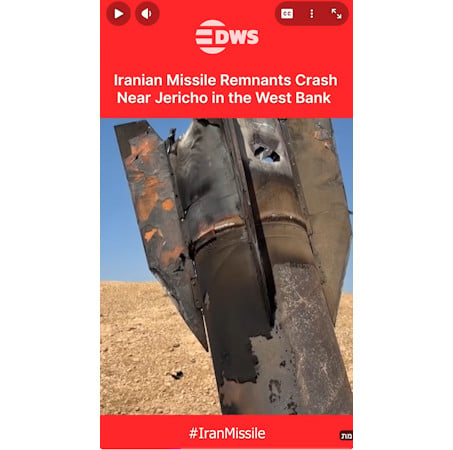
Late Sunday night and into the early hours of Monday morning, the IRGC initiated what it designated as “Operation Nasr” (Victory). The operation featured the synchronized launch of approximately 11 ballistic missiles alongside a wave of attack drones aimed at critical military infrastructure inside Israel. Iranian military planners specifically targeted major Israeli air facilities, including the Ramat David Airbase in the north, as well as the Tel Nof and Nevatim airbases in the central and southern sectors of the country.
According to statements released by the IRGC via state media, the choice of targets was highly deliberate. Tehran asserted that the airbases targeted were the exact launch sites used by the Israeli Air Force to execute the preceding strike in Beirut. The Iranian regime sought to frame the action as a calibrated warning design to deter future Israeli actions against its allies, rather than an initiation of total war.
In Israel, the attack triggered widespread emergency protocols. Authorities ordered the immediate closure of all educational institutions across the country and instructed civilians to remain within close proximity to reinforced bomb shelters. The IDF’s multi-layered air defense network, consisting of the Arrow-3, David’s Sling, and Iron Dome systems, engaged the incoming threats.
Israeli military officials reported that the vast majority of the ballistic missiles were successfully neutralized outside or high within the atmosphere. While falling debris from the mid-air interceptions ignited a series of brush fires in central and northern Israel, no structural damage to the airbases or civilian casualties were initially reported. However, the psychological impact of the direct strike dismantled any lingering illusions that the April ceasefire would hold.
The Israeli Counter-Offensive: Striking the Iranian Heartland
Israel did not wait for the dust to settle. In the early hours of Monday morning, the Israeli political leadership authorized a large-scale, long-range retaliatory offensive against mainland Iran. Dozens of Israeli combat aircraft, supported by aerial refueling tankers and electronic warfare platforms, traversed regional airspace to deliver a multi-pronged strike against Iranian military and industrial infrastructure.
Explosions reverberated across multiple Iranian provinces. In Tehran, a powerful blast shook the central district, rattling windows at the Foreign Ministry during a live press briefing. Iranian air defense batteries were activated across the capital, filling the night sky with anti-aircraft fire and interceptor missiles as they attempted to counter the incoming precision-guided munitions.
Simultaneously, secondary strikes targeted strategic locations in Isfahan and Tabriz—cities known to host critical elements of Iran’s ballistic missile production facilities and conventional military complexes. The most economically significant damage occurred in the southwestern Khuzestan province, where both Israeli and Iranian authorities confirmed a direct hit on the Karun Petrochemical Company located in the industrial city of Mahshahr.
The IRGC quickly issued a statement acknowledging the strike on the petrochemical plant and retaliated by attempting to target a similar industrial energy facility in the Israeli port city of Haifa. The exchange marked a dangerous shift from purely military assets to high-value economic and energy infrastructure, a development that international analysts warn could have catastrophic implications for global supply chains if the targeting grid expands further.
The Geopolitical Schism: Trump and Netanyahu at Odds
The sudden return to total war has exposed a profound diplomatic rift between the United States and the Israeli political leadership. U.S. President Donald Trump had spent the days leading up to the escalation working behind the scenes to finalize a permanent regional peace treaty. Operating through Pakistani mediators, Washington believed it was on the precipice of securing a historic diplomatic breakthrough that would permanently resolve the conflict that erupted on February 28.
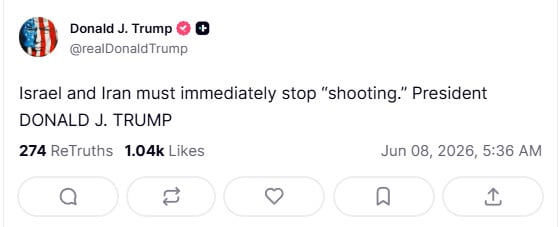
As the Iranian missiles were in transit on Sunday, President Trump engaged in urgent phone consultations with Israeli Prime Minister Benjamin Netanyahu, explicitly instructing the Israeli government to refrain from launching a counter-strike.
“I am going to call Bibi right now and tell him not to retaliate,” President Trump stated in a phone interview published by Axios. “Each of them had their fun. Israel had its strike and Iran had its strike. We don’t need another one. I call the shots. He doesn’t call the shots.”
Netanyahu’s decision to launch the massive air campaign against Tehran, Isfahan, and Mahshahr in direct defiance of Washington’s mandate represents a major turning point in U.S.-Israel relations. The unilateral action has drawn sharp criticism from lawmakers in Washington, with Democratic Senator Chris Murphy noting that the strike “compounds the humiliation” for the administration, illustrating the limits of American leverage over Jerusalem during moments of existential security crises.
Despite the open friction between Washington and Jerusalem, U.S. forces remain deeply entangled in the theater. U.S. Central Command (CENTCOM) confirmed that its naval and air assets operating in the region had intercepted two Iranian attack drones that posed an immediate threat to international maritime traffic. The contradiction highlights the complex position of the United States: working to prevent a wider war while remaining treaty-bound to defend regional stability and combat shared threats.
The Multi-Front Expansion: The Red Sea and Beyond
As the core combatants traded strikes, the wider network of regional actors moved quickly to exploit the chaos. In Yemen, the Iran-backed Houthi rebels officially declared a total ban on all Israeli-linked shipping operating within the Red Sea and the Gulf of Aden. The group backed this declaration by launching a long-range ballistic missile toward southern Israel, which was successfully intercepted but underscored the immediate threat to one of the world’s most critical maritime trade arteries.
The IRGC Navy also issued stern warnings to international maritime forces operating near the Strait of Hormuz, asserting its intent to enforce strict, unrecognized transit rules through the vital chokepoint. The move is widely interpreted as a direct challenge to the ongoing United States naval blockade of Iran, which has been maintained since the initial outbreak of the war in February.
| Conflict Matrix: 2026 Resumption of Hostilities | |
| Primary Combatants | Israel vs. Iran |
| Active Proxies / Allies | Hezbollah (Lebanon), Houthi Rebels (Yemen) |
| Initial Catalan Event | Hezbollah rocket barrage near Yiftach (June 7) |
| Israeli Escalation Phase | Precision airstrike on Beirut headquarters |
| Iranian Counter-Operation | Operation Nasr: 11 ballistic missiles fired at Israeli airbases |
| Israeli Retaliation Targets | Tehran, Isfahan, Tabriz, Mahshahr Petrochemical Plant |
| Global Economic Impact | Crude oil prices surge greater than 3% within hours |
The escalating rhetoric has forced neighboring Arab states into a delicate balancing act. Countries such as Saudi Arabia and the United Arab Emirates, which suffered minor commercial and civilian disruptions during the opening weeks of the war in March, are working frantically to preserve their own security. The Iranian Foreign Ministry took the unusual step on Monday of releasing a public clarification confirming that its forces had not directed any hostile actions toward Saudi territory, an effort by Tehran to prevent the Gulf states from fully aligning with the U.S.-led coalition.
Economic Fallout: Energy Markets in Turmoil
The financial consequences of the collapsed ceasefire were felt instantly across global markets. When commodity trading opened on Monday morning following the weekend recess, oil prices experienced an immediate, violent spike. The international benchmark, Brent crude, surged by 3.29 percent to settle at $96.15 per barrel, while West Texas Intermediate (WTI) mirrored the climb, rising 3.25 percent to reach $93.48 per barrel.
Energy analysts warn that if the targeting of petrochemical facilities like the Mahshahr plant becomes a standard operational template for either side, global energy supplies could face structural deficits not seen since the 1970s. The ongoing closure and contested status of the Strait of Hormuz compound the panic, as approximately one-fifth of the world’s petroleum consumption passes through the narrow waterway daily.
Importers are already moving into contingency postures. Indian Oil Minister Hardeep Singh Puri acknowledged the growing danger, noting that while New Delhi maintains strategic reserves sufficient to last between 76 to 80 days, an expansion of the conflict beyond the immediate Middle Eastern theater would present severe economic challenges for developing economies worldwide.
The Diplomatic Crossroads: Is Peace Still Possible?
As day 101 of the wider conflict dawns, the prospects for a negotiated settlement appear more remote than at any point in recent months. The Iranian Foreign Ministry stated on Monday that while they remain engaged in message exchanges via Pakistani mediators, the return to active hostilities will fundamentally alter and degrade the ongoing peace talks with the United States.
Inside Iran, the regime faces a complex domestic reality. The war has put massive strain on the country’s domestic economy, and international human rights organizations indicate that the government has intensified its internal security crackdown, executing numerous individuals accused of espionage for Western intelligence agencies since January. However, the direct strikes on Iranian soil have allowed the regime to rally nationalist sentiment, complicating any potential path toward compromise.
In Israel, Prime Minister Netanyahu has convened an emergency meeting of the security cabinet to review the operational results of the strikes on Tehran and Mahshahr. With the military leadership vowing to strike Iran with maximum force if further provocations occur, the region stands at a knife-edge. The structural deterrence that prevented an all-out war for decades has been dismantled, replaced by a highly volatile dynamic where any tactical miscalculation could trigger a catastrophic, multi-continental conflagration.
Sources & Links
- WPSU Radio: Israel and Iran Exchange Missile Fire Threatening Middle East Truce
- Institute for the Study of War (ISW): Iran Update Special Report – June 7, 2026
- CBS News: Live Updates: Israel and Iran Trade Strikes, Imperiling Already Fragile Ceasefire in War’s 100th Day
- The Hindu: West Asia War Updates: Iran Launches Missiles at Israel
- Al Jazeera: Iran War Day 101: Tensions Escalate as Iran and Israel Trade Air Attacks
- American Jewish Committee (AJC): The Iran Strikes, Explained: How We Got Here and What It Means
- The Hindu Live Blog: West Asia War LIVE: India Issues Fresh Iran Travel Warning
Disclaimer
Artificial Intelligence Disclosure & Legal Disclaimer
AI Content Policy.
To provide our readers with timely and comprehensive coverage, South Florida Reporter uses artificial intelligence (AI) to assist in producing certain articles and visual content.
Articles: AI may be used to assist in research, structural drafting, or data analysis. All AI-assisted text is reviewed and edited by our team to ensure accuracy and adherence to our editorial standards.
Images: Any imagery generated or significantly altered by AI is clearly marked with a disclaimer or watermark to distinguish it from traditional photography or editorial illustrations.
General Disclaimer
The information contained in South Florida Reporter is for general information purposes only.
South Florida Reporter assumes no responsibility for errors or omissions in the contents of the Service. In no event shall South Florida Reporter be liable for any special, direct, indirect, consequential, or incidental damages or any damages whatsoever, whether in an action of contract, negligence or other tort, arising out of or in connection with the use of the Service or the contents of the Service.
The Company reserves the right to make additions, deletions, or modifications to the contents of the Service at any time without prior notice. The Company does not warrant that the Service is free of viruses or other harmful components.