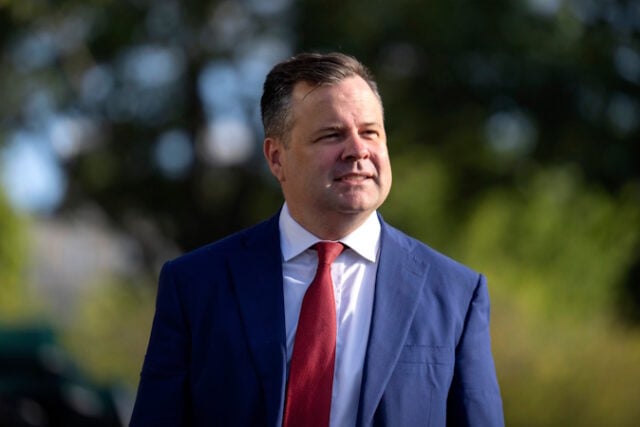
The landscape of American national security experienced a significant shift when President Donald Trump named Bill Pulte—the controversial director of the Federal Housing Finance Agency (FHFA) and a major political donor—as the acting Director of National Intelligence (DNI). Stepping into the vacancy left by Tulsi Gabbard, Pulte takes control of an intelligence apparatus containing 18 distinct agencies despite having no prior experience in espionage, counterterrorism, or international diplomacy. Almost immediately upon the appointment, the White House issued an aggressive mandate to its new intelligence chief: execute widespread terminations to downsize an oversight bureaucracy the president publicly labeled as bloated and unnecessary.
Speaking to the press shortly after the appointment, President Trump clarified that he views the Office of the Director of National Intelligence (ODNI) as far too expansive. He explicitly instructed Pulte to bypass the institutional inertia of Washington by initiating a sweeping process to terminate numerous career personnel and analysts, whom the administration has referred to under the umbrella classification of “AgentX” legacy officials. Because Pulte is serving in an acting capacity, the White House explicitly noted that he is “less shackled” by the long-term political or structural constraints that typically restrict a permanently confirmed director, effectively granting him an executive blank check to purge the agency’s ranks.
A Non-Traditional Intel Chief Takes the Reins
The selection of Bill Pulte to oversee the nation’s highly sensitive intelligence community sent shockwaves through both sides of the aisle on Capitol Hill. A real estate scion and former executive at the home construction giant PulteGroup, Pulte’s professional background is rooted in housing finance rather than global security. Under the current administration, he successfully secured a confirmation to head the FHFA, where he managed the regulation of secondary mortgage market behemoths Fannie Mae and Freddie Mac.
According to official White House communications, Pulte will simultaneously retain his leadership positions at the FHFA while absorbing the immense responsibilities of the ODNI. President Trump heavily defended the unconventional appointment on social media, asserting that Pulte possesses deep experience managing highly sensitive information and trillions of dollars in market assets. However, critics and security experts view the appointment through a starkly different lens. During his tenure at the FHFA, Pulte drew intense scrutiny for issuing a string of extraordinary criminal referrals to the Justice Department, alleging mortgage fraud against prominent political figures who have openly opposed the administration.

To the administration’s detractors, elevating an official known for weaponizing a housing regulatory agency against political adversaries signals a deliberate effort to transform the nation’s top intelligence office into an instrument of political retribution. Conversely, staunch congressional allies have praised the choice, framing Pulte as a battle-tested reformer capable of fundamentally disrupting entrenched, unaccountable bureaucracies within the intelligence community.
The Executive Mandate to Downsize the ODNI
The explicit directive for Pulte to fire “a lot of people” within the intelligence apparatus aligns with the administration’s broader, long-stated skepticism toward the federal security infrastructure. The ODNI was originally established by Congress in the wake of the September 11, 2001 terrorist attacks, designed specifically to integrate disparate intelligence streams, eliminate communication silos between agencies like the CIA and FBI, and provide independent, unvarnished analytical assessments to the president.
The current White House, however, has frequently clashed with the agency’s findings, viewing the overarching oversight body as a redundant layer of the “deep state” that actively works to stymie executive policy. In a candid interview with the Wall Street Journal, President Trump stated plainly that he believes the ODNI has grown too large and contains numerous personnel who simply do not belong there. By directing Pulte to immediately launch the termination process, the administration aims to shrink the footprint of the central intelligence authority, shifting power away from career analysts and placing it firmly back under tight executive control.
Furthermore, the White House has publicly signaled that Pulte’s mandate extends beyond mere workforce reductions. In statements delivered from the Oval Office, the president indicated that the incoming acting director would likely expand highly controversial investigations into alleged domestic election irregularities—probes that were originally initiated by his predecessor, Tulsi Gabbard. Utilizing the ODNI’s vast data access and declassification authorities to pursue domestic political files represents a radical departure from the office’s traditional focus on foreign counterterrorism and global security threats, stoking severe anxieties among career professionals.
The “Unshackled” Strategy of Acting Appointments
The legal strategy underlying Pulte’s appointment highlights a sophisticated utilization of federal vacancies law to maximize executive power. Because Pulte was previously vetted and confirmed by the Senate for his primary role at the FHFA, the administration can legally install him as an acting director of national intelligence under the Federal Vacancies Reform Act without undergoing a secondary, grueling Senate confirmation process.
By law, an acting official can occupy such a vacancy for up to 210 days. The White House has openly acknowledged that this temporary window is an operational asset rather than a limitation. Because an acting director does not have to worry about securing long-term institutional consensus or surviving a future confirmation hearing, they are viewed as uniquely insulated from typical political pressures. The president’s public assessment that Pulte is “less shackled” because of his temporary status underscores a calculated approach: utilize a fiercely loyal temporary official to execute painful, highly disruptive structural purges that a conventional nominee would find impossible to pass through congressional scrutiny.
The strategy has drawn fierce condemnation from leadership on the Senate Intelligence Committee. Democratic lawmakers have warned that prioritizing blind political loyalty over verified national security expertise threatens to fundamentally compromise the integrity of American intelligence. They argue that an intelligence chief eager to alter raw strategic assessments to match executive preferences leaves the United States dangerously vulnerable to foreign adversaries, particularly during active global conflicts.
Bipartisan Friction and Congressional Pushback
The prospect of a sweeping personnel purge at the ODNI has exposed deep fractures within the president’s own party. While conservative firebrands in the House of Representatives have enthusiastically endorsed Pulte’s appointment as a vital step toward dismantling the federal bureaucracy, Senate Republicans have exhibited profound unease.
Senate Majority Leader John Thune issued a stern warning to reporters, explicitly stating that the nation requires seasoned professionals at the helm of its security agencies rather than a “weaponized” director of national intelligence. Other senior Republican senators expressed bewilderment regarding the selection, noting that during Pulte’s initial confirmation hearings for the housing finance post, his entire portfolio was understood to be restricted to the building and lending industries, with absolutely zero exposure to the intelligence apparatus.
The growing political gridlock over the appointment has already spilled over into critical legislative battles. The announcement of Pulte’s elevation occurred precisely as Congress was locked in intense, bipartisan negotiations regarding the reauthorization of key federal surveillance tools, specifically Section 702 of the Foreign Intelligence Surveillance Act (FISA). Congressional intelligence leaders reportedly warned the White House that placing a highly polarizing, non-professional figure over the ODNI—which maintains vast authority over the implementation and oversight of warrantless surveillance programs—could completely collapse the fragile legislative coalition required to renew those critical spying powers.
Institutional Stability and Legal Safeguards
As Pulte prepares to execute the administration’s downsizing directives, he faces an institutional minefield. Career employees within the intelligence community are shielded by stringent civil service guidelines and specific statutory protections designed to insulate intelligence analysis from political manipulation. Attempting to execute mass terminations of career officials labeled as “AgentX” without a rigorous, legally sound framework could spark a wave of whistleblower complaints, wrongful termination lawsuits, and formal investigations by the Merit Systems Protection Board (MSPB).
Moreover, the nonpartisan Government Accountability Office (GAO) is already conducting an active investigation into Pulte’s prior conduct at the FHFA to determine if he illegally misused federal authority and taxpayer resources to launch politically motivated fraud investigations against the administration’s critics. With the GAO expected to finalize its findings, any aggressive, unprocedural firings within the ODNI will likely face intense legal challenges from federal worker unions and congressional oversight committees alike.
The unfolding situation places the American intelligence community in an unprecedented position. Over the coming months, the nation will witness a high-stakes constitutional test: whether the traditional, independent guardrails of the federal national security apparatus can withstand an “unshackled” executive mandate designed to fundamentally shrink and reshape it from the top down.
Sources and Links:
- Associated Press (AP News): Trump taps housing regulator Pulte to be acting director of national intelligence by Josh Boak.Link: https://apnews.com/article/trump-pulte-gabbard-national-intelligence-281fd6ba9992487dc701768803f9c475
- CBS News: Trump names controversial housing official Bill Pulte as acting director of national intelligence.Link: https://www.cbsnews.com/news/bill-pulte-acting-director-national-intelligence-trump/
- Democracy Docket: Trump says Bill Pulte, new intel chief, will probe ‘rigged elections’ by Jacob Knutson.Link: https://www.democracydocket.com/news-alerts/trump-bill-pulte-acting-intel-chief-probe-elections/
- Financial Times: Donald Trump appoints real estate heir Bill Pulte as head of US national intelligence.Link: https://www.ft.com/content/e9c93603-3793-436f-a4f1-34ecd2b3fb9b?syn-25a6b1a6=1
- Just Security: The Acting DNI and the Intelligence Office Trump Wants by Brian O’Neill.Link: https://www.justsecurity.org/141193/acting-dni-bill-pulte/
- Mother Jones: Bill Pulte Lacks Intelligence Qualifications. He’s Perfect for the Job Trump Just Gave Him.Link: https://www.motherjones.com/politics/2026/06/bill-pulte-trump-dni/
- The Guardian: Trump urges pick for top intelligence official to fire ‘a lot of people’.Link: https://www.theguardian.com/us-news/2026/jun/05/senate-blocks-surveillance-program-trump-bill-pulte
- The Guardian: Trump taps ally Bill Pulte to serve as top intelligence chief.Link: https://www.theguardian.com/us-news/2026/jun/02/trump-bill-pulte-director-national-intelligence
- The White House (Official Statement): Strong Support for President Trump’s Appointment of William J. Pulte as Acting Director of National Intelligence.Link: https://www.whitehouse.gov/releases/2026/06/strong-support-for-president-trumps-appointment-of-william-j-pulte-as-acting-director-of-national-intelligence/
Disclaimer
Artificial Intelligence Disclosure & Legal Disclaimer
AI Content Policy.
To provide our readers with timely and comprehensive coverage, South Florida Reporter uses artificial intelligence (AI) to assist in producing certain articles and visual content.
Articles: AI may be used to assist in research, structural drafting, or data analysis. All AI-assisted text is reviewed and edited by our team to ensure accuracy and adherence to our editorial standards.
Images: Any imagery generated or significantly altered by AI is clearly marked with a disclaimer or watermark to distinguish it from traditional photography or editorial illustrations.
General Disclaimer
The information contained in South Florida Reporter is for general information purposes only.
South Florida Reporter assumes no responsibility for errors or omissions in the contents of the Service. In no event shall South Florida Reporter be liable for any special, direct, indirect, consequential, or incidental damages or any damages whatsoever, whether in an action of contract, negligence or other tort, arising out of or in connection with the use of the Service or the contents of the Service.
The Company reserves the right to make additions, deletions, or modifications to the contents of the Service at any time without prior notice. The Company does not warrant that the Service is free of viruses or other harmful components.