Moving out, landing a job, and paying your own bills used to be seen as signs that you made it to adulthood. But a new study suggests that financial independence is arriving much later for many Americans.
About 72% of Gen Zers — those born between 1997 and 2012 — and 53% of millennials — born between 1981 and 1996 — still consider themselves financially dependent on their parents, according to Northwestern Mutual’s 2026 Planning & Progress Study.
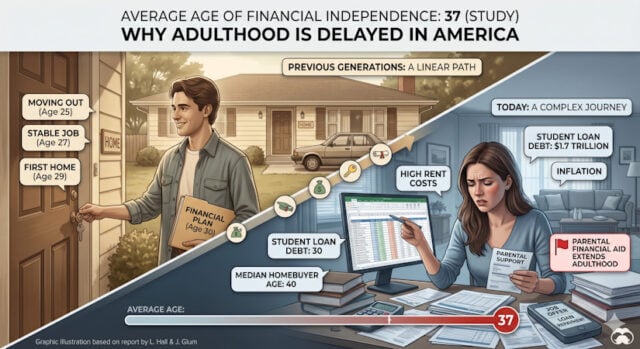
With so many young adults continuing to rely on family support, it’s perhaps no surprise that Americans don’t become financially independent until age 37 on average.
Why financial independence takes longer now
More than half of respondents said achieving financial independence is harder today than it was for previous generations, according to the survey.

The findings come as Americans face a range of economic pressures, from high housing costs to student loan debt and persistent inflation. The median age of first-time homebuyers reached a record high of 40 in 2025, according to the National Association of Realtors; high home prices and elevated mortgage rates continue to price many younger Americans out of the housing market.
Housing costs may be the single biggest factor delaying financial independence, according to certified financial planner Bobbi Rebell, author of How to Be a Financial Grownup.
“Everyone has to live somewhere,” Rebell tells Money. “There is no way to avoid it other than to live with someone else who is paying the cost, which is often parents.”
Meanwhile, Americans collectively carry roughly $1.7 trillion in student loan debt, a burden that can not only delay homeownership but also make it harder to save, invest and build financial stability.
While not everyone takes on student loans, Rebell says debt can make it harder for borrowers to achieve other financial goals during their early earning years. (The average borrower spends 16 to 19 years repaying their student loans.)
The result is a timeline that looks very different from previous generations. Traditional milestones such as moving out, buying a home and becoming fully self-sufficient are increasingly happening later in life — if at all.
“Adulting used to be more linear and, in many ways, [easier] to make sense of for young people,” Rebell says.
More parents are also helping adult children cover major expenses or contributing money toward a starter home, she adds, effectively extending financial support well into adulthood. A recent TD Bank survey found that 67% of first-time homebuyers either received or plan to receive money from a family member.
Will you ever become financially independent? Maybe not
For some Americans, financial independence feels increasingly out of reach. Roughly 1 in 5 respondents in the Northwestern Mutual survey said they don’t expect to ever reach that goal, a sentiment that remained relatively consistent across generations.
Rebell says that perception may partly reflect changing expectations about what financial independence looks like.
“It may mean living a lifestyle that is not on the same economic level as their parents,” she adds. “It may mean more roommates than they would like. It may mean working in a job because the pay is higher and they get health insurance even if they don’t like it.”
While younger adults were more likely to report relying on parental support, the trend wasn’t limited to Gen Z and millennials. About one third of Gen Xers (born between 1965 and 1980) also said they consider themselves financially dependent on their parents, suggesting that monetary support between generations can stretch well into adulthood.
“This is a massive wake-up call for America,” Jeff Sippel, chief strategy officer at Northwestern Mutual, said in a news release. “Boomers and Gen X have memories of their parents’ retirement — grounded in defined benefits and pensions — and see that their path will look very different.”
Disclaimer
Artificial Intelligence Disclosure & Legal Disclaimer
AI Content Policy.
To provide our readers with timely and comprehensive coverage, South Florida Reporter uses artificial intelligence (AI) to assist in producing certain articles and visual content.
Articles: AI may be used to assist in research, structural drafting, or data analysis. All AI-assisted text is reviewed and edited by our team to ensure accuracy and adherence to our editorial standards.
Images: Any imagery generated or significantly altered by AI is clearly marked with a disclaimer or watermark to distinguish it from traditional photography or editorial illustrations.
General Disclaimer
The information contained in South Florida Reporter is for general information purposes only.
South Florida Reporter assumes no responsibility for errors or omissions in the contents of the Service. In no event shall South Florida Reporter be liable for any special, direct, indirect, consequential, or incidental damages or any damages whatsoever, whether in an action of contract, negligence or other tort, arising out of or in connection with the use of the Service or the contents of the Service.
The Company reserves the right to make additions, deletions, or modifications to the contents of the Service at any time without prior notice. The Company does not warrant that the Service is free of viruses or other harmful components.