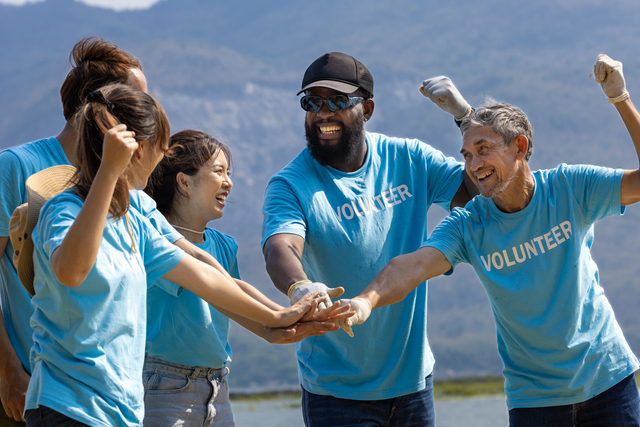
New research shows just one weekly activity could help you live a longer, healthier life: volunteering.
The study, set to be published in the January issue of Social Science & Medicine, found that volunteering—even for just one hour a week—is linked to slower biological aging, which reflects how old your cells and tissues appear compared to your actual age.
The researchers controlled for other health variables that can slow biological aging—including frequency of physical activity, smoking status, binge drinking, obesity, and more—and still found a connection between volunteering and slower biological aging.
Here’s what the study found, what biological age really means, and why volunteering could lead to a longer life.

The Link Between Volunteering and Biological Aging
Researchers analyzed self-reported data from 2,605 Americans aged 62 and older. They examined how often participants volunteered, noted if they were working or retired, and determined their biological age using advanced tools to measure aging at a cellular level.
The results showed that people who volunteered for one to four hours per week experienced slower biological aging compared to those who didn’t volunteer at all.
Retirees seemed to benefit the most, with a stronger association between volunteering and slower aging than current members of the workforce, even with as little as one hour of volunteering a week.
Also, the more someone volunteered, the more pronounced the health impact became. Volunteering more than four hours a week was associated with the greatest reduction in biological age acceleration, regardless of one’s work status.
This aligns with previous research showing that volunteering can reduce mortality among older adults. A 2023 study used a similar method to look at the impact of volunteering on biological aging and also found that volunteering was associated with slower biological aging. The new study found additional differences between retired and working individuals.
Still, the new research isn’t without limitations. “Volunteering is not an isolated act,” Sajad Zalzala, MD, longevity physician and medical director of AgelessRx, told Health.
“In order to volunteer, you have to be in good health. You have to be optimistic about your fellow man. You have to have enough free time and income,” Zalzala said. “The researchers attempted to compensate for all these other variables that are known to improve health, but it’s really hard to do that.”
What Is Biological Age?
Biological age is a measurement of how old your cells and tissues are and reveals how slowly or quickly you’re aging compared to your chronological age, which is simply how many years you’ve been alive.
There are a number of different tests that can determine biological age, from examining biomarkers like blood pressure and heart rate to observing physical appearance like wrinkles and gray hair.
One common method for assessing biological age—that was used in the new study—is epigenetic tests, which examine how your behaviors and environment cause changes in the expression of your DNA.
“As we age, there’s wear and tear on our genetic material of DNA,” Gary Small, MD, chair of psychiatry at Hackensack University Medical Center, told Health. “So you’re normally looking at chronologic age, but now we can measure that against so-called biological age, which looks at how the cells and tissues age, which is a predictor of mortality.“
For example, Zalzala said, if a 40-year-old’s biological age is 60, that could be an indicator of poor health and reduced longevity. On the flip side, if someone’s biological age is younger than their chronological age, that’s a sign of better health and a potentially longer life expectancy.
However, it’s worth noting that the science of epigenetic tests may not be mature enough to put too much weight into the data just yet, Zalzala cautioned.
Why Volunteering Could Lead To Healthier Aging
So why does volunteering have such a profound effect on health and longevity? Experts point to the combination of physical, social, and psychological benefits.
First, volunteering often involves physical activity, like walking, which contributes to healthier aging.
Social connections also play a key role. “We live in a society where we tend not to be as connected as we should be,” Zalzala said. “Volunteering can provide that social network.”
This can reduce stress and improve cognitive function.1 “We know that loners do not age well,” Small added. “If you’re isolated, you don’t have many conversations. You don’t have the emotional connection with others. Those kinds of experiences help us extend life expectancy.”
Volunteering can also create a sense of purpose, improving mental health and buffering any loss of important roles, like spouse or parent, as we age, according to the study authors.
“Volunteering can give us a bit of a psychological lift and make an individual feel like they’re trying to do something to make the world better,” Zalzala said.
Whether it’s mentoring, organizing community events, or passing out meals, volunteering may just help you live longer—and better. “Hopefully, this will get the attention of policymakers, and we can encourage people to volunteer more,” Small said.
Disclaimer
Artificial Intelligence Disclosure & Legal Disclaimer
AI Content Policy.
To provide our readers with timely and comprehensive coverage, South Florida Reporter uses artificial intelligence (AI) to assist in producing certain articles and visual content.
Articles: AI may be used to assist in research, structural drafting, or data analysis. All AI-assisted text is reviewed and edited by our team to ensure accuracy and adherence to our editorial standards.
Images: Any imagery generated or significantly altered by AI is clearly marked with a disclaimer or watermark to distinguish it from traditional photography or editorial illustrations.
General Disclaimer
The information contained in South Florida Reporter is for general information purposes only.
South Florida Reporter assumes no responsibility for errors or omissions in the contents of the Service. In no event shall South Florida Reporter be liable for any special, direct, indirect, consequential, or incidental damages or any damages whatsoever, whether in an action of contract, negligence or other tort, arising out of or in connection with the use of the Service or the contents of the Service.
The Company reserves the right to make additions, deletions, or modifications to the contents of the Service at any time without prior notice. The Company does not warrant that the Service is free of viruses or other harmful components.