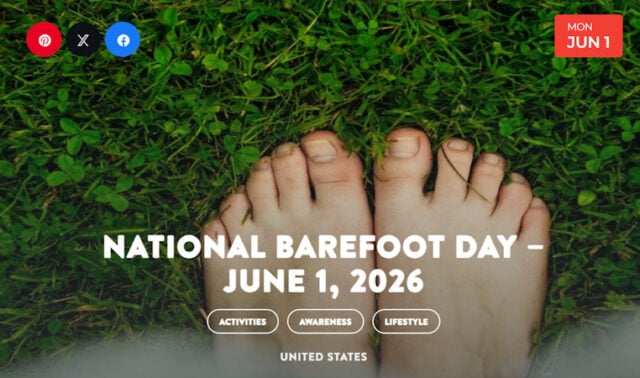
National Go Barefoot Day is observed on June 1. This day is an opportunity to kick off your shoes and run barefoot through the cool grass! More importantly, it is a day to help support a charity that provides millions of underprivileged children all around the world with shoes.
HOW TO OBSERVE – Now is a good time to clean out your closets and donate a pair or two of gently used shoes to a charitable organization in your area or see the following for information: Soles4Souls organization.
- 40000 BC – Archaeological and anatomical evidence from ancient skeletons in Eurasia suggests that humans began using simple protective footwear at least 40,000 years ago, as toe bones show reduced robustness consistent with shoe use instead of habitual barefoot walking.
- 3100 BC – In ancient Egypt, going barefoot or wearing simple sandals was common, and priests in particular performed many temple rituals barefoot as a sign of ritual purity and direct contact with the sacred ground of the gods.
- 5th Century BC – Classical Greek writers described footwear as a marker of status, with wealthier citizens wearing crafted sandals or boots while many poorer people remained barefoot, illustrating how bare feet became linked socially with poverty and low rank.
- 13th Century – By the Kamakura period in Japan, the custom of removing footwear before entering homes and sacred spaces such as Shinto shrines and Buddhist temples was well established, reflecting ideas of cleanliness and spiritual respect that endure in Japanese culture.
- 1300s – In Britain, King Edward II declares barleycorn as a means to measure shoe sizes.
- 1837 – Shoemaker Joseph Sparkes Hall invents the first women’s boots for Queen Victoria.
- 1883 – Jan Ernst Matzeliger invents the lasting machine that can produce 700 pairs of shoes per day making footwear accessible to everyone
- 1887 – The term ‘sneakers’ is used for the first time when this type of shoe, that doesn’t make much noise is introduced.
- 1960 – Ethiopian runner Abebe Bikila won the Rome Olympic marathon barefoot after finding provided shoes uncomfortable, setting a world record and drawing global attention to the performance potential of unshod running.
- 2004 – Public health and humanitarian campaigns increasingly highlighted that hundreds of millions of children lacked adequate shoes; in this context, innovators such as The Shoe That Grows (concept mid‑2000s, formal launch later) promoted adjustable footwear to protect barefoot children from soil‑transmitted diseases and injury.
- 2009 – Publication of Christopher McDougall’s book “Born to Run” popularized the idea that humans evolved to run barefoot or in minimal shoes, helping spark a global barefoot and minimalist running movement that questioned heavily cushioned footwear and inspired new biomechanical research.
- An estimated 300 million children around the world don’t have any shoes at all.
- Children who only have one pair of shoes will quickly outgrow them.
- Chlldren without shoes can’t attend school as they are usually part of the uniform.
- Physical activity is improved, including walking, running, jumping and playing.
- It has been found that growing up walking barefoot most of the time can increase the width of the feet.
- Around four centuries ago, the European upper-class, wore six-inch heels to signify their status.
- Soles4Souls created National Go Barefoot Day after the 2004 Tsunami disaster to support those affected by the event. Since 2005, over 56 million pairs of shoes have been donated worldwide since 2005.
- Neil Armstrong’s shoes worn on the moon are floating somewhere in space as he discarded them fearing they would carry contaminated particles.
- Not long ago, shoes did not have a left and right foot and were all identical.
- Better balance – your balance system is awakened when your feet touch the ground. This is essential for elderly people, as being off balance can cause trips or falls and even more serious health problems.
- Better circulation – barefoot means muscles that haven’t been used for a while are back in use, as well as increased blood flow to the feet and legs. More blood flow means less aches and pains, too!
- Lower blood pressure – there have been studies showing increased stimulation on the bottom of your feet can lower your blood pressure.
- Reflexology – exposing your feet to different surfaces can stimulate the nerve endings on the bottom of your feet. Reflexology has great benefits from reducing stress and tension, strengthening the immune system, and reducing inflammation.
- Better foot positioning
- Improved posture
- Relief from footwear restrictions
- In Hindu and Buddhist temples, visitors leave footwear outside to maintain ritual purity; in mosques, Muslims pray barefoot or in socks on clean prayer carpets; and some Eastern Christian traditions preserve the custom of clergy serving at the altar without shoes.
- In Japan, it is standard to remove outdoor shoes at the entrance of homes, many schools, some restaurants, and traditional inns, then switch to indoor slippers or go barefoot or in socks.
- Traditional martial arts like karate, taekwondo, and judo emphasize barefoot practice to improve stability, tactile feedback, and respect for the training floor, while yoga and Pilates rely on bare feet for grip and alignment.
Sources:

Disclaimer
Artificial Intelligence Disclosure & Legal Disclaimer
AI Content Policy.
To provide our readers with timely and comprehensive coverage, South Florida Reporter uses artificial intelligence (AI) to assist in producing certain articles and visual content.
Articles: AI may be used to assist in research, structural drafting, or data analysis. All AI-assisted text is reviewed and edited by our team to ensure accuracy and adherence to our editorial standards.
Images: Any imagery generated or significantly altered by AI is clearly marked with a disclaimer or watermark to distinguish it from traditional photography or editorial illustrations.
General Disclaimer
The information contained in South Florida Reporter is for general information purposes only.
South Florida Reporter assumes no responsibility for errors or omissions in the contents of the Service. In no event shall South Florida Reporter be liable for any special, direct, indirect, consequential, or incidental damages or any damages whatsoever, whether in an action of contract, negligence or other tort, arising out of or in connection with the use of the Service or the contents of the Service.
The Company reserves the right to make additions, deletions, or modifications to the contents of the Service at any time without prior notice. The Company does not warrant that the Service is free of viruses or other harmful components.