A major legal battle over the aesthetic and structural identity of Washington D.C.’s monument landscape reached a dramatic turning point. U.S. District Judge Christopher Cooper issued a sweeping 94-page opinion striking down the unilateral rebranding of the John F. Kennedy Center for the Performing Arts. The court ruled that the institution’s Board of Trustees had violated federal law by altering the facility’s official designation to include President Donald Trump’s name.
In addition to ordering the total removal of Trump’s name from the physical facade and all official branding materials within 14 days, the federal judge blocked a contentious White House-backed plan to shutter the venue for a massive, two-year structural overhaul. The dual rulings represent a stinging legal defeat for the administration’s broader push to imprint the president’s name on federal buildings, prompting an immediate, fiery response from Trump, who declared he would wash his hands of the institution entirely and transfer its operations to Congress.
The Core Legal Conflict: Statutory Authority vs. Board Monopolies
The heart of the legal crisis lies in the distinct statutory boundaries created by Congress when the National Cultural Center was established. Originally signed into law by President Dwight D. Eisenhower and subsequently renamed to honor the assassinated President John F. Kennedy in 1964, the center operates under a specific foundational federal law known as an “organic statute.”
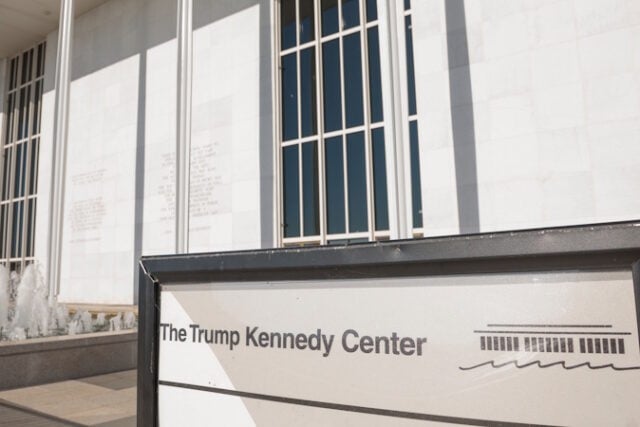
Judge Cooper’s opinion focused squarely on this legislative history. In December 2025, the Kennedy Center’s Board of Trustees—reconstructed with handpicked Trump loyalists who had voted the president into the role of chairman—passed a resolution to rename the complex the “Donald J. Trump and John F. Kennedy Memorial Center for the Performing Arts.” Shortly thereafter, the facility’s online presence and physical entryways were altered to display the abbreviated title, “The Trump Kennedy Center.”

The court rejected the board’s defense that it possessed the sweeping administrative power to alter the naming conventions of the building as part of its operational oversight.
“The Kennedy Center’s organic statute makes crystal clear that the Center is to be named for President Kennedy, and it cannot bear any other formal name or public memorial based on the Board’s unilateral say-so,” Cooper wrote. “Congress gave the Kennedy Center its name, and only Congress can change it.”
The ruling permanently bars the center from installing, maintaining, or displaying any physical or digital signage suggesting the building is dedicated to or named after anyone other than John F. Kennedy. Legal scholars noted that the decision reinforces a basic tenet of administrative law: executive branches and federal boards cannot override explicit designations written directly into the text of congressional statutes.
The Blocked Renovations and “Preordained” Closures
Beyond the high-profile fight over the naming rights, the court dealt a fatal blow to the administration’s plans for a complete physical shutdown of the complex. Following a unanimous board vote on March 16, the administration announced that the Kennedy Center would close its doors to the public immediately following the July 4th celebrations for a period of roughly two years to facilitate a $257 million renovation.
The scope of the project had caused deep alarm among historic preservationists and legislators. Documents pulled during discovery revealed the administration planned to “fully expose” the building’s core structural steel skeleton. Critics pointed to other high-profile architectural disruptions—such as the complete demolition of the White House East Wing to make room for a presidential ballroom and the extensive alterations made to the historic Rose Garden—expressing fear that unsupervised construction would fundamentally compromise the integrity of the living monument.
Judge Cooper ruled that the board had been “derelict in discharging the full range of its responsibilities” when it rubber-stamped the shutdown. The court found that the trustees relied on an “insufficient, one-sided presentation of information” curated by the administration, completely ignoring how a multi-year closure would impact the center’s legal mandate to provide continuous cultural programming and maintain its memorial functions.
The court labeled the decision-making process as “ill-informed and seemingly preordained,” noting that the board had failed to conduct independent architectural or economic assessments before moving to close the venue. While the ruling does not entirely halt localized structural repairs, it forces the board back to the drawing board, ensuring that any future construction timeline must respect the center’s operational mandate.
A Fractured Board and Shifting Bylaws
The ruling also brought to light intense internal political maneuvering within the Kennedy Center’s governing body. The parallel lawsuits prompting the decision were spearheaded by a coalition of architectural preservation groups—including the National Trust for Historic Preservation and the DC Preservation League—alongside Representative Joyce Beatty, an Ohio Democrat who serves as an ex officio member of the board.
Representative Beatty’s legal complaint alleged that during a pivotal virtual board meeting, administration officials explicitly muted her audio feed when she tried to voice opposition to the Trump renaming plan. Following that internal dissent, the board altered its internal bylaws to strip non-voting ex officio members, including sitting members of Congress, of their ability to vote on major procedural resolutions.
Judge Cooper systematically dismantled these changes, declaring the board’s structural manipulation unlawful. In a statement celebrating the decision, Representative Beatty emphasized the civic nature of the space:
“Today’s ruling rightly affirms that this administration’s efforts to rename and close the Center have no basis in law. The Kennedy Center is an institution that belongs to the American people, not to Donald Trump. He has desecrated this sacred memorial for his own vanity.”
Conversely, the Kennedy Center’s executive leadership, via Vice President of Public Relations Roma Daravi, defended the board’s actions. The institution argued that the renaming was a lawful and well-earned recognition of the president’s role in securing $257 million in congressional funding. Center officials expressed confidence that an appeals court would eventually overturn Cooper’s decision.
Attorneys for the center had previously warned the court that removing Trump’s name would inflict “irreparable financial harm.” They noted that Trump had already raised tens of millions of dollars from private donors and committed to securing another $150 million over the coming years—philanthropy they argued was entirely contingent upon his name remaining on the portico. Without that branding, they claimed, the ongoing operations of the venue could become “financially nonviable.”
Political Fallout and Executive Retraction
The fallout from the 94-page judicial reprimand was instantaneous. Taking to his Truth Social platform hours after the ruling dropped, President Trump issued a blistering response targeting Judge Cooper, an appointee of former President Barack Obama. Trump claimed the judge “should be ashamed of himself” and accused the court of leaving a structurally compromised building in a state of dangerous decay.
The president alleged that expert contractors had warned of “rotting beams” and imminent structural failures in the center’s underlying parking garages. He argued that “Radical Left Democrats” were sabotaging critical infrastructure simply out of political animus.
However, rather than committing the Department of Justice to a long-term legal defense of the naming rights, Trump signaled a surprise retreat from the cultural center entirely. Writing that he had no interest in continuing a “hopeless journey into ‘NEVER NEVER LAND'” unless he was permitted to completely overhaul the facility physically, financially, and artistically, Trump announced an abrupt policy pivot. He stated that he had instructed the Department of Commerce to coordinate with lawmakers to arrange a swift, permanent transfer of the Kennedy Center’s operation, maintenance, and management back to Congress.
While the Justice Department issued a brief statement affirming its intent to defend the administration’s right to restore the venue, Trump’s public exhaustion with the project suggests that the 14-day countdown to scrub the “Trump” branding from the building’s white marble walls will proceed without executive intervention. For now, the historic performing arts center remains under its original name, its doors open, and its structural future firmly tied to the halls of Congress.
Sources and Links:
- The Associated Press: Judge says Kennedy Center board broke law putting Trump’s name on building, blocks closure
- The Washington Post: Judge orders Kennedy Center to remove Trump’s name from building
- The Guardian: US judge orders removal of Trump’s name from Kennedy Center
- CBS News: Judge blocks closure of Kennedy Center and orders removal of Trump’s name
- PBS NewsHour: Judge says Kennedy Center board violated law putting Trump’s name on building, blocks closure
- The Times of India: Judge orders removal of Donald Trump’s name from Kennedy Center, blocks closure plan; US president blasts ruling
- Connecticut Public (NPR): Trump’s name must come off of the Kennedy Center, judge rules
- KING 5 News (TEGNA): Federal judge says President Trump’s name must be removed from Kennedy Center
Disclaimer
Artificial Intelligence Disclosure & Legal Disclaimer
AI Content Policy.
To provide our readers with timely and comprehensive coverage, South Florida Reporter uses artificial intelligence (AI) to assist in producing certain articles and visual content.
Articles: AI may be used to assist in research, structural drafting, or data analysis. All AI-assisted text is reviewed and edited by our team to ensure accuracy and adherence to our editorial standards.
Images: Any imagery generated or significantly altered by AI is clearly marked with a disclaimer or watermark to distinguish it from traditional photography or editorial illustrations.
General Disclaimer
The information contained in South Florida Reporter is for general information purposes only.
South Florida Reporter assumes no responsibility for errors or omissions in the contents of the Service. In no event shall South Florida Reporter be liable for any special, direct, indirect, consequential, or incidental damages or any damages whatsoever, whether in an action of contract, negligence or other tort, arising out of or in connection with the use of the Service or the contents of the Service.
The Company reserves the right to make additions, deletions, or modifications to the contents of the Service at any time without prior notice. The Company does not warrant that the Service is free of viruses or other harmful components.