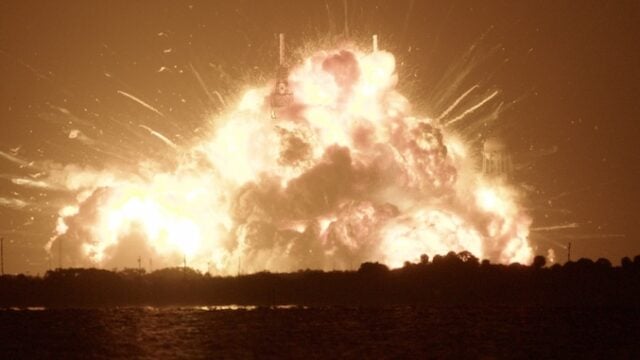
On Thursday night, May 28, 2026, the Florida Space Coast was rocked by a monumental explosion that lit up the night sky, shook local residences, and completely destroyed a heavy-lift New Glenn rocket belonging to Jeff Bezos’s aerospace firm, Blue Origin. The catastrophic anomaly occurred at approximately 9:00 p.m. EDT at Space Launch Complex 36 (LC-36), located at the Cape Canaveral Space Force Station. The incident happened during what was supposed to be a routine prelaunch static fire test—a critical milestone where the rocket’s first-stage engines are ignited at full power while the vehicle remains securely bolted to the launchpad.
The 321-foot-tall (98-meter) heavy-lift vehicle, named in honor of John Glenn, the first American astronaut to orbit Earth, erupted into a massive orange fireball that was visible for over a hundred miles along the Atlantic coast. Within moments, the towering structure crumbled under the force of the blast, leaving a thick plume of black smoke billowing skyward. Emergency crews rushed to the scene to mitigate the unfolding crisis, and flames continued to burn at the pad hours after the initial blast.
Immediate Corporate and Agency Reactions
Shortly after the incident, Blue Origin released an official statement via social media to address the explosion. “We experienced an anomaly during today’s hotfire test,” the company stated on X. “All personnel have been accounted for. We will provide updates as we learn more.”

Jeff Bezos, the billionaire founder of Blue Origin, echoed the sentiment later that evening, emphasizing that human safety had been preserved despite the severe equipment loss. “All personnel are accounted for and safe,” Bezos posted. “It’s too early to know the root cause but we’re already working to find it. Very rough day, but we’ll rebuild whatever needs rebuilding and get back to flying. It’s worth it.”
The aerospace news outlet Spaceflight Now, which captured the terrifying moment on its live streaming cameras, documented the rapid sequence of events that led to the vehicle’s sudden destruction. According to Spaceflight Now, “the blast appeared to originate at or near the base of the rocket’s first stage as its seven BE-4 engines were cycling through ignition.” The sheer force of the explosion blew out windows and rattled walls in nearby residential communities, including Cape Canaveral and Cocoa Beach, where terrified locals flooded social media platforms with videos of the bright orange horizon.
Elon Musk, the founder and chief engineer of Blue Origin’s primary commercial rival, SpaceX, publicly responded to the disaster. Musk, whose own company faced multiple launchpad explosions during the early development of its Falcon and Starship architectures, expressed solidarity with the Blue Origin team, posting on X: “Most unfortunate. Rockets are hard.”
Environmental Concerns and Public Warnings
By Friday morning, the focus shifted from immediate fire suppression to damage control and public safety. Space Launch Delta 45, the U.S. Space Force unit responsible for operations at Cape Canaveral, issued an urgent advisory to residents along Florida’s eastern coast. Military officials warned that the extreme energy of the explosion had propelled debris far beyond the boundaries of Launch Complex 36, and much of it had been pushed out over the Atlantic Ocean.
“Debris from the anomaly could wash ashore along publicly accessible areas over the coming days and weeks,” Space Launch Delta 45 cautioned in a public statement. “It is critical to report sightings to 911 for proper removal and mitigation. The debris could be hazardous and direct contact could pose health risks.”
To manage the recovery of hardware essential to the upcoming investigation, Blue Origin established a dedicated Wreckage Management Hotline (321-222-4355) and an email address (missionrecovery@blueorigin.com). The company urged beachgoers and coastal property owners not to touch or attempt to move any metallic or composite material they might find. Local emergency management personnel clarified that while the wreckage itself carries industrial chemical hazards, there was no ongoing toxic threat to the public from airborne fumes.
Commercial Fallout and Payload Status
The New Glenn rocket destroyed in Thursday’s blast was being prepped for its fourth-ever mission (NG-4), which had been tentatively scheduled to lift off as early as June 4, 2026. The primary objective of the flight was to deploy a batch of 48 low-Earth orbit (LEO) internet satellites for Amazon’s Project Kuiper—a massive satellite constellation designed to compete with SpaceX’s Starlink broadband network.
In a stroke of operational fortune, the 48 Amazon satellites were not mounted inside the rocket’s payload fairing at the time of the static fire. Standard industry practice dictated that the expensive satellite payload remain safely housed in a cleanroom integration facility nearby until the first-stage propulsion system proved its flight-readiness on the pad. While the satellites survived unscathed, Amazon’s broader network deployment strategy has suffered a devastating blow, leaving dozens of functional spacecraft stranded on the ground without a designated heavy-lift vehicle to launch them.
Ironically, United Launch Alliance (ULA) was scheduled to lift off an Atlas V rocket from an adjacent Cape Canaveral pad just twelve hours after the explosion, carrying an entirely separate batch of Amazon Kuiper satellites. Space Force officials confirmed that the ULA launch and other upcoming operations would proceed as planned, provided that nearby tracking assets were not structurally compromised by the New Glenn blast.
Deep Complications for NASA’s Artemis Program
While the commercial loss for Amazon is substantial, the strategic implications for the United States government and NASA are profoundly disruptive. The New Glenn architecture is a core pillar of NASA’s long-term Artemis program, which aims to establish a permanent human presence on and around the Moon.
Only days before the explosion, NASA had officially selected Blue Origin for a highly sought-after $188 million contract to launch the first of three uncrewed lunar missions intended to drop massive infrastructure—including heavy automated moon buggies—onto the lunar regolith. Furthermore, under the Artemis IV framework slated for later this decade, Blue Origin’s human-rated “Blue Moon” lander is scheduled to ferry astronauts from the Orion spacecraft directly to the lunar surface.
NASA Administrator Jared Isaacman spoke bluntly about the high stakes and the immense difficulty of deep-space vehicle engineering. “Spaceflight is unforgiving, and developing new heavy-lift launch capability is extraordinarily difficult,” Isaacman wrote in a statement posted to X. “NASA will work with our partners to support a thorough investigation of this anomaly, assess near-term mission impacts, and get back to launching rockets. We will provide information on any impacts to the Artemis and Moon Base programs as it becomes available.”
Industry experts warn that the explosion will completely reshape the timeline for U.S. lunar exploration. Aerospace journalists noted that because Launch Complex 36 is the only operational launchpad in the world configured to handle the unique liquid natural gas (LNG) and liquid oxygen plumbing required by the massive New Glenn rocket, the physical destruction of the pad’s ground support equipment effectively sidelines Blue Origin from major space operations for a year or more. The intense thermal energy and shockwave of the blast likely warped the pad’s steel umbilical towers, fractured concrete foundations, and obliterated complex propellant distribution networks.
A Program Beset by Prior Setbacks
The catastrophic explosion on May 28 represents the most severe failure in Blue Origin’s 26-year history, but it is not the first problem to plague the New Glenn program. The vehicle had only just returned to active status.
During its third operational mission (NG-3) in April 2026, the rocket successfully lifted off but suffered a critical cryogenic failure in its second stage as it entered orbit. That upper-stage malfunction led to the total loss of a commercial communications satellite, prompting a mandatory grounding and a comprehensive mishap investigation overseen by the Federal Aviation Administration (FAA).
Following weeks of data reviews and hardware modifications, the FAA finally cleared New Glenn to return to flight on May 22, 2026. Thursday’s ill-fated static fire test was the very first time Blue Origin engineers had attempted to fire up a fully integrated vehicle since receiving federal clearance to resume operations.
Given that this second catastrophic failure occurred less than a week after the lifting of the previous grounding order, Blue Origin is facing an uphill battle. The FAA will undoubtedly initiate a formal, sweeping investigation into the root cause of the LC-36 explosion. Investigators will be tasked with combing through thousands of channels of high-rate telemetry, analyzing high-speed launchpad footage, and meticulously examining recovered pieces of physical wreckage to determine whether the failure originated from a design flaw in the BE-4 engines, a structural breach in the propellant tanks, or a software error in the automated prelaunch sequencing.
Until the investigation concludes and the scorched remnants of Launch Complex 36 are entirely rebuilt, Jeff Bezos’s multi-billion-dollar dream of rivaling SpaceX and anchoring NASA’s return to the Moon will remain grounded in the ashes of the Space Coast.
Sources Used & Links:
- Spaceflight Now: Blue Origin’s New Glenn rocket explodes during prelaunch testing at Cape Canaveral
- Space.com: Blue Origin’s New Glenn rocket explodes in massive fireball during prelaunch test
- The Jerusalem Post: WATCH: Jeff Bezos’s Blue Origin New Glenn rocket explodes on launch pad
- The Times of India: Fireball on the launch pad: Blue Origin rocket explodes during engine test
- CBS News: Blue Origin explosion threatens to delay NASA’s moon program
- The Hindustan Times: Blue Origin’s Glenn rocket explodes at launch pad in Florida’s Cape Canaveral
- TIME Magazine: Jeff Bezos’s Blue Origin Rocket Explodes Into Flames on Launch Pad
- ClickOrlando (WKMG-TV): Here’s what we know so far about the Blue Origin rocket explosion on Florida’s coast
- The Guardian: Blue Origin rocket explodes during test in latest setback for Jeff Bezos-owned company
- Associated Press: Blue Origin rocket explodes on the launch pad during an engine-firing test
Disclaimer
Artificial Intelligence Disclosure & Legal Disclaimer
AI Content Policy.
To provide our readers with timely and comprehensive coverage, South Florida Reporter uses artificial intelligence (AI) to assist in producing certain articles and visual content.
Articles: AI may be used to assist in research, structural drafting, or data analysis. All AI-assisted text is reviewed and edited by our team to ensure accuracy and adherence to our editorial standards.
Images: Any imagery generated or significantly altered by AI is clearly marked with a disclaimer or watermark to distinguish it from traditional photography or editorial illustrations.
General Disclaimer
The information contained in South Florida Reporter is for general information purposes only.
South Florida Reporter assumes no responsibility for errors or omissions in the contents of the Service. In no event shall South Florida Reporter be liable for any special, direct, indirect, consequential, or incidental damages or any damages whatsoever, whether in an action of contract, negligence or other tort, arising out of or in connection with the use of the Service or the contents of the Service.
The Company reserves the right to make additions, deletions, or modifications to the contents of the Service at any time without prior notice. The Company does not warrant that the Service is free of viruses or other harmful components.