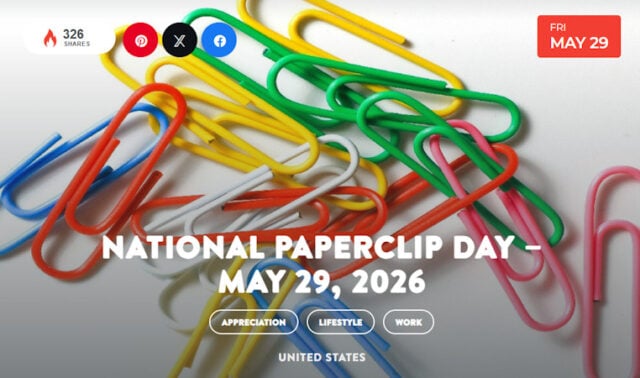
National Paperclip Day is on May 29 and we are pulling out all the fun factoids and creative hacks that this humble little invention brings with it. The paperclip, in various forms, shapes, and sizes, has been around for a little under two centuries now, although who knows what the Egyptians invented to keep their papyri together. Such is the fame of the paperclip, that several memorials have also been created to honor it, for several different reasons. So we’re here to dispel the myth that the paperclip is simply a dispensable office supply by revealing the significance and alternative uses of this simple twist of metal.
- 1841 – British inventor Samuel Slocum patents a machine for making pins on paper, an early attempt to fasten sheets together before modern paper clips existed.
- 1867 – While many may have claimed earlier invention of the paperclip, according to the Early Office Museum, Samuel B. Fay received the first patent for a “bent wire paper clip” in the United States in 1867.
- The original intention of Fay’s clip was to attach tickets to the fabric. However, U.S. patent 64,088 recognized that it could also be used to attach papers together.
- 1870s – The Gem paperclip, most likely produced in Britain in the early 1870s by The Gem Manufacturing Company, was never patented. It is the most common type of wire paper clip and is still in use today.
- 1877 – Another notable name to receive a patent for his paperclip design in the United States was Erlman J. Wright in 1877. At that time, he advertised his clip for use in fastening newspapers.
- 1877 – Cornelius J. Brosnan patents an “improvement in paper-fasts” that relies on a bent wire design, showing the growing interest in reusable paper fasteners
- 1892 – It was introduced to the United States around 1892 and in 1904, Cushman & Denison registered a trademark for the “Gem” name in connection with paper clips. Paperclips are still sometimes called Gem clips.
- 1899 – As many as 50 others received patents for similar designs prior to 1899.
- 1899 – William Middlebrook of Waterbury, Connecticut, patented a machine for making paperclips of the Gem design in 1899. The Gem paperclip was never patented.
- 1901 – Norwegian inventor Johan Vaaler secures patents in Germany and the United States for a paper clip design, which was later adopted in Norway as a national innovation.
- 1940 – Students at Oslo University start wearing the paperclip as a symbol of resistance to Nazi rule.
- 1941 – Early in WWII, Norwegians were particularly persistent in their development of symbols. The paper clip represented “sticking together” for a time until the Nazis caught on and banned the wearing of paper clips.
- According to a March 5, 1941, Provo, Utah newspaper article (The Daily Herald), the Norwegians switched to new symbols as quickly as the bans could be issued.
- 1997 – Microsoft introduces the animated paper clip assistant, nicknamed Clippy, in Office 97, turning the humble clip into a pop culture technology icon.
- 1998 – “The Paperclip Project,” a Holocaust Education class at Whitwell Middle School in Whitwell, Tennessee, creates an internationally recognized movement.
- 2004 – Released in 2004, an American documentary traces the story of the inception of the Paper Clips Project, which began as a project at Whitwell Middle School, Tennessee, to raise awareness about the 6 million Jewish lives lost during the Holocaust.
- 2005 – A paperclip bought a house – Canadian blogger Kyle MacDonald buys a house, a year after trading in a red paperclip.
- 2007 – In Sandvika, Norway, a five-meter-tall paperclip was erected as a national reminder of its role in Norwegian history. However, a red paperclip memorial was created in Kipling, Saskatchewan in 2007, and that became the biggest paperclip.
- 2010 – In Miass, Russia, Evgeny Stepovik created a huge stainless steel paperclip measuring roughly 30 feet high, which now holds the record for the largest paperclip.
- The Early Office Museum has identified 65 types of paper clips and listed them on its website. From the first patent in 1867, to the Vee-Clip first marketed in 1966, to an unidentified Serbian clip from 2008, the clips vary vastly in design, shape and size.
- The one paper clip that has withstood the test of time is the Gem Paper Clip (introduced in 1892). Its design is considered to be “perfect”, and it has even been featured in a Museum of Modern Art Exhibit.
- American consumers purchase some 11 billion paper clips a year. This astounding figure amounts to about 35 paper clips per person in the United States.
- Paperclips are not just for holding papers together. There are many other things that you can do with them!
- Replace a zipper tab
- Unclog a spray bottle
- Unclog a single-serve coffee maker
- Hem holder
- Emergency hooks for broken necklaces
- As emergency key chains (they’re really built almost the same as a normal key chain!)
- As emergency zipper tabs (few things are more irritating than being locked inside your jacket!)
- As DIY fish hooks (because we sometimes run out of authorized equipment, and the fish won’t care as long as there’s a worm!)
- As emergency hair barrettes (sometimes you just need to get that hair out of your face!)
- To hang ornaments whose little stringy thingies have torn (colored paper clips could actually add some color to the tree!)
- As lottery ticket scratchers (for those times when you just got your nails done and don’t want all that gray gunk under them!)
- To unclog narrow holes, like a spray can nozzles, salt and pepper shakers, glue bottle tips, etc.
Sources:

Dunns Online
Interesting Things
Disclaimer
Artificial Intelligence Disclosure & Legal Disclaimer
AI Content Policy.
To provide our readers with timely and comprehensive coverage, South Florida Reporter uses artificial intelligence (AI) to assist in producing certain articles and visual content.
Articles: AI may be used to assist in research, structural drafting, or data analysis. All AI-assisted text is reviewed and edited by our team to ensure accuracy and adherence to our editorial standards.
Images: Any imagery generated or significantly altered by AI is clearly marked with a disclaimer or watermark to distinguish it from traditional photography or editorial illustrations.
General Disclaimer
The information contained in South Florida Reporter is for general information purposes only.
South Florida Reporter assumes no responsibility for errors or omissions in the contents of the Service. In no event shall South Florida Reporter be liable for any special, direct, indirect, consequential, or incidental damages or any damages whatsoever, whether in an action of contract, negligence or other tort, arising out of or in connection with the use of the Service or the contents of the Service.
The Company reserves the right to make additions, deletions, or modifications to the contents of the Service at any time without prior notice. The Company does not warrant that the Service is free of viruses or other harmful components.