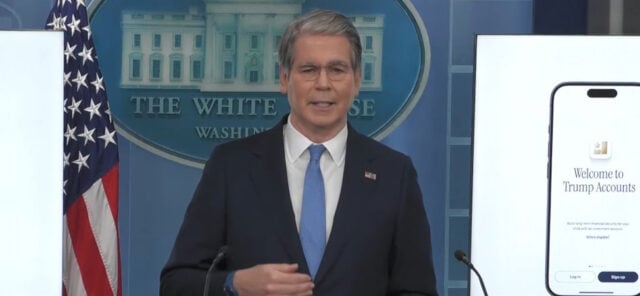
WASHINGTON — In a comprehensive and wide-ranging press briefing at the White House on Thursday afternoon, U.S. Treasury Secretary Scott Bessent outlined the administration’s core economic and national security priorities. Addressing a packed briefing room, Bessent covered a wide range of issues shaping the domestic and international landscape, from intense economic statecraft in the Middle East and Latin America to the shifting spending habits of everyday American consumers at the grocery store and the gas pump.
The press conference served as a vital look into the Treasury Department’s strategic evolution, highlighting a massive structural modernization of the nation’s sanctions architecture, updates on Internal Revenue Service (IRS) operations, and administrative preparation for a historic new piece of American currency.
The Middle East and the “Economic Fury” Doctrine
The central focus of international queries during the briefing was the administration’s aggressive posture in the Middle East, particularly the ongoing geopolitical standoff with Iran. Faced with questions about the possibility of a temporary or interim agreement to ease regional hostilities, Bessent was firm, downplaying any immediate pivot toward accommodation while explaining the parameters of the administration’s “Economic Fury” maximum pressure campaign.
“Our objective is clarity and impact, not permanent, open-ended stalemates,” Bessent stated. “Everything depends on what the president wants to do, and President Trump is not going to make a bad deal for the American people.”

Bessent addressed recent speculation regarding potential off-ramps or interim diplomatic frameworks by reinforcing that any hypothetical engagement would require an absolute, verifiable shift in behavior from Tehran. He underscored that the current strategy has successfully imposed a financial stranglehold on the regime, cutting deep into its projected oil revenues, disrupting its shadow banking networks, and actively neutralizing its illicit financial flows.
Furthermore, Bessent issued an explicit warning regarding maritime security in the region, specifically addressing threats to shipping lanes. He noted that the United States is closely monitoring logistical compliance in critical waters, emphasizing that the Treasury would not hesitate to target secondary actors or neighboring jurisdictions—mentioning potential consequences for entities in Oman or surrounding areas—should they assist in implementing restrictive tolling systems or facilitating sanctions evasion in the vital Strait of Hormuz.
The Secretary called on global allies, particularly European partners, to match the American momentum by formally designating Iranian financiers, dismantling front companies, and shuttering associated bank branches.
Modernizing the Sanctions Architecture: Russia and Cuba
A significant portion of the press conference was dedicated to explaining a major structural shift within the Office of Foreign Assets Control (OFAC). Bessent formally announced the launch of a comprehensive sanctions modernization initiative aimed at ensuring American economic restrictions remain highly targeted, agile, and effective rather than lingering indefinitely as blunt instruments.
As a demonstration of this new policy, Treasury announced the removal of 76 outdated entries from its Specially Designated Nationals and Blocked Persons (SDN) List. The targets removed included deceased individuals, scrapped or decommissioned maritime vessels, and defunct financial networks established over a decade ago that no longer possess sufficient identifiers for modern screening or present an ongoing national security threat.
"The success of our sanctions should be measured in terms of effect, impact, and national security benefit—not just based on the number of names Treasury

places on a list."
— Treasury Secretary Scott Bessent
Bessent utilized this policy pivot to explain how the U.S. is calibrating its ongoing economic containment strategies against major adversaries, notably Russia and Cuba:
Russia
Regarding the extensive sanctions framework imposed on Russia, Bessent emphasized that the Treasury is actively tailoring its architecture to combat increasingly sophisticated evasion schemes, particularly involving secondary networks and shadow fleets. Rather than allowing restrictions to become permanent geopolitical fixtures that risk causing long-term, unpredictable generational impacts, the administration is focusing heavily on real-time adjustments. The goal remains to directly penalize the state’s military-industrial capabilities and revenue streams while minimizing unintended spillover effects on the broader global financial system.
Cuba
Addressing policy toward Cuba, the Secretary indicated that the modernization initiative involves rigorous, interagency vetting to ensure that any adjustments to existing sanctions accurately match current security realities. Bessent reiterated that sanctions are designed to be dynamic tools of economic statecraft aimed at altering state behavior, rather than permanent structural penalties. Any active measures maintained or adjusted regarding Cuba will remain strictly aligned with the administration’s goals of promoting regional stability and curbing state-sponsored disruption.
Consumer Spending, Inflation, and Energy Dynamics
Turning his attention toward domestic affairs, Bessent analyzed the current state of the American consumer, acknowledging the persistent economic pressures families are experiencing across the country. The Secretary focused heavily on the intersection of consumer spending behavior, energy costs, and utility prices.
While noting that overall economic resilience remains notable, Bessent observed that high prices at the grocery store and volatile gas prices continue to influence daily household decisions. The administration’s domestic policy, he explained, is designed to complement the monetary actions of the Federal Reserve by focusing heavily on supply-side interventions.
- Energy Infrastructure: The Secretary argued that breaking long-term vulnerabilities to energy price shocks requires a dual approach: aggressively boosting domestic fossil fuel production in the short term to lower baseline fuel costs, while systematically integrating advanced energy technologies to bolster long-term domestic infrastructure.
- Economic Growth Projections: When pressed on the nation’s long-term fiscal health and debt obligations, Bessent expressed strong confidence in the transformative power of emerging technologies. He reiterated his perspective that widespread integration of Artificial Intelligence (AI) and automated systems will catalyze substantial productivity gains across multiple sectors, ultimately generating the robust economic expansion and tax revenues necessary to stabilize the nation’s fiscal trajectory.
IRS Reform and the Anticipated $250 Bill
In the final segment of the briefing, Bessent addressed highly anticipated developments involving internal revenue administration and a historic proposal currently making its way through the legislative process.
IRS and Administrative Efficiency
Bessent provided brief updates on the ongoing structural evolution of the Internal Revenue Service (IRS). In alignment with the broader Treasury-wide modernization push, the administration is emphasizing operational efficiency, technological upgrading, and a focus on high-risk compliance areas, ensuring that the agency functions with maximum accountability to the American taxpayer.
The Commemorative $250 Bill
Reporters questioned the Secretary extensively regarding recent reports that the Bureau of Engraving and Printing has initiated preliminary preparations for a new $250 denomination of legal tender. Bessent confirmed that the Treasury Department has taken limited, preparatory steps in anticipation of the potential passage of stalled legislation currently introduced in Congress.
The proposed legislation, initially put forward by Representative Joe Wilson (R-S.C.), aims to introduce the unique denomination to commemorate a major milestone in American history. Bessent acknowledged that preliminary design concepts have been reviewed, featuring a portrait of President Donald Trump alongside a 250th anniversary commemorative logo and the President’s official signature. Bessent indicated that while full implementation remains dependent on the ultimate trajectory of the congressional legislation, the agency is ensuring its technical capabilities are fully aligned should the bill clear the legislature.
Sources Consulted and Verifiable Links
The information presented in this comprehensive report is drawn directly from official government communications and live media coverage of the Treasury Department’s actions on May 28, 2026:
- U.S. Department of the Treasury (Official Press Release – May 28, 2026): Treasury Begins Sanctions Modernization Effort by Removing Outdated Entries. Accessible at Treasury Press Release sb0509.
- U.S. Department of the Treasury (Official Remarks – May 19, 2026): Remarks by Secretary of the Treasury Scott Bessent Before the No Money for Terror Conference. Accessible at Treasury Press Release sb0500.
- The Guardian (Live Geopolitical Briefing – May 28, 2026): Middle East crisis live: US Treasury Secretary Scott Bessent leads White House press briefing. Accessible at The Guardian Live Coverage.
- The Guardian (Economic Analysis – May 25, 2026): The world is heading toward a financial crisis – the state of US politics has left us ill-prepared. Accessible at The Guardian Business Analysis.
- Tribune-Review / Associated Press (Currency Legislation Report – May 28, 2026): Treasury Department confirms it has taken limited steps toward a $250 bill featuring Donald Trump. Accessible at TribLive News World Report.
Disclaimer
Artificial Intelligence Disclosure & Legal Disclaimer
AI Content Policy.
To provide our readers with timely and comprehensive coverage, South Florida Reporter uses artificial intelligence (AI) to assist in producing certain articles and visual content.
Articles: AI may be used to assist in research, structural drafting, or data analysis. All AI-assisted text is reviewed and edited by our team to ensure accuracy and adherence to our editorial standards.
Images: Any imagery generated or significantly altered by AI is clearly marked with a disclaimer or watermark to distinguish it from traditional photography or editorial illustrations.
General Disclaimer
The information contained in South Florida Reporter is for general information purposes only.
South Florida Reporter assumes no responsibility for errors or omissions in the contents of the Service. In no event shall South Florida Reporter be liable for any special, direct, indirect, consequential, or incidental damages or any damages whatsoever, whether in an action of contract, negligence or other tort, arising out of or in connection with the use of the Service or the contents of the Service.
The Company reserves the right to make additions, deletions, or modifications to the contents of the Service at any time without prior notice. The Company does not warrant that the Service is free of viruses or other harmful components.