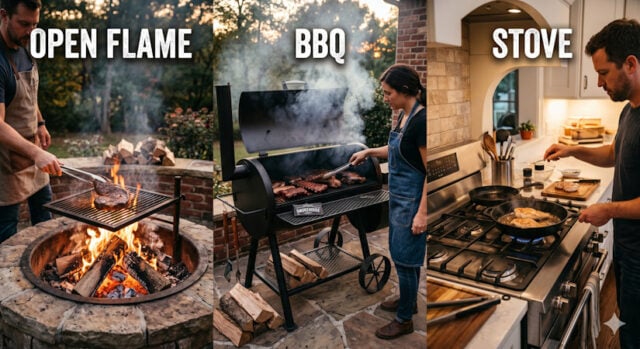
There is a primal instinct that triggers the second a match strikes seasoned hardwood. Long before the food even hits the grate, the scent of shifting wind and glowing embers commands our attention. We have all experienced the undeniable contrast: a ribeye seared on an indoor electric stovetop tastes excellent, but that exact same cut cooked over an open pit feels transformative.
This sensory leap is not a trick of nostalgia or the consequence of fresh outdoor air. When you abandon the controlled environment of a kitchen range for the untamed dynamics of an open flame, you alter the fundamental chemistry of your dinner. Cooking over wood, charcoal, or open fire introduces volatile organic compounds, extreme radiant heat profiles, and vaporized lipid reactions that an indoor kitchen cannot replicate.
The Lignin Legacy: Smoke as an Ingredient
To understand why a flame changes flavor, you have to look at what is burning. Gas ranges and electric cooktops rely on clean, sterile thermal transfers. They heat the pan, and the pan heats the food. Firewood, however, is a complex biological matrix built from three primary structural components: cellulose, hemicellulose, and lignin.
As wood burns, it undergoes a process called pyrolysis—the thermal decomposition of organic material in an oxygen-depleted environment. Instead of instantly turning to ash, the structural wood walls break down and release a gas stream containing hundreds of distinct flavor compounds. Among these, the breakdown of lignin is what entirely redefines the food’s flavor profile.

- Guaiacol: This is the specific phenol compound responsible for the actual taste of smoke on your tongue. It provides that savory, deeply roasted, and unmistakably campfire-like background note.
- Syringol: While guaiacol handles the taste buds, syringol targets the olfactory system. It is the molecule your nose instantly registers as the classic wood-smoke aroma.
- Eugenol and Furans: Lignin and hemicellulose also fracture into sweet, warm derivatives. Eugenol brings a faint, clove-like spice, while furans introduce a rich, toasty caramel note.
When these airborne compounds drift across an open flame, they do not just sit passively on your food. They dissolve into the surface moisture and fats of the meat or vegetables. Because phenolic compounds are highly fat-soluble, the marbled ribbons of a steak or the oiled surface of a grilled pepper act like a sponge, permanently locking in these complex flavor elements.
The Sizzle and Return: Flavor Vaporization
One of the most dramatic flavor shifts on an open grill happens below the food, right in the heart of the embers. When you cook a piece of meat on a standard kitchen skillet, the rendered fat and juices pool around the bottom of the food. This creates a steam barrier that can impede crisping unless constantly managed.
On an open-flame grill, fat rendering, marinade drippings, and proteins fall directly through the grates and strike the white-hot coals or burning logs below.
When meat drippings hit a heat source measuring upwards of 500°C, they do not just burn—they instantly vaporize.
This explosive vaporization sends a localized plume of aerosolized fats and carbon compounds shooting back upward. This smoke is entirely different from the wood smoke itself; it is an atomized mist of the food’s own rendering juices. As it coats the underside of the food, it undergoes a secondary chemical breakdown, depositing a rich, complex, and intensely savory glaze that gives open-flame cooking its signature “grill taste.”
Unleashing the Ultimate Maillard Reaction
Beyond adding smoke molecules, open fire fundamentally changes the texture and exterior crunch of food through intense heat. Charcoal and hardwood fires burn significantly hotter than household gas burners, often reaching temperatures between 450°C and 650°C at the core.
This extreme, dry radiant heat accelerates the Maillard reaction—the intricate chemical dance between amino acids and reducing sugars that creates the browned, savory crust on seared foods.
| Cooking Environment | Average Surface Temperature | Primary Heat Transfer | Exterior Crust Development |
| Indoor Stovetop Pan | 175°C – 230°C | Conduction (Direct Contact) | Even, uniform browning; dependent on pan contact. |
| Open Flame / Charcoal | 450°C – 650°C | Radiant & Convection | Rapid, micro-charred crust; multi-dimensional depth. |
Because the heat from an open flame is so intense, it drives surface moisture away almost instantly. Since the Maillard reaction cannot truly take off until surface water boils off, the blistering environment of an open fire forces this browning process into overdrive.
Furthermore, because an open flame is inherently turbulent and uneven, it creates tiny hotspots across the food’s surface. This leaves behind a delicate network of micro-charred edges. This contrast between deeply browned patches and tiny ribbons of crisp char creates a complex, bitter-to-savory flavor counterpoint that keeps our palate engaged.
The Hidden Power of Moisture and Airflow
Cooking indoors can easily trap moisture. When you roast in a conventional oven or sear in a high-sided pan, humidity builds up around the food. While moisture keeps things from drying out, excessive stagnant humidity stalls crust formation and dampens flavor development.
Open-flame cooking relies on constant, active atmospheric movement. As hot air rises from the fire, it draws cooler air in from the sides, creating a natural convection current. This high airflow rapidly sweeps away evaporating surface moisture from the food, allowing the exterior to crisp and brown with unmatched speed while keeping the interior dense, tender, and juicy.
Simultaneously, burning fresh wood releases a small amount of water vapor trapped within the logs’ cellular structure. This creates a stealthy, humid micro-climate right at the grate level. This precise balance of high airflow and clean wood moisture softens the food’s surface just enough to let smoke particles cling efficiently, preventing the exterior from forming a tough, leathery skin before the interior is fully cooked.
Why Every Fire Tells a Different Flavor Story
The final reason fire-cooked food tastes so distinctly dynamic is that open flames are highly customizable biological systems. No two fires are identical. The age of the wood, the moisture content of the coals, and the specific tree species all act as a living seasoning profile.
Fruitwoods like apple and cherry contain unique distributions of hemicellulose that yield sweeter, milder furans when burned. Hardwoods like hickory and oak are packed with dense lignin networks, producing a heavy, punchy concentration of guaiacol that delivers an intense backyard barbecue profile. Even the minerals absorbed by a tree from its native soil act as natural catalysts during combustion, subtly tilting the smoke chemistry from year to year.
Ultimately, cooking over an open flame removes the sterile predictability of modern appliances and returns us to an honest, chemically rich style of cooking. It transforms a simple meal into a multi-layered sensory event, proving that the ancient relationship between fire and food is rooted in pure, delicious science.
Sources Used and Links:
- Agriculture Institute: What’s in Smoke? Understanding the Components and Their Roles
- Backyard Brick Ovens: The Science Behind Wood-Fired Cooking: Why Food Tastes Better
- Beef & Bass: Why charcoal cooking makes food taste better
- Destination BBQ: The Maillard Reaction: Here’s What You Should Know
- Smoked BBQ Source: The Science of Smoke
Disclaimer
Artificial Intelligence Disclosure & Legal Disclaimer
AI Content Policy.
To provide our readers with timely and comprehensive coverage, South Florida Reporter uses artificial intelligence (AI) to assist in producing certain articles and visual content.
Articles: AI may be used to assist in research, structural drafting, or data analysis. All AI-assisted text is reviewed and edited by our team to ensure accuracy and adherence to our editorial standards.
Images: Any imagery generated or significantly altered by AI is clearly marked with a disclaimer or watermark to distinguish it from traditional photography or editorial illustrations.
General Disclaimer
The information contained in South Florida Reporter is for general information purposes only.
South Florida Reporter assumes no responsibility for errors or omissions in the contents of the Service. In no event shall South Florida Reporter be liable for any special, direct, indirect, consequential, or incidental damages or any damages whatsoever, whether in an action of contract, negligence or other tort, arising out of or in connection with the use of the Service or the contents of the Service.
The Company reserves the right to make additions, deletions, or modifications to the contents of the Service at any time without prior notice. The Company does not warrant that the Service is free of viruses or other harmful components.