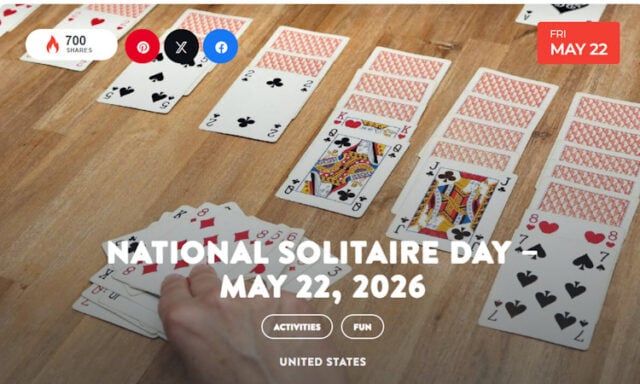
On National Solitaire Day on May 22, let’s acknowledge the brilliance behind the game of solitaire and how it has helped entertain us for years. There is so much history behind the game and numerous fun facts! Here’s all you need to know.
- 1697 – A French engraving from 1697 by Claude-Auguste Berey shows Princess de Soubise playing a solitaire-style card layout, providing one of the earliest concrete visual records of the game in Europe.
- 1746 – The board game Peg Solitaire is all the rage.
- 18th Century – The solitaire card game is introduced in Europe.
- 1801 – The Oxford English Dictionary records the first known English use of the word “solitaire” for a card game in 1801, marking the term’s formal entry into written English.
- 1870 – Lady Adelaide Cadogan releases “Illustrated Games of Patience,” one of the first major English-language collections of solitaire (patience) rules, which helps standardize and popularize many layouts.
- 1890s – The widely played layout later known as Klondike is associated with the Klondike Gold Rush of the 1890s, when prospectors popularized the game in North America and lent it the regional name
- 1902 – Klondike, a variation of Solitaire, becomes popular.
- Klondike, the classic version of the game, uses a standard 52-card deck. The object of the game is to clear the board by creating a stack of cards from low to high in each suit. If the player completes all suits, they win the game of Solitaire.
- 1989 – Solitaire was developed for Microsoft by an intern.
- 1990 – Programmer Wes Cherry’s Microsoft Solitaire, with card art by Susan Kare, ships free with Windows 3.0, teaching millions to use the mouse while becoming one of the most-played computer games in history.
- It wasn’t until now that Microsoft included Solitaire in Windows 3.0 that the game truly went viral. Microsoft Solitaire successfully helped teach computer users how to use a mouse and, in the process, became one of the most played video games in history.
- 2012 – Microsoft evolved Solitaire into the Microsoft Solitaire Collection. These changes feature five of the top Solitaire games in one app. Since then, the game has been played by over 242 million people.
- In 2020, National Solitaire Day gained quite a bit of traction when it set its own record for the most solitaire games played in one day.
- Solitaire was developed for Microsoft in 1989 by an intern
- Wes Cherry adapted the popular card game for Microsoft during his internship. The game was included in Windows 3.0, which debuted in 1990.
- The highest score you can earn in the standard version of Microsoft Solitaire is 24,113.
- According to Usman Latif of TechUser.net, 1 in 400 Solitaire games are unsolvable. Three factors play into a game that you can’t win, according to Latif:
- No aces are in the fifteen playable cards
- None of the seven playable cards in the row stacks can be moved to a different row stack.
- None of the eight playable cards in the deck can be moved to any of the seven row-stacks.
- So, as it turns out, most games are lost because of user error.
- The word solitaire comes from Latin solitarius. Solitarius comes from two separate words: solitas and solus. Solitas means isolation and solus means alone or separated from others. By the 18th century, the word developed into solitaire, the English word we know today.
- If you’re going to hit “card games” on Google, the first result would be the game “Patience.” Did you know that this was another name for Solitaire?
- There are professional solitaire players. Yes, it’s a thing! Esports isn’t news to us but professional solitaire players? They can earn up to $250,000 a year in online competitions.
- There are more variations of solitaire than any other card game. Other formats include classic, spider, pyramid, freecell, and dash solitaire games.
- Solitaire games first emerged in the Baltic region in the 18th century, possibly as a form of fortune-telling.
- The oldest known collection of patience game instructions was published in Russia, in 1826.
- Charles Dickens references a game of patience in his famous novel, Great Expectations.
- Queen Victoria’s husband, Albert, was a keen solitaire player.
- There’s an 80% chance of Solitaire games being winnable. For other variants of Solitaire, like FreeCell and Pyramid, the chances of winning are 99% for Freecell, whereas if you are looking for more of a challenge, Pyramid offers only a 0.5 to 5.5% chance of winning.
- It is fascinating that until 2019, mathematicians around the world couldn’t compute how to dominate a game of Solitaire. This shockingly interesting equation, known as the ’embarrassment of mathematics,’ was finally addressed by a PC program called Solvitaire decades after the game’s release.
- Solitaire at the movies:
- Jaws (1975). This incredibly famous Steven Spielberg film features a scene where an oceanographer, played by Richard Dreyfuss, is chilling out by playing solitaire on a boat.
- Ocean’s Thirteen (2007). When Danny Ocean (played by George Clooney) and his gang of criminals team up for another heist, the computer version of solitaire is played in one hotel scene.
- The Lego Movie (2014). This movie takes the game of computer Solitaire to a whole new level when it is played by inanimate action figures in one of the scenes.
- The Manchurian Candidate (1962). A classic game for a classic film, the original card version of the game is used in this story as part of a trigger phrase for a sleeper agent who is a spy in the Korean War. Very tricky!
Sources:

Gamesver
Disclaimer
Artificial Intelligence Disclosure & Legal Disclaimer
AI Content Policy.
To provide our readers with timely and comprehensive coverage, South Florida Reporter uses artificial intelligence (AI) to assist in producing certain articles and visual content.
Articles: AI may be used to assist in research, structural drafting, or data analysis. All AI-assisted text is reviewed and edited by our team to ensure accuracy and adherence to our editorial standards.
Images: Any imagery generated or significantly altered by AI is clearly marked with a disclaimer or watermark to distinguish it from traditional photography or editorial illustrations.
General Disclaimer
The information contained in South Florida Reporter is for general information purposes only.
South Florida Reporter assumes no responsibility for errors or omissions in the contents of the Service. In no event shall South Florida Reporter be liable for any special, direct, indirect, consequential, or incidental damages or any damages whatsoever, whether in an action of contract, negligence or other tort, arising out of or in connection with the use of the Service or the contents of the Service.
The Company reserves the right to make additions, deletions, or modifications to the contents of the Service at any time without prior notice. The Company does not warrant that the Service is free of viruses or other harmful components.