The United States Department of Justice (DOJ) has delivered its first major offensive strike through its newly minted National Fraud Enforcement Division (NFED). In a highly anticipated public briefing, federal officials announced a sweeping multi-jurisdictional crackdown resulting in criminal charges against 15 defendants. The individuals stand accused of systematically pilfering state-managed, federally funded Medicaid programs to the tune of more than $90 million.
The enforcement action marks the very first coordinated, headline-grabbing rollout by the elite fraud unit since its formal inception. Observers view the move as a definitive shot across the bow to bad actors attempting to exploit government benefits, public safety nets, and taxpayer resources.
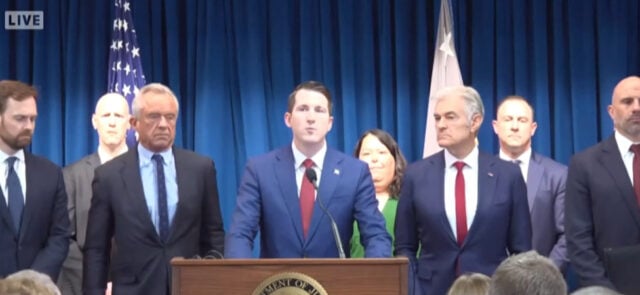
Federal prosecutors, flanked by leaders from the Federal Bureau of Investigation (FBI) and the Department of Health and Human Services Office of Inspector General (HHS-OIG), unsealed multiple criminal indictments outlining an intricate web of corruption, kickbacks, artificial billing, and manufactured medical diagnoses. According to Assistant Attorney General Colin McDonald, who commands the National Fraud Enforcement Division, the scale of the theft was not merely a administrative oversight, but rather an organized campaign of theft that treated public welfare assets like a private corporate ledger.
The announcement sets a strict precedent for the Trump Administration’s newly organized economic task forces, Signaling an aggressive, zero-tolerance landscape for corporate and institutional white-collar crime.

Genesis of the National Fraud Enforcement Division
To understand the weight of the $90 million indictments, one must look to the structural architecture of the unit that brought them to light. The National Fraud Enforcement Division was officially codified via a memorandum issued by Acting Attorney General Todd Blanche on April 7, 2026. Designed as a highly centralized, agile, and data-driven division within the DOJ, the NFED was built to fulfill the mandates of the White House Task Force to Eliminate Fraud—a whole-of-government anti-corruption initiative chaired by Vice President J.D. Vance.
Prior to the NFED’s creation, anti-fraud operations inside the DOJ were largely fragmented across localized U.S. Attorneys’ offices, the Criminal Division’s Fraud Section, and independent agency watchdogs. This siloed landscape often slowed complex investigations, allowing sophisticated rings of bad actors to exploit jurisdictional blind spots. The NFED was engineered specifically to break down these institutional silos. By combining data analytics teams, forensic accountants, and federal prosecutors under a unified command, the division acts as a specialized task force capable of tracking illicit capital flows in real time.
The $90 million Minnesota Medicaid sweep represents the blueprint of this integrated approach. Moving forward, the DOJ is executing a 120-day review to determine whether non-criminal elements, such as civil False Claims Act (FCA) enforcement teams, will be entirely absorbed into the NFED, creating an absolute monolith for white-collar oversight.
The $90 Million Minnesota Target: Seven Programs Systematically Pilfered
The centerpiece of the DOJ’s inaugural announcement focuses on a cluster of seven state-managed Medicaid programs in Minnesota that prosecutors say were completely compromised. The unsealed indictments reveal an operational philosophy among the conspirators that crossed multiple vulnerable healthcare sectors, turning programs meant for the impoverished, the unhoused, and neurodivergent children into lucrative engines for illicit wealth.
+-------------------------------------------------------------------------+
|                  MINNESOTA MEDICAID FRAUD BREAKDOWN                     |
+-------------------------------------------------------------------------+
| TOTAL TAXPAYER FUNDS TARGETED: $90,000,000+                            |
| TOTAL DEFENDANTS INDICTED:      15 Individuals                          |
| SECTORS EXPLOITED:              Autism Care, Housing Stabilization      |
+-------------------------------------------------------------------------+
| HEALTHCARE IMPACT:                                                      |
| * One critical unhoused support program entirely defunded and closed   |
| * Autism diagnostic services hyper-inflated via fabricated billings    |
+-------------------------------------------------------------------------+
The underlying anatomy of the schemes generally relied on a mixture of four illegal mechanisms:
- Fabricated Clinical Diagnoses: Creating phantom patient profiles or exaggerating mild conditions to bill for top-tier intensive therapies.
- Kickback Networks: Subsidizing or paying illicit cash incentives to parents and legal guardians in exchange for signing off on encounter forms for services that were never actually provided.
- Child Exploitation Billing: Treating children as mere “billing opportunities” to exhaust maximum coverage limits allowed under state and federal guidelines.
- Phantom Service Invoicing: Submitting massive data packets for therapy sessions, equipment distributions, and home visits that occurred only on paper.
The Autism Care Exploitation
Among the individual cases brought by the NFED, the fraud targeting specialized developmental therapies represents what federal officials called the single largest autism fraud case in the history of the Department of Justice. Health and Human Services Secretary Robert F. Kennedy Jr. spoke bluntly during the press briefing regarding the moral failures inherent to the conspiracy.
“Today’s arrests represent the largest autism fraud bust in American history,” Secretary Kennedy stated. “This was not a paperwork error. It was not a technical violation. This was organized theft from the most vulnerable children in our society.”
The investigative metrics compiled by the DOJ’s data analytics branch highlight the scope of the anomalies. Conspirators allegedly leveraged a rapid scaling model to pump fraudulent claims through state portals. Assistant Attorney General Colin McDonald pointed to one specific Minnesota autism care program to illustrate how data tracking exposed the crime. Six years ago, the program cost taxpayers roughly $600,000 annually. By the time the NFED intervened, its annual budget footprint had spiked past $400 million.
“That number is not driven by supply and demand,” McDonald remarked during the announcement. “It is not driven by healthcare, and it is certainly not driven by charity. It is fraud, plain and simple.”
The Destruction of Housing Stabilization Resources
Equally damaging was a parallel scheme targeting Minnesota’s Housing Stabilization Services program—a critical state framework built to help unhoused individuals find and maintain safe shelter. According to federal court documents, the program was targeted so aggressively by fraudulent networks that its structural solvency collapsed.
In 2020, the state calculated the program’s operational baseline at roughly $2.5 million per year. However, driven by systematic overbilling and phantom patient claims, the program’s expenses reached an unsustainable $104 million by 2024. The sudden influx of false claims exhausted all available public funds, forcing state administrators to intervene.
“One of the programs has been completely shut down because there’s no money left: It’s all gone,” McDonald reported. He clarified that because the program was completely defunded and subsequently dismantled, the vital housing resources no longer exist for the vulnerable, unhoused populations who genuinely relied on them.
Drama on the Ground: Arrests, Flight, and Accountability
The execution of the warrants by the FBI and local law enforcement partners brought immediate drama, underscoring the high stakes of the federal crackdown. While fourteen of the indicted co-conspirators were successfully taken into federal custody without incident, one notable defendant attempted a desperate escape.
FBI co-Deputy Director Christopher Raia confirmed that federal agents are currently engaging in an active manhunt for Mohammed Omar, one of the primary targets named in the indictments. According to Raia, when tactical teams arrived at Omar’s residence to execute the arrest warrant, the defendant evaded containment by leaping directly from a fourth-story balcony.
The DOJ has since filed additional criminal charges against Omar for seeking to flee from law enforcement and attempting to obstruct justice. Federal authorities have deployed specialized tracking units and issued national alerts to apprehend him, warning the public that harboring the fugitive carries steep criminal penalties.
The Shadow of “Feeding Our Future”
The NFED’s $90 million announcement did not happen in an institutional vacuum. It occurred against the immediate backdrop of the sentencing of Aimee Bock, the founder and mastermind behind the infamous “Feeding Our Future” scandal. That separate, massive pandemic-era conspiracy resulted in the theft of $250 million intended to feed low-income children during global supply chain disruptions.
On the same day the new $90 million indictments were made public, Bock appeared in federal court shackled at her feet and wearing a neon green jail jumpsuit. She was sentenced to an extraordinary 41 and a half years in federal prison and ordered to pay $243 million in direct restitution.
Though Bock’s defense attorney, Kenneth Udoibok, attempted to soften the court’s perception by arguing his client “went into a vortex” and simply trusted the wrong individuals, federal prosecutors successfully argued that her harsh sentence should serve as a stark warning to others. The structural remnants of the Feeding Our Future investigative network provided the foundational data, institutional memory, and operational infrastructure that allowed the NFED to quickly map out and dismantle this new $90 million Medicaid syndicate.
The Strategic Playbook of Modern White-Collar Enforcement
The launch of the National Fraud Enforcement Division signals an evolutionary leap in how the United States government polices economic crimes. Historically, white-collar defense strategies relied on drawing out investigations, muddying compliance narratives, and offering financial settlements through corporate non-prosecution agreements. The NFED’s initial deployment indicates that the era of simple financial slap-on-the-wrist settlements may be drawing to a close.
The division’s primary asset is its advanced implementation of predictive data analytics. Rather than waiting for traditional whistleblowers to file lengthy qui tam (lawsuits brought by private citizens on behalf of the government) actions under the False Claims Act, the NFED uses algorithm-driven systems to actively mine public health billing data, federal procurement networks, and tax registries. By establishing normal baseline ranges for regional spending, the unit’s software automatically flags anomalous spikes—such as an autism program jumping from $600,000 to $400 million—long before manual audits would catch the variance.
Traditional Enforcement vs. NFED Strategy
-----------------------------------------------------------------
Traditional: Reactive -> Dependent on Whistleblowers -> Slow Audits
NFED Unit:   Proactive -> Algorithmic Data Mining  -> Rapid Indictments
-----------------------------------------------------------------
This structural shift requires companies, healthcare systems, and non-profit organizations nationwide to completely re-evaluate their corporate compliance infrastructure. Legal experts warn that entities interacting with federal or state funding pools must immediately take three proactive steps to safeguard against the NFED’s heightened scrutiny:
- Re-Engineer Internal Control Audits: Shift from annual retrospective compliance reviews to continuous, real-time transaction monitoring that mirrors the federal government’s data-mining techniques.
- Elevate Boardroom Legal Oversight: Corporate boards must ensure that compliance executives possess absolute autonomy and direct lines of communication to senior leadership, removing any internal barriers to self-reporting.
- Rigidly Scrutinize Third-Party Partners: Under the NFED’s expanded conspiracy frameworks, prime contractors can be held criminally liable for the fraudulent billing habits of their sub-contractors and clinical affiliates.
A Blunt Warning to Fraudsters Nationally
The message delivered by the Department of Justice during this inaugural rollout was intentionally unyielding. Federal officials made it clear that the $90 million Minnesota Medicaid sweep is merely the opening salvo in a sustained, multi-year campaign targeting systemic fraud across all fifty states.
With more than 1,750 federal subpoenas already issued, 130 search warrants executed, and 1,000 witness interviews completed by the task force, the operational velocity of the division is accelerating. The FBI’s forensic accounting units are also looking into potential links between these domestic fraud syndicates, local elected officials, and international terrorist financing networks, raising the possibility of future national security charges.
Assistant Attorney General Colin McDonald closed the DOJ’s landmark press briefing with a blunt, direct warning aimed squarely at individuals currently engaging in systemic fraud against public systems.
“My message to the fraudsters is this: Eat, drink and be merry today because your days of frolicking and freedom are numbered,” McDonald declared. “We are doing everything we can to find you. And when we do, we will prosecute you to the absolute fullest extent of the law.”
Verified Sources and Resource Links
The comprehensive reporting, metrics, and quotes detailed within this article were compiled exclusively from official government publications, legal updates, and breaking news dispatches issued on and around May 21, 2026.
- The United States Department of Justice (Office of Public Affairs): National operational announcements regarding the Fraud Division’s enforcement actions and systemic billion-dollar crackdowns. DOJ OPA Official Press Room
- The United States Department of Justice (U.S. Attorney’s Office, Northern District of California): Case archives regarding the $90 million healthcare fraud indictments and regional War on Fraud directives. DOJ USAO Northern District of California Press Release
- The White House Office of the Press Secretary: Official policy fact sheets detailing the establishment of the Department of Justice’s Division for National Fraud Enforcement. White House Policy Fact Sheets (2026)
- Fox News Digital (Live Legal Coverage): Real-time journalistic updates covering the DOJ Minnesota fraud announcements, the Mohammed Omar manhunt, and the federal sentencing of Aimee Bock. Fox News Live News Portal
- Jenner & Block LLP (Corporate Legal Insights): Strategic white-collar analysis tracking the formation, structural scope, and operational mandates of the National Fraud Enforcement Division. Jenner & Block Legal Analysis
- Gibson, Dunn & Crutcher LLP (Enforcement Updates): Historical and statistical breakdowns regarding data-driven federal healthcare investigations and False Claims Act milestones. Gibson Dunn Year-End Enforcement Update
Disclaimer
Artificial Intelligence Disclosure & Legal Disclaimer
AI Content Policy.
To provide our readers with timely and comprehensive coverage, South Florida Reporter uses artificial intelligence (AI) to assist in producing certain articles and visual content.
Articles: AI may be used to assist in research, structural drafting, or data analysis. All AI-assisted text is reviewed and edited by our team to ensure accuracy and adherence to our editorial standards.
Images: Any imagery generated or significantly altered by AI is clearly marked with a disclaimer or watermark to distinguish it from traditional photography or editorial illustrations.
General Disclaimer
The information contained in South Florida Reporter is for general information purposes only.
South Florida Reporter assumes no responsibility for errors or omissions in the contents of the Service. In no event shall South Florida Reporter be liable for any special, direct, indirect, consequential, or incidental damages or any damages whatsoever, whether in an action of contract, negligence or other tort, arising out of or in connection with the use of the Service or the contents of the Service.
The Company reserves the right to make additions, deletions, or modifications to the contents of the Service at any time without prior notice. The Company does not warrant that the Service is free of viruses or other harmful components.