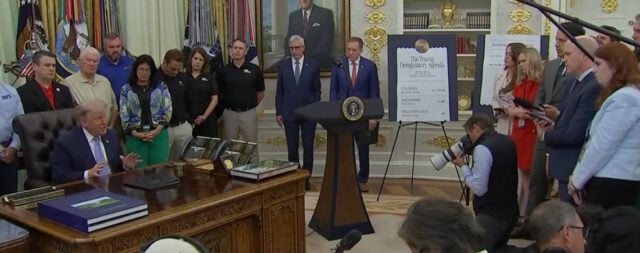
WASHINGTON — In an unannounced, wide-ranging exchange with reporters gathered in the Oval Office, President Donald Trump unveiled an aggressive regulatory rollback targeting climate-focused chemical restrictions. The administration claims the move will directly lower food costs for American families and alleviate financial pressures on businesses. The decision targets Biden-era environmental restrictions on hydrofluorocarbons (HFCs)—the specialized chemical compounds used as coolants in commercial food refrigeration, supply chain transport, and residential air conditioning systems.
Speaking from behind the Resolute Desk during an event initially scheduled to touch on technological competitiveness and the domestic supply chain, the President linked the dense web of environmental mandates directly to the persistent inflation Americans encounter at the grocery checkout.
“We are doing away with regulations that kill American businesses and drive the price of basic food through the roof,” Trump told reporters. “These complex chemical rules, these mandates on air conditioning and commercial cooling systems, they are a hidden tax on every single supermarket, every food transport truck, and every kitchen table in this country. We are putting a stop to it today.”
The centerpiece of the policy shift is a coordinated executive push by the Environmental Protection Agency (EPA) to dismantle the 2023 Technology Transitions Rule. That environmental directive, established under the previous administration, forced a rapid domestic phase-out of high Global Warming Potential (GWP) coolants. It mandated that major industries transition to expensive, newly formulated chemical alternatives. By easing these requirements, the White House projects immediate financial relief across the agricultural, logistics, and retail sectors, estimating total savings for American businesses and families to exceed $2.4 billion.

The Chemistry of Inflation: Connecting Food Supply to Chemical Controls
To understand the administration’s policy, it is necessary to examine how food distribution relates to environmental chemical controls. Modern food security relies entirely on the “cold chain”—a continuous, temperature-controlled supply chain that stretches from agricultural fields and slaughterhouses to transport trucks, distribution hubs, and commercial grocery display cases.
[ Farm / Production ] ➔ [ Refrigerated Transport ] ➔ [ Distribution Center ] ➔ [ Grocery Display ]
         │                          │                         │                      │
   (Chilled Safely)           (In-Transit Coolers)         (Mass Cold Storage)     (Retail Units)
For decades, this infrastructure relied on HFCs. While efficient and non-flammable, climate scientists identify HFCs as potent greenhouse gases that trap heat in the atmosphere at thousands of times the rate of carbon dioxide ($CO_2$). In October 2023, the EPA finalized the Technology Transitions Rule, implementing strict caps on HFC use. The rule prohibited the manufacture and installation of cooling systems that use traditional chemical variants. The rule forced a transition toward alternatives like hydrofluoroolefins (HFOs) or natural refrigerants like ammonia and propane.
The Trump administration argues that while the environmental goals were noble in theory, the practical economic fallout was disastrous for the food sector. Supermarket chains and independent grocers operate on notoriously razor-thin profit margins, frequently averaging between 1% and 2%. The mandated transition required these entities to either completely replace expensive commercial condenser units or retrofit existing setups with chemical alternatives that can cost up to four times more per pound than traditional coolants.
According to administration officials, these regulatory compliance costs did not simply disappear into corporate ledgers. Instead, they cascaded directly down the supply chain, inflating the retail price of temperature-sensitive food staples such as beef, poultry, dairy, and fresh produce. By reversing these mandates, the administration expects to lower operational overhead for food retailers, providing them the financial flexibility to reduce consumer prices.
Dismantling the Technology Transitions Rule
The administrative pivot, executed under EPA Administrator Lee Zeldin, alters the regulatory framework that governed commercial and residential cooling. The rule change offers immediate relief to industrial operations by raising the permitted Global Warming Potential threshold for large-scale cold storage facilities and agricultural warehouses.
Previously, the cap was set to drop to a restrictive ceiling of 150 to 300 GWP depending on the exact facility footprint. Under the newly proposed technical modifications, that threshold will be lifted to 700 GWP. This allows industrial food distributors to continue utilizing more affordable, widely available mid-tier chemical compounds.
| Industrial Sector | Previous Biden-Era GWP Cap | New Trump Administration GWP Cap | Projected Industry Economic Impact |
| Cold Storage Warehouses | 150 – 300 GWP | 700 GWP | Avoids mandatory facility overhauls; lowers storage fees. |
| Refrigerated Transport Trucks | Phased Restrictions | Extended Compliance | Reduces maintenance overhead for distribution fleets. |
| Residential Air Conditioning | Strict Cutoffs by 2025/2026 | Indefinite Extensions | Eliminates stranded equipment inventory for contractors. |
Furthermore, the revised policy addresses “inventory stranding”—a serious logistical vulnerability for commercial heating, ventilation, and air conditioning (HVAC) contractors. The initial 2023 framework established firm cutoffs for the distribution, sale, and installation of older components. This left suppliers with millions of dollars in unusable inventory and forced consumers to purchase entirely new systems rather than repairing existing ones.
The EPA’s current proposal permanently preserves installation flexibilities for residential and light commercial AC units manufactured or imported before January 1, 2025. Homeowners will no longer be forced to replace functional outdoor condensers due to a lack of approved chemical options, lowering repair costs during peak summer months.
Oval Office Exchange: Tensions and Ideological Divides
The atmosphere inside the Oval Office during the press gaggle was charged, reflecting the sharp ideological divides over federal deregulation and climate science. Reporters repeatedly questioned the President on whether undermining HFC restrictions would accelerate global warming and compromise international environmental agreements, such as the Kigali Amendment to the Montreal Protocol.
Trump rejected the premise that deregulation would lead to environmental degradation, emphasizing American economic dominance and industrial competitiveness over international regulatory compliance.
“We are leading China, we are leading everybody, and I don’t want to do anything that’s going to get in the way of that lead,” Trump said, gesturing broadly. “China doesn’t follow these rules. They use whatever they want, they build factories every single week, and yet our companies are told they can’t use perfectly safe, incredibly effective cooling systems because of a radical left-wing agenda. It stops now. We are going to have clean air, clean water, but we are also going to have affordable food and a booming economy.”
When pressed by reporters on how quickly consumers would see grocery prices decline as a result of chemical rollbacks, the President maintained that cutting overhead at the top of the supply chain yields immediate relief at the bottom. The administration estimates that rewriting the emissions standards for shipping fleets and transport companies alone will save the commercial logistics sector up to $1.5 billion in compliance costs.
Consumer Realities and Economic Perspectives
Independent economic analysis suggests that while the rollback provides genuine financial relief to corporate agricultural entities and supermarket conglomerates, the ultimate impact on consumer grocery bills may be complex. Recent consumer price index evaluations demonstrate that inflation remains highly localized across different product categories.
[ CONSUMER GROCERY CART PRICE TRENDS ]

Decreasing Safely:
======= Egg Prices (-13.0%)
==== Bread Prices (-3.2%)
= Produce / Vegetables (-0.7%)

Increasing Pressures:
= Dairy Products (+0.5%)
==== Sugar & Sweets (+3.7%)
=========== Ground Beef (+11.6%)
============ Coffee Prices (+11.3%)
While some essential items like eggs and bread have experienced modest price drops due to stabilizing supply chains, other critical goods—particularly ground beef, dairy, and imported coffee—continue to face upward price pressures. Economists note that food pricing is dictated by a complex array of overlapping global factors, including geopolitical stability, fuel costs, and international trade tariffs.
Reduced cooling overhead will lower operating costs for grocery stores, but whether those savings are passed directly to consumers or used to rebuild corporate margins depends heavily on local market competition. However, for small businesses, independent grocers, and localized cold-storage operators, avoiding mandatory equipment upgrades provides an immediate defense against insolvency.
Environmental Backlash and the Regulatory Outlook
The decision has triggered immediate pushback from environmental organizations, climate policy scientists, and progressive lawmakers. Critics argue that HFCs represent some of the most dangerous short-lived climate pollutants in existence, and that pausing the transition to cleaner alternatives undermines years of international environmental diplomacy.
Opponents of the rollback point out that major domestic chemical manufacturers had already invested billions of dollars into researching, developing, and patenting low-GWP alternatives, such as HFOs. Some segments of the corporate manufacturing sector actually favored the original Biden-era framework, as it created a guaranteed domestic market for their newer, higher-margin chemical products. By reopening the market to older HFC variations, environmental groups warn that the United States risks falling behind in the global green technology race while increasing its overall carbon footprint.
The White House remains unmoved by these warnings. The administration views the regulatory rollback as a crucial component of its broader economic agenda, which prioritizes domestic energy production, systemic deregulation, and direct cost relief for working-class citizens. As the EPA moves forward with public comment periods to finalize the rule changes, the debate over this policy will serve as a core battleground regarding the balance between economic growth and environmental protection.
Sources Used & Links
- The Associated Press (AP): Trump says he’s postponing signing an executive order on AI out of concern it would hurt AI industry
- The Washington Post: Trump to ease rule on climate super pollutants, says move will cut costs
- U.S. Environmental Protection Agency (EPA): EPA Proposes Reforming Biden Technology Transitions Rule to Lower Costs for American Families at the Grocery Store
- Axios: Trump set to ease climate requirements on food industry refrigeration
- Poynter Institute: Donald Trump says grocery, energy prices are down. In reality, it’s a mixed bag for consumers
Disclaimer
Artificial Intelligence Disclosure & Legal Disclaimer
AI Content Policy.
To provide our readers with timely and comprehensive coverage, South Florida Reporter uses artificial intelligence (AI) to assist in producing certain articles and visual content.
Articles: AI may be used to assist in research, structural drafting, or data analysis. All AI-assisted text is reviewed and edited by our team to ensure accuracy and adherence to our editorial standards.
Images: Any imagery generated or significantly altered by AI is clearly marked with a disclaimer or watermark to distinguish it from traditional photography or editorial illustrations.
General Disclaimer
The information contained in South Florida Reporter is for general information purposes only.
South Florida Reporter assumes no responsibility for errors or omissions in the contents of the Service. In no event shall South Florida Reporter be liable for any special, direct, indirect, consequential, or incidental damages or any damages whatsoever, whether in an action of contract, negligence or other tort, arising out of or in connection with the use of the Service or the contents of the Service.
The Company reserves the right to make additions, deletions, or modifications to the contents of the Service at any time without prior notice. The Company does not warrant that the Service is free of viruses or other harmful components.