The Lights Go Out at the Ed Sullivan Theater
On the night of May 21, 2026, the marquee lights of the historic Ed Sullivan Theater flickered off, signaling the end of an era. The final episode of The Late Show with Stephen Colbert marked more than just the retirement of a beloved late-night host; it served as the official funeral for a thirty-three-year broadcast institution. For over three decades, dating back to David Letterman’s fiery leap from NBC to CBS in 1993, The Late Show represented the pinnacle of network late-night television. By permanently retiring the franchise and handing the time slot back to regional affiliates, CBS effectively waved a white flag, retreating from the late-night wars that had defined broadcast entertainment for over half a century.
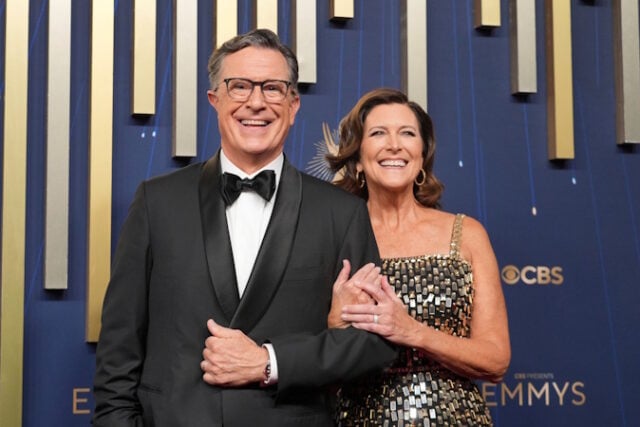
The studio atmosphere for the series finale was an intoxicating blend of Irish-wake celebration and palpable grief. The guest list reads like a roll call of cultural titans and comedic peers: Jon Stewart, Jimmy Kimmel, Jimmy Fallon, Seth Meyers, John Oliver, Tom Hanks, Julia Louis-Dreyfus, Pedro Pascal, and even David Letterman himself returned to the stage he built. Musical guest Bruce Springsteen provided the emotional crescendo, while a historic “Strike Force Five” reunion brought together late-night’s fiercest competitors under one roof. In an unprecedented act of solidarity, ABC’s Jimmy Kimmel Live! opted to air a repeat episode rather than compete against Colbert’s final sign-off—a rare, deep-seated gesture of respect mirroring Kimmel’s 2015 shutdown for Letterman’s retirement.
Yet, beneath the glittering parade of celebrities and the booming applause of a fully packed house, a chilling undercurrent remained. Colbert’s departure was not a voluntary retirement. Unlike Letterman’s grand, self-directed exit or Conan O’Brien’s defiant network shifts, Colbert’s show was canceled. The finality of the evening felt less like a natural conclusion and more like an evacuation. As Colbert delivered his final “Colbert Report” and performed a final, poignant duet with Talking Heads frontman David Byrne, the national audience witnessed the closing chapter of a uniquely human television program.
The Corporate Guillotine and the Trump Factor
The official narrative spun by CBS executives since their shocking July 2025 announcement has consistently pointed toward financial realities. Paramount Global, the parent company of CBS, insisted that dissolving The Late Show was purely an economic decision triggered by a challenging linear television environment, declining ad revenues, and shifting viewer demographics. However, media insiders, industry analysts, and even David Letterman himself have publicly discarded this corporate explanation.

Late-Night Viability Framework:
[Broadcast Infrastructure Costs] + [Highly Paid Signature Stars]
                 vs.
[Declining Linear Viewership] + [Severe Regulatory / Political Pressures]
The timeline surrounding the cancellation remains deeply suspicious. The corporate execution order dropped precisely three days after Colbert used his opening monologue to ruthlessly mock a $16 million legal settlement between Paramount and Donald Trump over a disputed 60 Minutes interview. It also occurred just a week before federal regulators approved an $8 billion mega-merger between Paramount and Skydance Media—a transaction that required a smooth, frictionless relationship with a highly volatile White House administration.
Trump, who frequently labeled Colbert a “dead man walking” on television, openly celebrated the cancellation on Truth Social, declaring his absolute delight that the host “got fired.” The political pressure extended far beyond mere social media posts. FCC Chairman Brendan Carr threatened punitive regulatory actions against broadcast affiliates, prompting major station owners like Nexstar and Sinclair to temporarily pull late-night broadcasts from specific regional markets. For academic researchers and media historians, the abrupt end of Colbert’s run represents a landmark moment in which corporate appeasement met political intimidation.
“The legacy of this show needs to be that we remember it as the show that was canceled because a presidential administration wanted it off the air. We haven’t connected every single dot on that, but it’s very clear that this was a political decision. And I think 20, 30, 40 years later, that is going to be strongly remembered about this show — that this was a moment of authoritarian triumph.” — Heather Hendershot, Professor of Communication Studies, Northwestern University
Evolution of a Satirist: From Caricature to Moral Anchor
To truly appreciate the void left by Colbert’s departure, one must look at his remarkable twenty-one-year journey across the late-night landscape. Colbert first captured the cultural zeitgeist on Comedy Central’s The Colbert Report (2005–2014). For nearly a decade, he executed one of the most audacious, high-wire acts in comedic history: playing a pompous, ultra-conservative cable news blowhard modeled directly after Fox News’s Bill O’Reilly. The performance was so deeply committed, so structurally flawless, that it fundamentally altered political satire.
When Colbert shed that hyper-partisan armor in 2015 to succeed Letterman on CBS, critics wondered if the real Stephen Colbert could survive without his fictional shield. The initial transition was rocky. Under the early guidance of CBS executives, Colbert tried to blend in, chasing mainstream, apolitical sketches that went against his sharp comedic instincts. His ratings lagged behind Jimmy Fallon’s playful, viral-heavy Tonight Show.
The turning point came with the political upheaval of 2016. Recognizing the existential anxiety gripping millions of viewers, Colbert abandoned generic late-night pleasantries and leaned entirely into political monologue. He transformed The Late Show into a nightly antidote for citizens feeling disorientated by a chaotic news cycle. Colbert didn’t just tell jokes; he became a moral anchor. His monologues offered daily reassurance that the world, not the viewer, had lost its mind. This course correction was a massive success: Colbert seized the number-one spot in late-night ratings, holding it securely for nine consecutive seasons, culminating in a Primetime Emmy Award for Outstanding Variety Talk Series in 2025.
The Human Element: Grief, Faith, and the Geek Flag
While political commentary drove his ratings, what separated Colbert from his peers was his extraordinary capacity for raw, unfiltered humanity. Colbert’s childhood was shaped by unspeakable tragedy—the loss of his father and two brothers in a commercial plane crash when he was just ten years old. This profound grief, combined with his open, deeply intellectual adherence to his Catholic faith, infused The Late Show with an emotional depth completely unprecedented in the history of late-night television.
Viewers did not just tune in for political takedowns; they tuned in for existential grace. Colbert hosted legendary, vulnerable conversations that shattered the traditional bounds of entertainment television:
- The Biden Interview: A deeply moving dialogue with then-Vice President Joe Biden, where the two men openly parsed the mechanics of personal loss, shared grief, and finding the will to carry on.
- The Cooper Exchange: A viral conversation with CNN’s Anderson Cooper about the beauty of suffering and how learning to love our grief connects us to our humanity.
- The Faith Dialogues: Intellectual explorations with stars like Dua Lipa and John Oliver, examining how comedy, Catholicism, and social justice intersect in a broken world.
Simultaneously, Colbert used his platform to champion unapologetic, uncool intellectual curiosity. Whether he was reciting flawless Elvish poetry alongside Peter Jackson, arguing minute details of J.R.R. Tolkien’s lore, or dedicating an entire recurring segment (The Sound of Science) to breakthrough astrophysical discoveries with Neil deGrasse Tyson, Colbert made it safe to be a geek. He proved that a late-night host could be deeply silly, fiercely political, profoundly religious, and intensely intellectual all at the same time.
What This Means for Late-Night Variety Shows
The total retirement of The Late Show franchise is the ultimate indicator of a dying medium. For decades, the 11:35 p.m. time slot was network television’s crown jewel—a highly lucrative arena where iconic hosts established a network’s identity. Today, that model is financially broken and culturally isolated.
| Metric | The Golden Age (1990s-2000s) | The Modern Era (2026) |
| Primary Audience Delivery | 5 to 10+ million linear viewers nightly | Fractured streaming clips, TikTok, YouTube shorts |
| Monetization Model | Premium linear television ad blocks | Low-yield digital ad revenue shares |
| Network Strategy | High-budget signature star development | Low-cost syndication, cheap time-buy agreements |
| Cultural Status | National consensus-builder | Segmented political echo chambers |
CBS’s replacement for Colbert is perhaps the most telling aspect of this transition. The network has sold the historic time slot to Byron Allen’s Allen Media Group via a time-buy agreement to air Comics Unleashed—a syndicated, pre-taped talk show featuring stand-up comedians trading generic jokes. Allen openly admitted that the program will strictly avoid anything topical, political, or remotely controversial.
This pivot represents a complete corporate retreat. Network television is actively abandoning the cultural frontline. Producing a nightly, topical variety show requires massive, highly compensated writing staffs, expensive studio bands, and intense legal clearance teams. In a world where linear viewership has plummeted by over 50 percent as audiences migrate to streaming platforms and TikTok feeds, media conglomerates can no longer justify spending $50 million annually on a single late-night voice—especially a voice that draws regulatory scrutiny and political blowback from the executive branch.
We are entering an era of safe, sanitized, and deeply fragmented late-night content. The era of the singular late-night host acting as America’s bedtime storyteller is officially over. Late-night variety comedy will survive, but it will live on as disjointed digital clips on YouTube, low-budget weekly streaming shows on platforms like HBO or Netflix, and independent podcasts. By giving up The Late Show, network television didn’t just lose Stephen Colbert; it lost its cultural relevance.
Sources Used and Links
- The Washington Examiner: The Colbert collapse: How television’s sharpest satirist lost his edge — and his show https://www.washingtonexaminer.com/premium/4567688/colbert-collapse-television-sharpest-satirist-lost-the-late-show/
- LateNighter: Kimmel Will Not Air New Episode Opposite Colbert’s Finale https://latenighter.com/news/kimmel-will-not-air-new-episode-opposite-colberts-finale/
- The Guardian: ‘He had a unique ability to be human’: late-night TV says goodbye to Stephen Colbert https://www.theguardian.com/tv-and-radio/2026/may/20/late-night-tv-says-goodbye-to-stephen-colbert
- Parade: ‘The Late Show with Stephen Colbert’ Last Episode Details https://parade.com/tv/stephen-colbert-last-final-late-show-guide
- Sentinel Colorado: Stephen Colbert’s long goodbye is coming to an end, leaving a void https://sentinelcolorado.com/uncategorized/stephen-colberts-long-goodbye-is-coming-to-an-end-leaving-a-void/
- Wikipedia: The Late Show with Stephen Colbert https://en.wikipedia.org/wiki/The_Late_Show_with_Stephen_Colbert
Disclaimer
Artificial Intelligence Disclosure & Legal Disclaimer
AI Content Policy.
To provide our readers with timely and comprehensive coverage, South Florida Reporter uses artificial intelligence (AI) to assist in producing certain articles and visual content.
Articles: AI may be used to assist in research, structural drafting, or data analysis. All AI-assisted text is reviewed and edited by our team to ensure accuracy and adherence to our editorial standards.
Images: Any imagery generated or significantly altered by AI is clearly marked with a disclaimer or watermark to distinguish it from traditional photography or editorial illustrations.
General Disclaimer
The information contained in South Florida Reporter is for general information purposes only.
South Florida Reporter assumes no responsibility for errors or omissions in the contents of the Service. In no event shall South Florida Reporter be liable for any special, direct, indirect, consequential, or incidental damages or any damages whatsoever, whether in an action of contract, negligence or other tort, arising out of or in connection with the use of the Service or the contents of the Service.
The Company reserves the right to make additions, deletions, or modifications to the contents of the Service at any time without prior notice. The Company does not warrant that the Service is free of viruses or other harmful components.