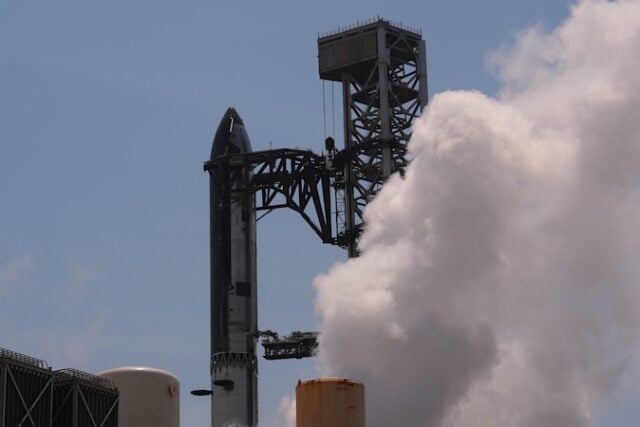
The landscape of space exploration has transitioned from incremental progress to an era of rapid, iterative engineering. At the absolute forefront of this technological revolution is SpaceX’s Starship architecture. Initially designed as a massive, fully reusable transportation system optimized for Low Earth Orbit (LEO), lunar, and Martian logistics, the vehicle has progressed through dozens of structural and engine variants.
With the debut of the Starship Version 3 (V3) variant, SpaceX has introduced a significantly elongated, highly optimized heavy-lift vehicle designed to push payload envelopes past previous historical maximums. This generation marks the practical culmination of testing cycles conducted across early iterations, advancing Starship from an experimental orbital prototype to a functional, highly economical interstellar transport platform.
Technical Architecture of the Starship V3 System
The Starship V3 vehicle scales up previous architectures to optimize internal propellant volume, structural integrity, and raw propulsive output. The vehicle remains a two-stage super-heavy launcher consisting of a foundational booster stage and an integrated upper stage that doubles as the primary spacecraft payload vessel. However, structural extensions have significantly altered the vehicle’s height, mass distributions, and overall capabilities compared to earlier test models.
+-------------------------------------------------------------+
|                     STARSHIP V3 UPPER STAGE                 |
|  - Elongated Nosecone & Propellant Tanks                     |
|  - Upgraded Raptor 3 Vacuum & Sea-Level Engines             |
|  - Payload Capacity: ~200 Metric Tons (Fully Reusable)      |
+-------------------------------------------------------------+
                              |
                     [HOT STAGING RING]
                              |
+-------------------------------------------------------------+
|                     SUPER HEAVY V3 BOOSTER                  |
|  - Stretched Liquid Oxygen / Liquid Methane Tanks           |
|  - 33+ Upgraded Raptor 3 Engines                            |
|  - Estimated Total Thrust: >74 MN (Meganewtons)             |
+-------------------------------------------------------------+
Stretched Propellant Tanks and Dimensions
The most noticeable aspect of the Starship V3 configuration is its sheer physical scale. The upper stage has been stretched significantly, elongating both the liquid oxygen and liquid methane tanks. This elongation yields several design updates:

- Increased Propellant Mass: By lengthening the fuselage, the vehicle can hold hundreds of additional tons of cryogenic propellant, directly increasing its velocity changing capabilities.
- Aerodynamic Refinements: The elongation alters the fineness ratio of the upper stage, reducing drag profiles during high-velocity atmospheric ascent and downrange entry maneuvers.
- Optimized Forward Flaps: The forward actuation flaps have been shifted further leeward to shield them from extreme thermal plasma streams during atmospheric reentry, a critical fix directly informed by the structural damage observed during earlier integrated flight tests.
Transition to Raptor 3 Engines
At the heart of the V3’s performance uplift is the integration of the Raptor 3 engine cycle. The Raptor 3 eliminates external plumbing, brackets, and sensor lines, resulting in a cleaner, highly consolidated engine architecture that relies heavily on internal, regenerative cooling channels and integrated 3D-printed metal manifolds.
This reduction in external clutter drastically lowers the dry mass of each engine unit while minimizing the risk of external fire propagation within the booster’s high-pressure engine bay. Furthermore, the chamber pressure has been augmented to support increased thrust profiles, enabling the Super Heavy booster’s cluster of 33 engines to easily exceed the historical 74 MN thrust milestones established during early developmental iterations.
Launch Operations and Flight Profiles
The flight profile of the Starship V3 leverages advanced orbital dynamics and precise mechanical capture sequences that completely eliminate traditional expendable hardware paradigms. From ignition to orbital insertion, every step is built around maximizing thermal-structural margins and system recoverability.
The Ignition Sequence and Acoustic Loads
The operational cycle begins at the orbital launch mount at Starbase in Boca Chica, Texas. Upon full main-engine ignition, the 33 Raptor 3 engines throttle up to full power, producing unprecedented acoustic energy fields. Sound pressure measurements taken during related Super Heavy operations confirm overall sound pressure levels reaching approximately 121 to 123 dB at distances exceeding 10 kilometers from the pad. To handle these intense acoustic and kinetic forces, SpaceX relies on an expanded water-deluge steel plate system designed to absorb shock waves and protect the base structural framework from erosive trenching during the initial seconds of liftoff.
Hot-Staging Innovation
As the vehicle clears the dense lower atmosphere, it prepares for its staging sequence. Unlike legacy aerospace systems that rely on pneumatic pushers or unpowered coast phases, Starship V3 employs a continuous-thrust hot-staging ring.
During this maneuver, the Super Heavy booster throttles down its inner cluster of engines while the Starship upper stage simultaneously ignites its vacuum-optimized Raptor engines directly into a heavy, reinforced steel interstage ring. Vents along the circumference of the hot-staging ring allow the hot exhaust gases to escape safely without overpressurizing the booster’s top dome. This approach maintains continuous forward acceleration on the upper stage, preventing propellant from sloshing inside the tanks and maximizing overall gravitational efficiency.
       [Stage 2: Starship Upper Stage]
             ▲   ▲   ▲   ▲   ▲ (Raptor Engines Ignite)
        ======================= [Vented Hot-Staging Ring]
             |   |   |   |   | (Gases Escape Laterally)
       [Stage 1: Super Heavy Booster]
Dual-Stage High-Velocity Recovery
Following stage separation, the flight path splits into two distinct, highly synchronized recovery routes:
- Booster Return & Catch: The Super Heavy booster performs a rapid flip maneuver, executing a boostback burn utilizing its internal engine clusters to reverse its horizontal velocity vectors back toward the launch site. As it drops through the lower atmosphere, it uses grid fins to guide itself directly back toward the launch tower. In the final seconds of descent, a high-thrust landing burn stabilizes the vehicle, allowing massive mechanical launch tower arms—colloquially referred to as “Mechazilla”—to catch the booster cleanly out of mid-air. This eliminates the heavy structural overhead of traditional landing legs.
- Atmospheric Reentry & Thermal Management: Concurrently, the upper stage continues its ascent into orbital velocities. Upon concluding its mission profile, the ship initiates a controlled deorbit maneuver, entering the atmosphere at an aggressive high-alpha angle of attack between 60 and 70 degrees. The entire underbelly of the craft is covered in thousands of hexagonal, mechanically attached ceramic heat shield tiles. The hexagonal geometry prevents high-velocity plasma from finding straight, unshielded seams through the tile matrix, successfully isolating the primary stainless steel hull from extreme convective and radiative heating environments.
Economic and Strategic Disruptions to the Global Space Industry
The introduction of a fully scalable, highly reusable V3 configuration alters the baseline economics of global payload delivery. For decades, the metric for space accessibility was defined by expendable launch options where multi-million-dollar boosters were discarded into the ocean after a single operational use. SpaceX broke this mold with the Falcon 9, but Starship V3 pushes the cost-per-kilogram metric down by orders of magnitude.
Comparative Launch Economics
To comprehend the financial disruption brought by Starship V3, it is useful to evaluate its projected mass-delivery capabilities against existing and historical heavy-lift platforms across the globe:
| Launch Vehicle Platform | Maximum Payload to LEO (Metric Tons) | Operational Reuse Strategy | Estimated Launch Cost (USD) |
| NASA Space Launch System (SLS) | ~95 t | Fully Expendable | ~$2 Billion+ |
| Ariane 64 (ESA Evolution) | ~21 t | Fully Expendable | ~$100 – $115 Million |
| SpaceX Falcon Heavy | ~64 t | Partially Reusable | ~$90 – $97 Million |
| SpaceX Starship V3 | ~200 t | Fully Reusable (Both Stages) | ~$2 – $3 Million |
Analyses of modern launch architectures demonstrate that while standard expendable rockets like Europe’s Ariane 64 or America’s SLS demand significant financial resources per flight, a mature Starship architecture can reliably place between 100 and 150 metric tons into Low Earth Orbit for roughly $30 million per launch.
Once fleet maturity and high launch cadence are unlocked, the marginal cost of a fully reusable Starship V3 flight could plummet to $2 to $3 million. This represents an unprecedented drop in space access costs, lowering orbital delivery from historical averages of $10,000 per kilogram to an estimated $15 to $20 per kilogram.
Geopolitical Repositioning
This paradigm shift forces international space agencies and commercial competitors to entirely re-evaluate their long-term launcher designs. The European Space Agency, for instance, has initiated architectural structural studies to look past its expendable Ariane 6 frameworks, recognizing that a world dominated by ultra-low-cost, fully reusable super-heavy launch systems leaves very little market share for traditional, non-reusable launchers. The massive internal volume of Starship V3 also opens the door for rapid deployment of sprawling commercial mega-constellations, heavy defense infrastructure, and completely automated deep-space robotic observatories that would otherwise be constrained by tight payload fairing envelopes.
Enabling Next-Generation Exploration: Artemis and Mars
Beyond the economic implications for commercial satellite markets, the scale of Starship V3 is structurally tied to the future of deep-space human exploration, acting as a foundational pillar for both NASA’s lunar campaigns and long-term plans to establish a permanent presence on Mars.
       [Starship Tanker] ───┐
                            ▼
  [Starship HLS / Depot] ◄───[Orbital Refueling]
        │
        ▼
  [Lunar Descent] ──► [Artemis Lunar Base Station]
Orbital Refueling: The Critical Enabler
Because a massive rocket requires an enormous amount of energy to break free from Earth’s deep gravity well, launching directly to the Moon or Mars with a heavy payload is a thermodynamic challenge. Starship V3 circumvents this limitation by utilizing orbital propellant transfer.
A standard Starship variant optimized as a propellant tanker launches first, parking in a stable low Earth orbit. Subsequent launches fill this orbiting depot with liquid oxygen and liquid methane. The primary exploration Starship—whether it is a specialized Human Landing System (HLS) or a cargo vessel—then launches, meets up with the depot, and fully replenishes its propellant reserves while in orbit. This orbital refuel completely resets the rocket’s efficiency equation, allowing it to depart for deep space with its full 150+ metric ton payload capacity intact.
Supporting NASA’s Artemis Campaign
Under the framework of NASA’s Artemis program, a modified version of the Starship upper stage serves as the Human Landing System (HLS) for upcoming lunar surface return missions, including Artemis III and IV. The Orion spacecraft, launched via NASA’s Space Launch System, will transport astronauts to a specialized lunar orbit.
Once there, the crew will dock with the pre-positioned Starship HLS, which acts as a high-capacity orbital elevator to transport the astronauts down to the lunar South Pole. The expanded internal volume of the V3 upper stage provides crew living space that far exceeds any historical lander design, allowing scientists to stay on the moon for extended, weeks-long surface science campaigns.
The Strategic Pathway to Mars
The ultimate long-term goal of the Starship architecture is to facilitate a sustained, logistically independent human colony on Mars. Because the Martian atmosphere is thin and mostly composed of carbon dioxide, landing heavy equipment using traditional parachutes or simple heat shields is practically impossible. Starship V3 resolves this through its high-thrust propulsive landing capability, utilizing its Raptor engines to execute controlled terminal descent maneuvers through the thin Martian air.
                       [Martian Atmosphere Entry]
                                  │
                                  ▼
                     [Supersonic Retro-Propulsion]
               (Raptor Engines Fire Counter to Velocity)
                                  │
                                  ▼
                     [Controlled Vertical Touchdown]
Furthermore, the choice of a liquid methane and liquid oxygen propellant mixture is a calculated decision for long-term exploration. By implementing chemical processing, future explorers can combine atmospheric carbon dioxide with hydrogen sourced from local subsurface water ice deposits to synthesize fresh methane and oxygen propellants directly on the Martian surface. This in-situ resource utilization loop allows the Starship V3 vehicle to refuel itself on Mars using localized planetary resources, creating an entirely closed-loop, sustainable round-trip pipeline that eliminates the need to transport heavy return-trip fuel from Earth.
Conclusion
The evolution of SpaceX’s Starship platform into the V3 generation marks a definitive turning point in modern aerospace history. By combining advanced materials manufacturing, streamlined Raptor 3 propulsion hardware, and a bold architecture built around total, rapid reusability, the vehicle effectively dismantles the strict economic barriers that have restricted human spaceflight for nearly a century.
Whether operating as a commercial satellite freight system, an orbital propellant depot, or an interplanetary transport vessel, Starship V3 turns what was once a series of highly speculative, long-term exploration concepts into an imminent, practical reality. As launch cadences accelerate and recovery systems mature, the cosmos will shift from an exclusive domain accessible to a select few to an open, industrialized frontier for all of humanity.
Sources Used and Links:
- American Association of Petroleum Geologists (AAPG) Explorer: Return to the Moon
- Australian Acoustical Society: Measuring the world’s most powerful rocket: Noise from Starship Super Heavy
- Belfer Center for Science and International Affairs (Harvard Kennedy School): Parallel Burn: A Synchronized Push to the Moon and Mars
- PubMed Central / New Space Journal: Mission Architecture Using the SpaceX Starship Vehicle to Enable a Sustained Human Presence on Mars
- Digital Commons @ Utah State University (USU): Equatorial Low Earth Orbit (ELEO): An Orbital Incubator and Nursery
- USC Illumin Magazine: How Reusable Rockets Land And Why It Matters
- Deutsches Zentrum für Luft- und Raumfahrt (DLR) / Acta Astronautica: Evaluating launcher options for Europe in a world of Starship
- SpaceX: Starship’s Twelfth Flight Test
- Space.com: How to watch SpaceX launch its 1st Starship V3 megarocket on May 21
- The Independent: Starship launch: How to watch make-or-break SpaceX mission this week
- NASASpaceflight: Community Stream Guide
Disclaimer
Artificial Intelligence Disclosure & Legal Disclaimer
AI Content Policy.
To provide our readers with timely and comprehensive coverage, South Florida Reporter uses artificial intelligence (AI) to assist in producing certain articles and visual content.
Articles: AI may be used to assist in research, structural drafting, or data analysis. All AI-assisted text is reviewed and edited by our team to ensure accuracy and adherence to our editorial standards.
Images: Any imagery generated or significantly altered by AI is clearly marked with a disclaimer or watermark to distinguish it from traditional photography or editorial illustrations.
General Disclaimer
The information contained in South Florida Reporter is for general information purposes only.
South Florida Reporter assumes no responsibility for errors or omissions in the contents of the Service. In no event shall South Florida Reporter be liable for any special, direct, indirect, consequential, or incidental damages or any damages whatsoever, whether in an action of contract, negligence or other tort, arising out of or in connection with the use of the Service or the contents of the Service.
The Company reserves the right to make additions, deletions, or modifications to the contents of the Service at any time without prior notice. The Company does not warrant that the Service is free of viruses or other harmful components.