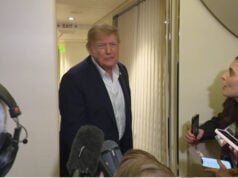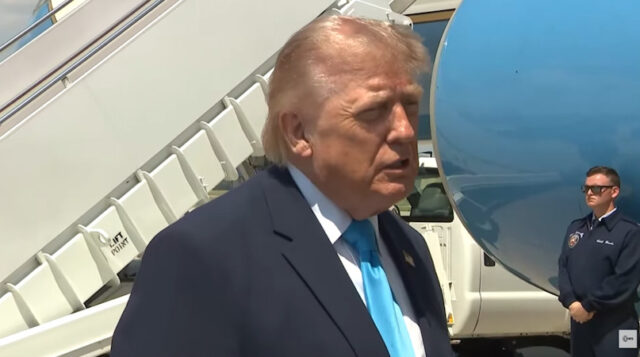
Speaking to a scrum of reporters at Joint Base Andrews after returning from a Coast Guard Academy commencement ceremony, President Donald Trump addressed the sweeping settlement that effectively ends his private $10 billion lawsuit against the Internal Revenue Service (IRS). When pressed on whether the newly established $1.776 billion “Anti-Weaponization Fund” would extend financial payouts to individuals convicted of violent offenses during the January 6, 2021, Capitol attack, the president confirmed their potential eligibility while distancing himself from the exact mechanics of the deal.
“It’ll all be dependent on a committee,” Trump stated to reporters on the tarmac. “I didn’t do this deal. It was told to me yesterday.”
Despite deflecting personal credit for negotiating the parameters, the president aggressively defended the core intent of the massive fiscal pool. Trump emphasized that the primary objective of the $1.8 billion program is “reimbursing people who were horribly treated” by the federal government under the prior administration’s Department of Justice (DOJ). He previously noted the inherent historical irony of his dual position as a private plaintiff and the nation’s chief executive, remarking during an earlier exchange, “It’s interesting because I’m the one that makes a decision, right? It’s awfully strange to make a decision where I’m paying myself.”
The Core Blueprint of the Anti-Weaponization Fund
Administered under the Department of Justice by Acting Attorney General Todd Blanche—who formerly served as Trump’s personal criminal defense attorney—the fund replaces direct cash damages to the Trump family with a massive administrative compensation framework.
Anti-Weaponization Fund Framework
├── Total Treasury Allocation: $1,776,000,000 (Judgment Fund)
├── Administrative Lead: Acting AG Todd Blanche
└── Distribution: 5-Member Commission (Appointed via Majority Vote)
The DOJ’s formal press release states that the fund is designed to “provide a systematic process to hear and redress claims of others who suffered weaponization and lawfare.” While the administration points to the Obama-era Keepseagle v. Vilsack civil rights fund as an administrative precedent, legal experts argue that using the public treasury to compensate individuals convicted of criminal federal offenses is entirely unprecedented in American history.

The Origins: The IRS Return Leaks and the $10 Billion Conflict
The multi-billion-dollar dispute traces back to the unauthorized disclosure of Trump’s confidential tax records by former IRS independent contractor Charles Littlejohn. In 2019 and 2020, Littlejohn systematically extracted and distributed years of tax return data belonging to Trump and other ultra-wealthy Americans to investigative media outlets, including The New York Times and ProPublica.
The leaked documents revealed that Trump paid little to no federal income taxes for several years, relying on massive, complex business loss deductions across the Trump Organization. While Littlejohn was ultimately prosecuted and sentenced to five years in federal prison in January 2024, Trump’s legal team filed a $10 billion lawsuit against the IRS in January, arguing that the tax-collecting agency failed to protect confidential executive data.
+--------------------------------------------------------------------------+
|                     TRUMP IRS PRIVACY LITIGATION TIMELINE                 |
+--------------------------------------------------------------------------+
| [2019-2020] Former contractor Charles Littlejohn leaks tax records.      |
| [Jan 2024]  Littlejohn sentenced to 5 years in federal prison.            |
| [Jan 2026]  Donald Trump, his adult sons, & corporate entities sue IRS.  |
| [May 2026]  Lawsuit dismissed in Florida following $1.8B fund deal.       |
+--------------------------------------------------------------------------+
Shifting Focus: The Secret “Audit Shield” Addendum
While public attention focused on the potential payouts for political allies, tax experts uncovered a quietly published addendum attached to the primary dismissal paperwork on the Department of Justice website. Titled “Permanent Exclusion of Trump Tax Audits,” the document establishes a sweeping, permanent barrier protecting the First Family from federal tax enforcement.
Under the terms of the addendum, the IRS is permanently prohibited from initiating or continuing any civil tax audits, retroactive financial investigations, or criminal tax evasion prosecutions against:
- Donald J. Trump
- Donald Trump Jr. and Eric Trump
- The Trump Organization and its corporate subsidiaries
The permanent exclusion applies retroactively to all historical filing years. Financial analysts note that while the White House emphasizes Trump receives no direct cash payouts from the settlement, erasing the ongoing, high-stakes IRS audits into his corporate tax structures carries an immense financial benefit, potentially shielding the family from hundreds of millions of dollars in back taxes and structural fraud penalties.
Dismantling the Legal Merits and the Expiration Debate
The Justice Department’s decision to settle the case for billions in programmatic funds drew immediate condemnation from congressional watchdogs, who argued that Trump’s private lawsuit was legally deficient and should have been dismissed. Under federal law, claims for unlawful disclosure of tax information are subject to a strict two-year statute of limitations.
Legal filings submitted by congressional opponents showed that Trump was fully aware of the precise nature of the data breach no later than October 2023, during Littlejohn’s formal plea hearings. Consequently, critics asserted that the legal deadline to bring the suit expired in October 2025, making the entire $10 billion claim entirely untimely. Furthermore, the DOJ’s willingness to create a massive settlement fund for Trump’s case directly contradicts its aggressive defense against concurrent class-action lawsuits filed by ordinary citizens whose tax data was also exposed by Littlejohn.
Fierce Political Backlash and Constitutional Roadblocks
The revelation that January 6 defendants and high-profile Trump loyalists could receive taxpayer-funded compensation sparked a furious response from congressional Democrats and government ethics watchdogs.
Representative Jamie Raskin, the ranking Democrat on the House Judiciary Committee, released a sharp condemnation of the arrangement:
“This case is nothing but a racket designed to take $1.7 billion of taxpayer dollars out of the Treasury and pour it into a huge slush fund for Trump at DOJ to hand out to his private militia of insurrectionists, rioters, and white supremacists, including those who brutally beat police officers on January 6, 2021.”
Other lawmakers joined the outcry. Senator Chris Van Hollen publicly lambasted the deal, stating, “While people drown in high prices and inflation, Trump is lining his and his buddies’ pockets. We will fight this.” Representative Pramila Jayapal called the self-dealing “an outrage that American taxpayers are having to pay for,” expressing astonishment at the transparency of the administration’s institutional maneuver.
In response, the House Democratic Litigation Task Force, led by Representative Joe Neguse and represented by counsel Matt Platkin, filed an emergency motion in federal court to block the implementation of the settlement. Platkin summarized the core constitutional argument:
“We have never seen a president sue himself for billions of dollars to compensate himself for harms that he alleges happened to himself in a personal capacity and then go ahead and settle the case for billions of dollars of your money, of taxpayer dollars, without even bothering to justify it to a court.”
Concurrently, independent watchdog groups are opening fresh legal fronts. Donald K. Sherman, president of Citizens for Responsibility and Ethics in Washington (CREW), called the settlement “one of the single most corrupt acts in American history,” accusing the administration of subverting the judicial process to avoid formal legal scrutiny.
A Fractured Judicial Conclusion
The voluntary notice of dismissal was finalized by U.S. District Judge Kathleen Williams in Florida, ending the active court docket just days before a strict deadline requiring both sides to justify why a sitting president could legally sue his own administration.
In her final filing, Judge Williams openly admonished both the Justice Department and the IRS for a profound lack of transparency. She noted that neither agency submitted the formal settlement documents to the court nor provided any structural proof that a valid, non-collusive legal controversy actually existed between the president and his own executive departments.
Sources Used and Links:
- Associated Press (AP): “Justice Department announces nearly $1.8B fund to compensate Trump allies in a deal to drop IRS suit” | Associated Press Politics
- Al Jazeera: “Trump drops IRS lawsuit, sets up $1.7bn US anti-weaponisation fund” | Al Jazeera Economy
- WLRN / NPR News: “President Trump drops lawsuit against IRS” | WLRN National Politics
- InvestmentNews: “Trump drops $10 billion IRS lawsuit as $1.7B settlement fund takes shape” | InvestmentNews Regulation & Compliance
- The Dispatch: “The Founders Never Conceived of a President Like Trump” | The Dispatch Perspectives
- YouTube – MS NOW Channel: “Trump’s IRS suit ends with $1.8B compensation fund – but who is this money going to?” | MS NOW Broadcast Analysis
- YouTube – Veritone Politics: “Jan. 6 defendants could receive money from DOJ’s $1.8B fund, Trump suggests” | Veritone Press Briefing Footage
Disclaimer
Artificial Intelligence Disclosure & Legal Disclaimer
AI Content Policy.
To provide our readers with timely and comprehensive coverage, South Florida Reporter uses artificial intelligence (AI) to assist in producing certain articles and visual content.
Articles: AI may be used to assist in research, structural drafting, or data analysis. All AI-assisted text is reviewed and edited by our team to ensure accuracy and adherence to our editorial standards.
Images: Any imagery generated or significantly altered by AI is clearly marked with a disclaimer or watermark to distinguish it from traditional photography or editorial illustrations.
General Disclaimer
The information contained in South Florida Reporter is for general information purposes only.
South Florida Reporter assumes no responsibility for errors or omissions in the contents of the Service. In no event shall South Florida Reporter be liable for any special, direct, indirect, consequential, or incidental damages or any damages whatsoever, whether in an action of contract, negligence or other tort, arising out of or in connection with the use of the Service or the contents of the Service.
The Company reserves the right to make additions, deletions, or modifications to the contents of the Service at any time without prior notice. The Company does not warrant that the Service is free of viruses or other harmful components.