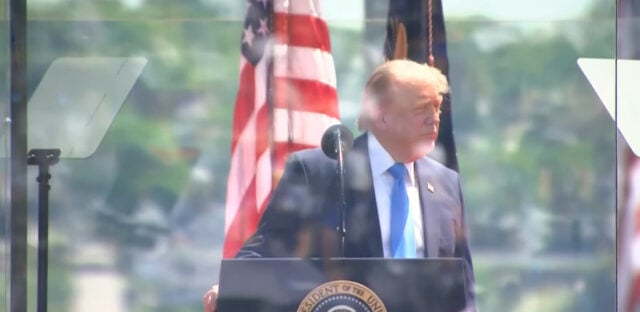
NEW LONDON, Conn. — Under a cloudless sky and amid intense, scorching early-summer heat, President Donald J. Trump took the stage at Cadet Memorial Field on Wednesday to deliver the keynote address at the U.S. Coast Guard Academy’s 145th Commencement Exercises. Speaking before a class of newly commissioned officers who endured a rigorous 200-week training program, the commander in chief delivered a wide-ranging, combative speech that contrasted praise for the cadets’ “unbelievable heroism” with raw political messaging and warnings about an ongoing, weeks-long military conflict overseas.
The address marked a milestone for the administration. Having previously spoken at the New London academy during his first term in May 2017, President Trump became the first president in American history to deliver two keynote commencement addresses at the institution. However, unlike his previous appearance nearly a decade ago, this address took place against the backdrop of an active overseas war, changing the tone from a traditional domestic celebratory send-off to a sobering, real-world charge to wartime military leaders.
A Direct Charge to America’s “First Defenders”
Addressing the sea of white service uniforms on the scorching field, Trump praised the graduating class of 2026 for their unwavering resolve, defining their future roles not merely as maritime law enforcers, but as vital assets in global power projection.

“You’ve all been tested,” Trump told the cadets, referencing the grueling physical and mental demands of their academy journey. “You’ll be tested further, and probably at higher levels as your career goes on.”
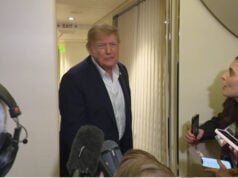
The president called the graduates America’s “first defenders” and “first responders,” emphasizing that the modern Coast Guard operates far beyond the United States’ coastlines. He noted that the branch handles a unique mix of national security, law enforcement, and intelligence tasks that are increasingly vital to defending the American homeland. Prior to boarding Air Force One for the trip to Connecticut, Trump had emphasized this point informally to reporters, noting, “You don’t really realize how important the Coast Guard is until you have a hurricane.” On the field, however, his focus shifted decisively toward geopolitical conflict and hard power.
The Backdrop of War: The Iran Conflict
The core of the address focused heavily on the current war with Iran, which has reached its 12th week. The conflict marks the first time during his tenure that U.S. troops have been actively engaged in a new war of this scale before a service academy address, lending immediate gravity to the proceedings.
Trump framed the ongoing military operations as a testament to American strength, describing the operational theater as “the hottest country anywhere in the world” and presenting the conflict’s status as unambiguous American leverage.
Iran War Status - Week 12
--------------------------------------------------
Current Phase:     Fragile ceasefire / Negotiations
US Stance:         "In no hurry" for a deal
Key Pivot Point:   Deciding between final strikes or a signed document
“The only question is, do we go ahead and finish it up or are they going to be signing a document? Let’s see what happens,” Trump told the crowd.
The statement comes after a week of heightened tensions. Trump had previously threatened to launch renewed, severe military strikes against Iran as regional negotiations appeared to stall and a fragile ceasefire teetered on the edge of collapse. However, on Monday, the president publicly extended a window of diplomacy, stating he would grant Tehran a few more days due to “serious negotiations” occurring behind closed doors.
Before flying to Connecticut, Trump clarified his strategic patience to reporters, explaining that he felt “in no hurry” to hastily sign an agreement to end the war, explicitly citing domestic political considerations and the upcoming November midterm elections as factors in his deliberate approach.
Shifting From Military Praise to Political Broadsides
While graduation addresses by a commander in chief at the nation’s military service academies are traditionally nonpartisan, unifying events, President Trump used the platform to pivot into sharp political territory, championing his administration’s accomplishments while criticizing his political predecessors.
Declaring that “America is back,” Trump described the current state of the nation as an era of profound national resurgence, characterized by restored strength, elevated morale, and renewed economic confidence. He sharply criticized previous leadership eras, asserting that the United States had long been “run by foolish politicians” who compromised American interests on the global stage.
The president used the platform to reaffirm his core populist policies, specifically praising his administration’s aggressive use of trade tariffs and strict border enforcement mechanisms. He made it clear that his foreign and economic policy rejected traditional diplomatic apologies in favor of unapologetic strength.
“Under this administration, we don’t apologize for American power or wealth. What we do really is we want to maximize it. We take advantage of it. We unleash it, and we wield it to pursue our country’s glorious destiny and our beautiful American Dream.”
Heat Waves and Historical Records
The ceremony itself proved to be an exercise in endurance for the cadets, faculty, and families gathered at Cadet Memorial Field. A severe heat wave blanketed New London, forcing attendees to endure soaring temperatures with virtually no shade available on the open field. The extreme weather required medical intervention on-site, with at least one individual passing out from the heat, and prompted organizers to scramble to assist elderly relatives and visitors seeking relief.
Despite the punishing weather, the atmosphere remained highly charged. Trump lightered the mood momentarily by celebrating his unique historical footprint at the academy. Reflecting on his 2017 address, he joked about returning again in the future to ensure his record remained completely secure.
“We’re going to have to try it maybe a third time, too, to keep that record intact,” Trump joked, drawing applause from the audience.
The graduation at New London marks the beginning of the annual rotation of executive branch addresses at the nation’s premier military institutions. Following Trump’s address to the Coast Guard, Vice President JD Vance is scheduled to travel to Colorado Springs on May 28 to deliver the commencement address to the graduating class at the U.S. Air Force Academy.
As the ceremony concluded and the class of 2026 tossed their covers into the air, the reality of their immediate assignments loomed large. For these new ensigns, the celebration is brief; they enter a global maritime environment where the lines between homeland defense and active international conflict have rarely been more blurred.
Sources Used and Links:
- The Associated Press (AP News): Trump tells Coast Guard graduates they will ‘be tested’ in their military careers
- KSAT 12 News: Trump tells Coast Guard graduates they will ‘be tested’ in their military careers
- FOX 61 Connecticut: President Trump speaks at Coast Guard Academy
- U.S. Coast Guard Academy / Joint Press Release: President Donald J. Trump will deliver keynote address at Coast Guard Academy Commencement
- WTIC / NewsWest 9: President Trump to deliver keynote address at Coast Guard Academy in Connecticut
Disclaimer
Artificial Intelligence Disclosure & Legal Disclaimer
AI Content Policy.
To provide our readers with timely and comprehensive coverage, South Florida Reporter uses artificial intelligence (AI) to assist in producing certain articles and visual content.
Articles: AI may be used to assist in research, structural drafting, or data analysis. All AI-assisted text is reviewed and edited by our team to ensure accuracy and adherence to our editorial standards.
Images: Any imagery generated or significantly altered by AI is clearly marked with a disclaimer or watermark to distinguish it from traditional photography or editorial illustrations.
General Disclaimer
The information contained in South Florida Reporter is for general information purposes only.
South Florida Reporter assumes no responsibility for errors or omissions in the contents of the Service. In no event shall South Florida Reporter be liable for any special, direct, indirect, consequential, or incidental damages or any damages whatsoever, whether in an action of contract, negligence or other tort, arising out of or in connection with the use of the Service or the contents of the Service.
The Company reserves the right to make additions, deletions, or modifications to the contents of the Service at any time without prior notice. The Company does not warrant that the Service is free of viruses or other harmful components.