by Sarah Elizabeth Hogenboom-Jones
WASHINGTON, D.C. — Ten percent of Americans report using installment plans frequently when making purchases online, and another 17% use them occasionally. A total of 51% have used installment plans for online purchases, while 48% say they never have.
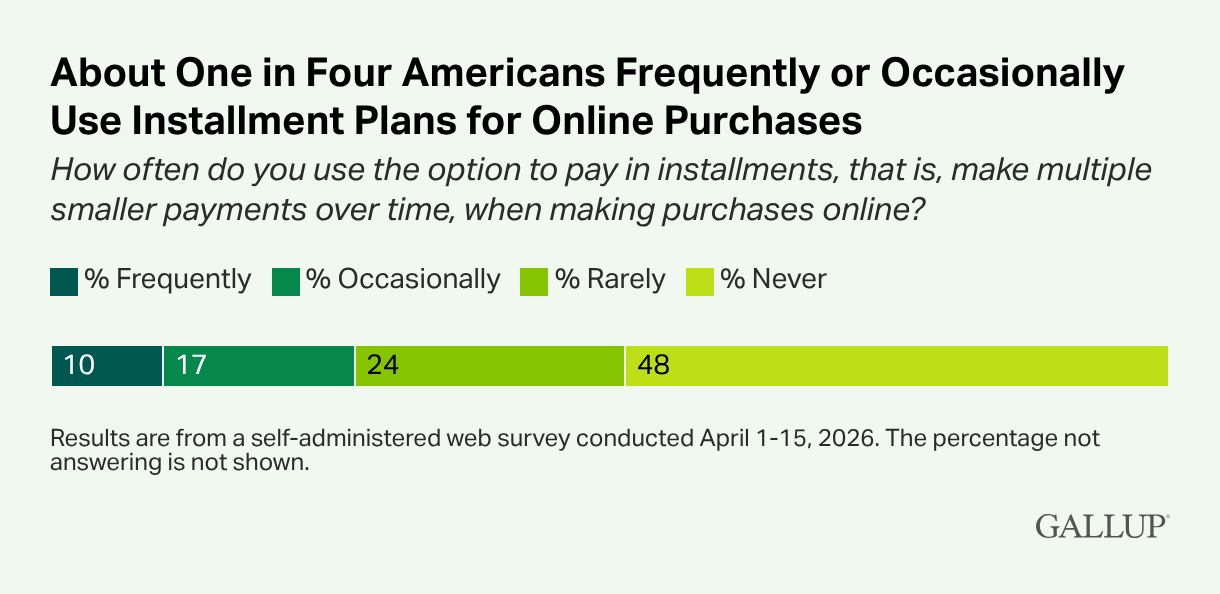
Lower-income Americans (those with annual household incomes under $48,000) are more likely to frequently or occasionally use installment payments (37%) than middle-income (between $48,000 and $89,999) and higher-income (at least $90,000) Americans are (29% and 21%, respectively). There are no statistically meaningful differences in installment-plan use by age, education or gender.
The results are based on an April 1-15 survey of 1,024 U.S. adults who are members of the Gallup Panel. Gallup did not ask respondents which types of purchases they use these installments for or how much they spend on purchases with these plans.

Installment-Plan Use Associated With Not Having Enough Money to Live Comfortably
Americans’ perceptions of whether they have enough money to live comfortably are related to their use of installment plans. Those who report that yes, they do have enough money to live comfortably are less likely to use installment plans frequently or occasionally, compared with those who say they do not have enough money to live comfortably.
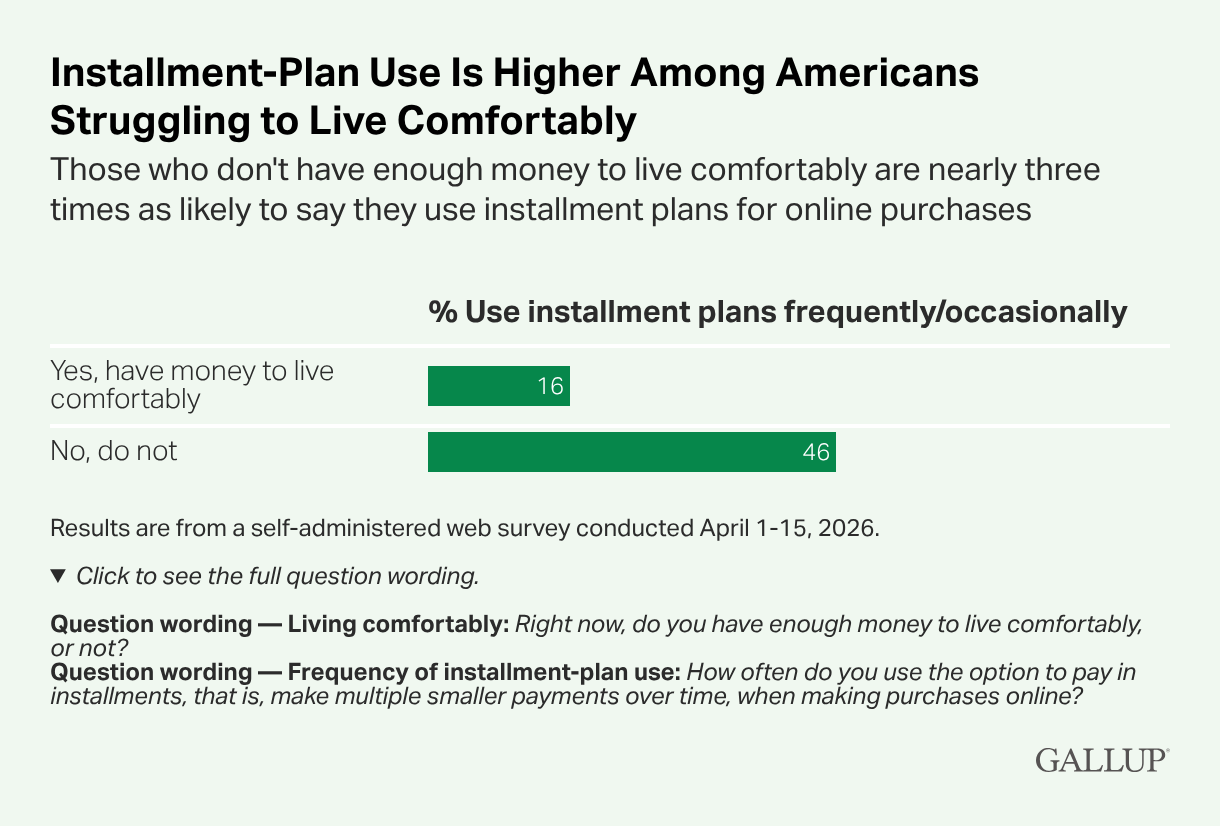
Additional analysis shows that, compared with others in the same income band, those who report that they do not have enough money to live comfortably are more likely to use installment plans frequently or occasionally.
Installment-Plan Use Higher Among Those Worried About Credit Card Payments
The survey also asked Americans how much they worry about each of nine different financial matters, as this phone survey did. Among the nine, worry about making minimum credit card payments is comparatively low, but those who do worry about this are much more likely to use installment plans when making online purchases. Installment-plan usage is highest among those who are very (57%) or moderately (52%) worried about making minimum monthly payments on their credit cards, and decreases among those who are less worried.
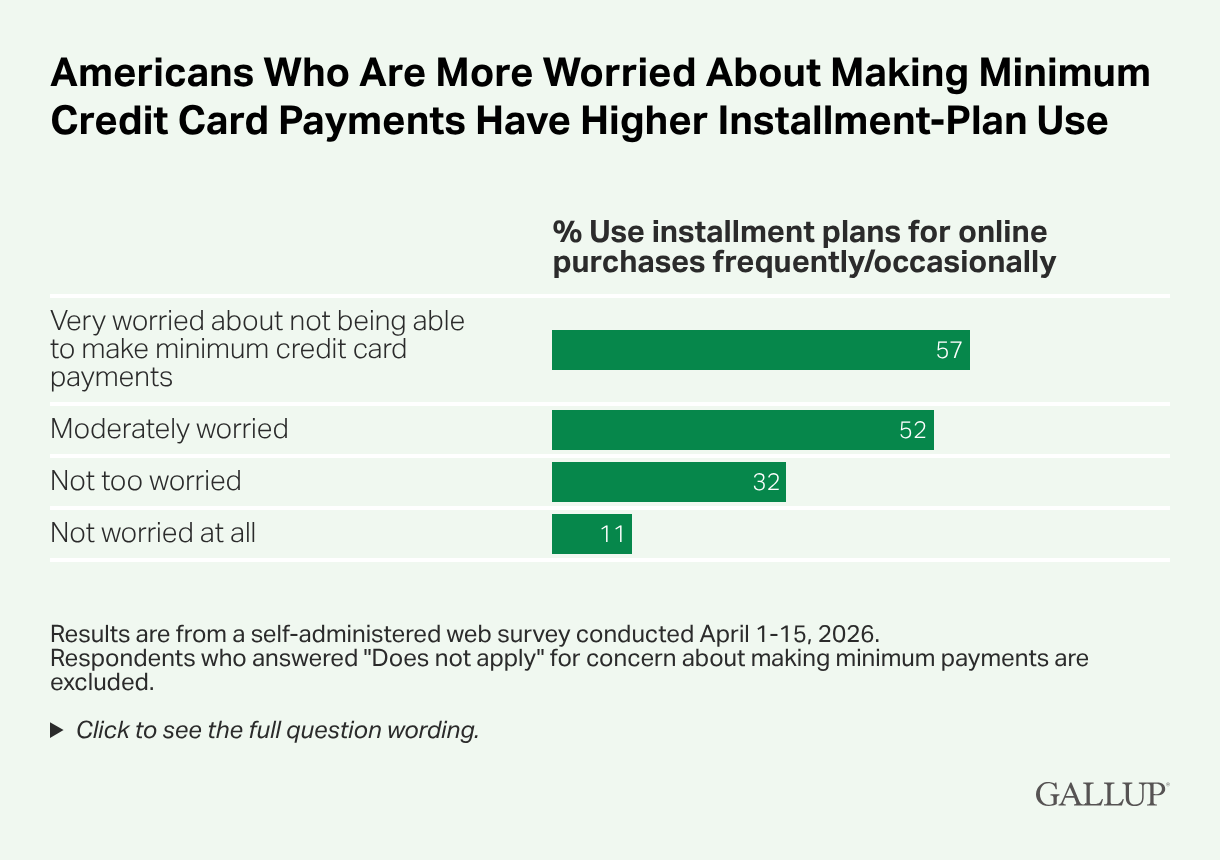
While more lower- than middle- and upper-income Americans worry about making minimum credit card payments, the data indicate that even middle- and upper-income Americans worried about this are more likely to use installment plans.
Implications
About half of Americans have used an installment plan for an online purchase, but a smaller 27% make frequent or occasional use of these plans. Usage is more common among lower-income Americans and those who say they don’t have enough money to live comfortably.
A 1941 Gallup poll found that about 70% of Americans, in the era before credit cards, had used installment plans at some point. Thirty-six percent were paying for something on installment at that time, indicating that widespread use of installment plans is not new to American consumers. Upper-income people were less likely than lower-income Americans to use installment plans, according to the poll.
Today, in addition to income differences, Americans who express worry about making their minimum credit card payments are more likely to use installment plans. Their use of these plans may help them avoid increasing their credit card balance or be a way to buy needed or wanted items or services when income is tight or credit cards are maxed out. For others, paying in installments may be a budgeting tool or a matter of convenience.
Stay up to date with the latest insights by following @Gallup on X and on Instagram.
Disclaimer
Artificial Intelligence Disclosure & Legal Disclaimer
AI Content Policy.
To provide our readers with timely and comprehensive coverage, South Florida Reporter uses artificial intelligence (AI) to assist in producing certain articles and visual content.
Articles: AI may be used to assist in research, structural drafting, or data analysis. All AI-assisted text is reviewed and edited by our team to ensure accuracy and adherence to our editorial standards.
Images: Any imagery generated or significantly altered by AI is clearly marked with a disclaimer or watermark to distinguish it from traditional photography or editorial illustrations.
General Disclaimer
The information contained in South Florida Reporter is for general information purposes only.
South Florida Reporter assumes no responsibility for errors or omissions in the contents of the Service. In no event shall South Florida Reporter be liable for any special, direct, indirect, consequential, or incidental damages or any damages whatsoever, whether in an action of contract, negligence or other tort, arising out of or in connection with the use of the Service or the contents of the Service.
The Company reserves the right to make additions, deletions, or modifications to the contents of the Service at any time without prior notice. The Company does not warrant that the Service is free of viruses or other harmful components.