The Simulation of War in the Heart of Democracy
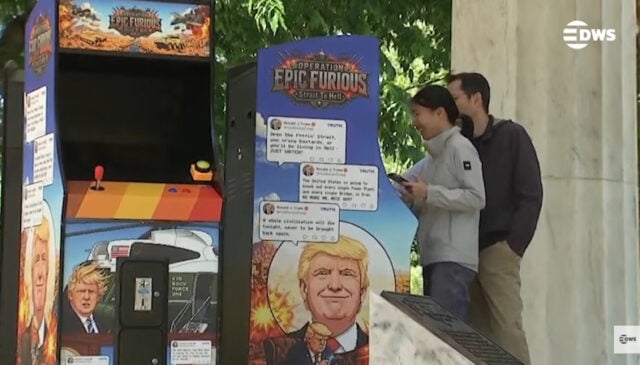
As the sun rose over the Potomac on May 14, 2026, the familiar silhouette of the Washington Monument was framed not by the usual throng of school groups, but by a sprawling, high-tech encampment known as the “Epic Furious” setup. Hundreds of monitors, high-fidelity VR rigs, and military-grade server stacks hummed in a coordinated symphony of digital dissent. This is not a promotional event for a new blockbuster game; it is a massive, multi-day protest against Operation Epic Fury, the United States’ escalating military campaign in the Middle East.
The “Epic Furious” installation—a derisive play on the official operation’s name—represents a radical evolution in social resistance. Organized by a coalition of veterans, tech-activists, and digital artists, the setup allows the public to “play” through the strategic simulations currently being utilized by the Department of War (formerly the Department of Defense). The goal: to expose the “gamification” of modern warfare and the human cost of what the administration calls a doctrine of “maximum lethality”.
Operation Epic Fury: The Context of the Conflict
To understand the protest, one must understand the conflict it mirrors. Operation Epic Fury was launched in early 2026 following a series of maritime escalations in the Persian Gulf (Admiral, 2026). Unlike previous “limited” engagements, the current administration has framed this as a “swift, crisp operation” intended to prevent global energy disruption, while internal critics suggest the goal is a total regime change (Nazir, 2026).

The conflict has been characterized by its reliance on hybrid warfare and the erosion of traditional legal boundaries. As military planners stress-test operational options under realistic constraints—including contested command and control and sustainment under fire—the Department of War has leaned heavily into war gaming to drive its decision-making (Admiral, 2026). Protesters at the National Mall argue that these “games” have become too detached from reality, reducing civilian casualties to mere data points on a digital leaderboard.
The Anatomy of the “Epic Furious” Setup
The protest installation is divided into several “zones” that mimic the structure of a modern military command center.
The “Red Zone” Simulation
At the center of the Mall, a bank of 50 VR stations provides a 1:1 simulation of the tactical environments in Tehran and the Strait of Hormuz. Users are invited to put on headsets and experience “missions” titled Lethality Over Legality, a direct nod to the administration’s stated preference for raw power over procedural caution (Kon-yu, 2026).
In these simulations, the “players” face the same split-second decisions as drone operators and ground troops. However, unlike traditional military shooters—which often rely on stereotypical “terrorist” archetypes and generic Islamic locales (Höglund, 2026)—the Epic Furious simulation uses real-time satellite data and civilian testimonials to populate the game world. When a “player” strikes a target, the screen doesn’t show a score; it displays the name, age, and family history of the person caught in the blast radius.
The “War Room” Server Stack
Behind the VR rigs sits a massive, transparent server room. This area, dubbed the “War Room,” live-streams data from the actual Operation Epic Fury theater. Protesters use open-source intelligence (OSINT) to track troop movements and strike locations, then display them on a giant LED wall overlooking the Lincoln Memorial.
By mirroring the official war games used by the U.S. Naval War College to “stress test” operational options, the protesters are effectively performing a public audit of the war (Admiral, 2026). “They call it a war game,” says one activist, a former logistics officer. “We’re just showing them what happens when you actually play it.”
A New Era of Social Resistance
The Epic Furious setup is the latest example of what researchers call “socio-discursive strategies” in the defense of democracy (Lindén, 2026). In an era where traditional picketing often falls on deaf ears, activists are turning to creative, high-tech methods to capture public attention. This follows a trend of “creative resistance” that includes everything from anonymous satirical sculptures to massive legal mobilizations against corporate and government overreach (Lindén, 2026; Fjellborg, 2026).
The Intersection of Labor and Peace
Interestingly, the protest has found an unlikely ally in the labor movement. Representatives from several major unions, currently embroiled in their own battles against corporations using bankruptcy to undermine collective power, have joined the encampment (Velazquez, 2026). Their presence highlights a growing sentiment that the resources being funneled into Operation Epic Fury are being diverted from domestic infrastructure and labor protections.
“Labor power and the anti-war movement are two sides of the same coin,” says Alvin Velazquez, a labor advocate visiting the site. “When corporations and governments prioritize ‘lethality’ abroad, they inevitably bring that same disregard for human rights back to the factory floor” (Velazquez, 2026).
The Psychological Toll: “Macho Sensitivity” and War
One of the most discussed aspects of the Epic Furious protest is its critique of the emotional rhetoric surrounding the current administration. Critics have noted that the naming of “Operation Epic Fury” itself is a departure from the more “tepid” language of the past, such as “Operation Enduring Freedom” (Kon-yu, 2026).
The protest highlights what some psychologists call “macho sensitivity”—a style of leadership where power is expressed through volatile, emotional outbursts rather than reasoned policy (Kon-yu, 2026). By turning this “fury” into a literal game, the protesters aim to show the absurdity of a foreign policy driven by “big feelings” and irrational fears of the “other” (Kon-yu, 2026).
Public and Legal Response
The National Park Service (NPS) has allowed the installation to remain for the time being, though tensions are high. The Department of War has issued a statement condemning the protest as a “distraction to national security,” while legal experts are debating whether the use of real-time military data in a public simulation constitutes a breach of classified protocols.
However, the protesters remain defiant. They argue that as long as the government treats warfare as a series of “decision games” to be won, they will continue to provide a “real-world” assessment of the score (Admiral, 2026).
The Future of the Mall: From Monuments to Mainboards
As the protest enters its second week, the National Mall has been transformed. It is no longer just a place of static history; it has become a living, breathing laboratory for the future of political engagement. The Epic Furious setup proves that in 2026, the most effective way to challenge a narrative of “maximum lethality” is to provide a simulation of maximum reality.
Whether the installation leads to a shift in policy remains to be seen. But for the thousands of people who have walked through the “Red Zone” and seen the human faces behind the digital targets, the game of war will never look the same again.
References and Links:
Admiral, W. R. (2026). President’s Forum. U.S. Naval War College Review, 8506. https://digital-commons.usnwc.edu/cgi/viewcontent.cgi?article=8506&context=nwc-review
Fjellborg, D. (2026). Division of labour in social movements: the interplay between legal mobilization and public protest in Swedish mining resistance. Journal of Law and Society. https://www.diva-portal.org/smash/get/diva2:2016294/FULLTEXT02.pdf
Höglund, J. (2026). Electronic Empire: Orientalism Revisited in the Military Shooter. Game Studies, 8(1). https://gamestudies.org/0801/articles/hoeglund
Kon-yu, N. (2026). Friday essay: ‘epic fury’ – the men of MAGA might be the most emotional US leaders ever. The Conversation. https://search.informit.org/doi/10.3316/informit.T2026031300002000260954231
Lindén, M. (2026). Safeguarding American democracy: resisting electoral manipulation after the attack on the Capitol. Democratization. https://doi.org/10.1080/13510347.2026.2643873
Nazir, A. (2026). Operation Epic Fury: Hybrid Warfare and Legal Erosion in the 2026 US-Israel. Research Consortium Archive. https://www.rcresearcharchive.com/index.php/Journal/article/view/730/717
Velazquez, A. (2026). Bankrupting Labor Power. Stanford Law Review, 78. https://review.law.stanford.edu/wp-content/uploads/sites/3/2026/05/Velazquez-78-Stan.-L.-Rev.-1023-1.pdf
Disclaimer
Artificial Intelligence Disclosure & Legal Disclaimer
AI Content Policy.
To provide our readers with timely and comprehensive coverage, South Florida Reporter uses artificial intelligence (AI) to assist in producing certain articles and visual content.
Articles: AI may be used to assist in research, structural drafting, or data analysis. All AI-assisted text is reviewed and edited by our team to ensure accuracy and adherence to our editorial standards.
Images: Any imagery generated or significantly altered by AI is clearly marked with a disclaimer or watermark to distinguish it from traditional photography or editorial illustrations.
General Disclaimer
The information contained in South Florida Reporter is for general information purposes only.
South Florida Reporter assumes no responsibility for errors or omissions in the contents of the Service. In no event shall South Florida Reporter be liable for any special, direct, indirect, consequential, or incidental damages or any damages whatsoever, whether in an action of contract, negligence or other tort, arising out of or in connection with the use of the Service or the contents of the Service.
The Company reserves the right to make additions, deletions, or modifications to the contents of the Service at any time without prior notice. The Company does not warrant that the Service is free of viruses or other harmful components.